By the late 19th century, Germany had become an integral part of the global economy: a leading industrial nation importing raw goods and expertise from around the world, while exporting chemicals, advanced engineering, and pharmaceutical goods in return. Yet Germany has also been central to the dark side of globalisation as a hub for illicit narcotics, as a destination for trafficked sex workers, and as a source of illegal arms exports. This project will rethink Germany's place in the world by examining the history of its "deviant globalisation," and how its role in global networks of illicit obscenity, financial fraud, and traffic in humans, arms, and narcotics has evolved over the long 20th century. Beginning in 1904 when Imperial Germany signed its first international convention against traffic in "white slavery," the project will extend into the early 2000s as a re-united Germany, established as a global economic leader, became firmly embedded in international prohibition systems and transnational criminal networks. This research provides a view into how we understand modern German history in a global context, but also into how globalisation - as it has waxed and waned over the 20th century - has served as a catalyst for international networks of criminality and illicit trade in the centre of Europe.
Funding: Volkswagen Foundation
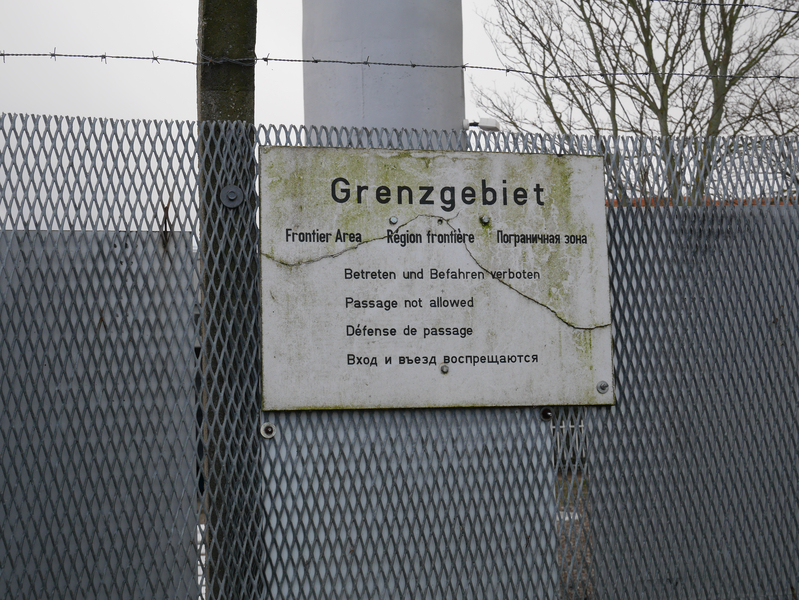
Image: "Border area" sign on the Kühlungsborn lake border observation tower © Wikimedia Commons.



Territoriality, materiality and practices as interfaces of border research (June 17, 2022)
Verboten, Verrucht, Verpönt: Deviance, Crime and the Illicit in Global German History (July 7-8, 2022) Programme Workshop
Africa and the Global Cold War III (September 24-26, 2022)
Between Deviance and Marginalisation. Gendered Perspectives on Transnational Crime (October 26-28, 2022)
New Transnational and Global Approaches to the GDR Border (July 10-11, 2019)
Entangling Histories of International Trafficking (June 25, July 2,7, 2021)
Leipzig-Erfurt Workshop on Spatial History and Spatial Visualisation (16 September 2021)
Territoriality, materiality and practices as interfaces of border research(June 17, 2022)
Verboten, Verrucht, Verpönt: Deviance, Crime and the Illicit in Global German History (July 7-8, 2022)
Africa and the Global Cold War III (September 24-26, 2022)
Between Deviance and Marginalisation. Gendered Perspectives on Transnational Crime (October 26-28, 2022)
Programme
Sarah Frenking, Incidents in the Reichsland: Crossing, Policing, Nationalising the German-French Border (1887-1914) (Campus, 2021).
Sarah Frenking, with Sarah Ehlers, Sarah Kleinmann, Nina Régis, Verena Triesethau (eds.): Begrenzungen, Überschreitungen - Limiter, franchir. Interdisziplinäre Perspektiven auf Grenzen und Körper - Approches interdisciplinaires sur les frontières et les corps. Göttingen: Vandenhoeck&Ruprecht 2021.
Sarah Frenking: Le spectacle de la ligne de frontière. Police, médias et franchissements militaires de la frontière franco-allemande vers 1900, in: Francia. Forschungen zur Westeuropäischen Geschichte, (2022), forthcoming (also: Prix "Traduire et diffuser" of the DHI Paris).
Sarah Frenking: Making the French-German Border. Practices, Conceptions and Perceptions of Spatial Policing 1887-1914, in: Levke Harders, Falko Schnicke (eds.): Belonging across Borders. Studies of the German Historical Institute London, Oxford University Press, Oxford 2022, pp. 137-165.
Ned Richardson-Little, "Arms Intervention: Weimar Germany, Imperial Influence and Weapons Trafficking in Warlord China," Journal of Modern European History (19:4, 2021, 510-528).
Ned Richardson-Little "Transnational Drug Trafficking and the German Embrace of International Narcotics Law from the Kaiserreich to the Nazis" in Dietmar Müller and Katja Naumann (eds.) Transregional Connections in the History of East Central Europe (De Gruyter, 2021).
Ned Richardson-Little "'Hashers Don't Read Das Kapital': East Germany, Socialist Prohibition, and Global Cannabis," in James Mills and Lucas Richert (eds.) Cannabis: Global Histories (MIT Press, 2021).
Ned Richardson-Little, The Drug War in a Land Without Drugs: East Germany and the Socialist Embrace of International Narcotics Law in Journal of the History of International Law. (21: 2, 2019, 270-298).

![[Translate to English:] facebook icon](/fileadmin/SocialMediaIcons/iconfinder_06-facebook_white.svg)

![[Translate to English:] instagram icon](/fileadmin/SocialMediaIcons/iconfinder_38-instagram_white.svg)
![[Translate to English:] YouTube icon](/fileadmin/SocialMediaIcons/iconfinder_18-youtube_white.svg)
![[Translate to English:] xing icon](/fileadmin/SocialMediaIcons/iconfinder_xing_white.svg)

University of Erfurt (Campus)
Nordhäuser Str. 63
99089 Erfurt