
Peace Missions and Informal Power Networks
Project Description
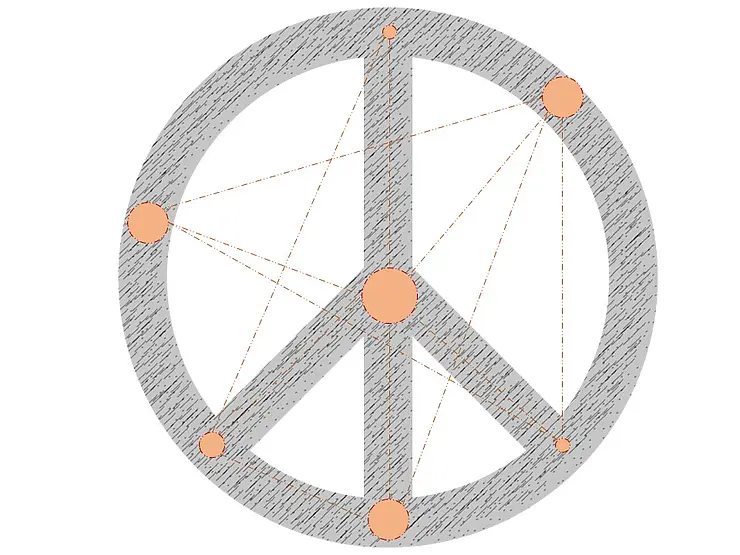
The project, titled “Building a Legitimate Post-Conflict State? An Empirical Analysis of External Peace Missions and Informal Power Networks”, is funded by the Gerda Henkel Stiftung from 2018-2020. It studies the interaction of international peacebuilding actors with informal power networks in post-conflict nations and analyses how these interactions affect the legitimacy of state-institutions.
The main aim of the research is to explore the possibilities and barriers in the interaction between informal power networks, state institutions and formal external peace missions in the cases of EU missions in Kosovo and Mali, by better understanding the network structure of state capture in such contexts. Specifically, it identifies the contours of change within the state and examine the political character of state formation and its impacts on legitimacy in the eyes of different population groups. This interface and interaction of the external, as well as internal conceptions of legitimacy, will improve chances of successful conflict transformation and peacebuilding.
The study employs three complementary methodologies to acquire original empirical data. At the first level, anonymous key semi-structured informant interviews will provide essential information to trace the strategy of external peace missions and the legitimacy claims of the primary stakeholders at the national level. They will also facilitate identification of the informal power networks. The information obtained from the interviews above will be complemented by a qualitative social network analysis and survey-techniques to acquire data for the variables ‘interaction patterns’ and ‘empirical legitimacy’.
Output
Publications
Solveig Richter 2017: „Der Wolf im Schafspelz: Illegitime Herrschaft durch ‚State Capture‘ in Nachkriegs- und Transitionsgesellschaften“, in: Zeitschrift für Friedens- und Konfliktforschung, 6: 2, S. 174-206. (“Wolf in Sheep's Clothing - Illegitimate rule through State Capture in post-war and transitional societies“)
Siddharth Tripathi 2019: Decentering Peace Studies: Conceptualisations of Peace in India, with Kristina Roepstorff, in Zeitschrift für Friedens- und Konfliktforschung, 9. S. 79-99.
Siddharth Tripathi (ed.) 2018: International Relations: Theories and Approaches, Worldview Publishers: New Delhi, ISBN: 978-93822-67-324.
Conferences and Conference Papers
Solveig Richter and Siddharth Tripathi: „Blended Legitimacy in the Dynamics of State Formation in the Global South: External Missions and Informal Power Networks”.
Solveig Richter and Siddharth Tripathi: „Beyond “The West versus the Rest” Divide: Exploring Synergies between the Global North and the Global South in the Study of Violent Conflicts”.
Siddharth Tripathi and Solveig Richter: ”(Re) Building Post-Conflict States: Legitimacy of International Intervention in Kosovo”.
Siddharth Tripathi and Solveig Richter: State Capture in South-Eastern Europe: External Peace Missions and Informal Power Networks in Kosovo.
Siddharth Tripathi: ‘The South Turn in International Relations and the Problem of Agency’.
Siddharth Tripathi: Breaking the Glass Ceiling of Injustice: Meira Paibis and Naga Mothers as Agents of Peace in India.
Project results were presented at the following conferences:
Sustainable Peacebuilding Conference, Kroc Institute for International Peace, South Bend, US, 2019.
EISA (European International Studies Association) Annual Conference, Sofia, Bulgaria, 2019.
ISA (International Studies Association) Accra, Ghana, 2019.
BISA (British International Studies Association) London, UK, 2019.
CEEISA (Central European International Studies Association) Belgrade, Serbia, 2019.
EISA (European International Studies Association), 12th Pan-European Conference on International Relation, Prague, Czech Republic, 2018.
Field Research by Dr. Siddharth Tripathi
Kosovo: April- June 2019
Brussels: March 2019
Kosovo: August 2018