
Mekelle–Erfurt Research Cooperation Initiative Kick-Off Week
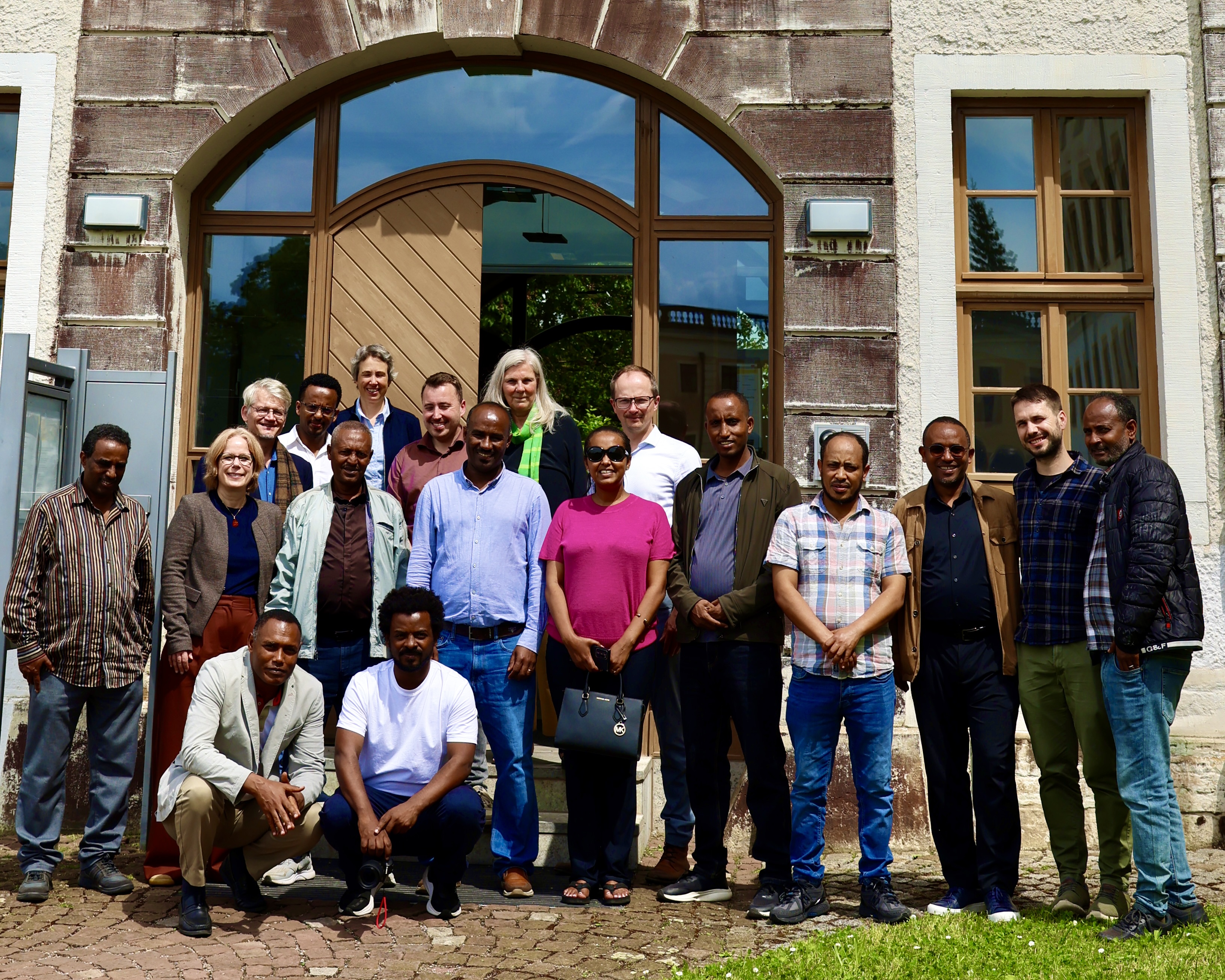
From June 1 to 4 2026, the kick-off workshop for the Mekelle–Erfurt Research Cooperation Initiative took place at the Centre for Transcultural Studies in Gotha. The two-year MERCI project (Mekelle–Erfurt Research Cooperation Initiative) aims to resume and expand academic cooperation between the University of Erfurt and Mekelle University – in particular the Department of History and Cultural Studies – following the war in Tigray (Ethiopia). The new Ethiopian fellows, Alemu Mengesha, Kiros Gebreyohannes, Dr Mulubrhan Adane and Shewit Abraham, were welcomed. In addition to lectures and discussion sessions, the four-day workshop also included a visit to the Gotha Perthes Collection at the Gotha Research Library.
The workshop was funded by the Gerda Henkel Stiftung.
Workshop: ‘Transcultural Personal Testimonies’
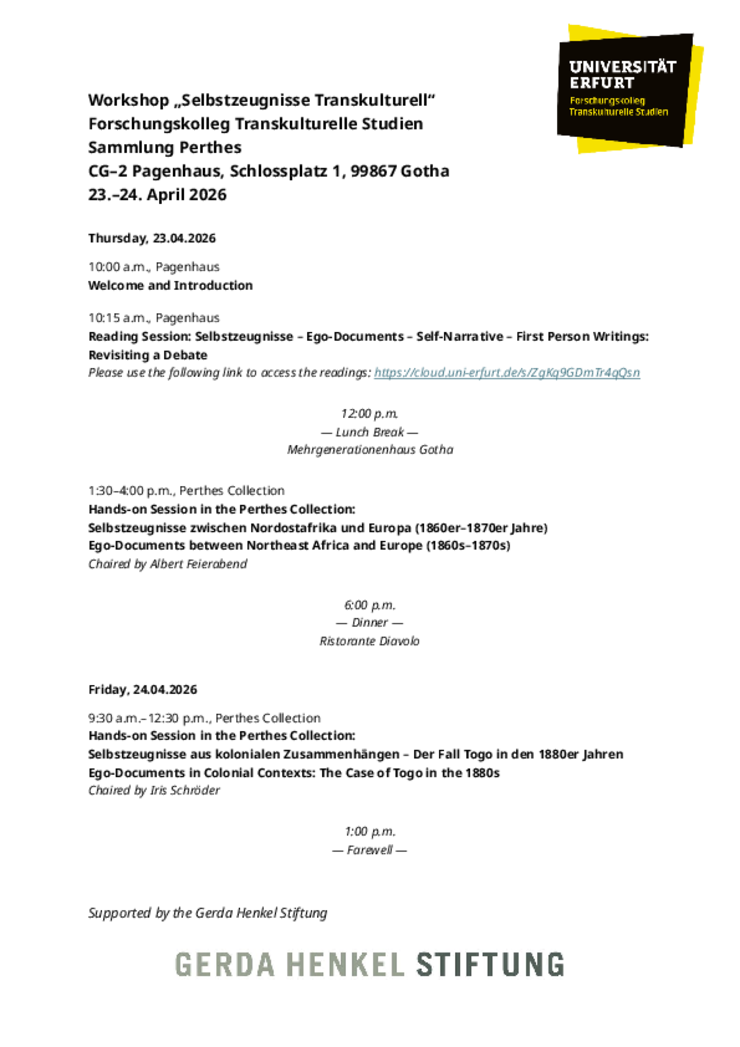
On April 23 and 24 2026, the workshop “Selbstzeugnisse Transkulturell” took place at the Centre for Transcultural Studies in Gotha. Following the welcome and a reading session, Albert Feierabend gave his lecture “Ego-Documents between Northeast Africa and Europe (1860s–1870s)”. On the second day, the workshop continued with a hands-on session at the Gotha Perthes Collection on the topic “Ego-Documents in Colonial Contexts: The Case of Togo in the 1880s”.
The workshop was funded by the Gerda Henkel Foundation.
Workshop & lecture: Takele Merid Afessa (Addis Ababa University), 24.06.2025
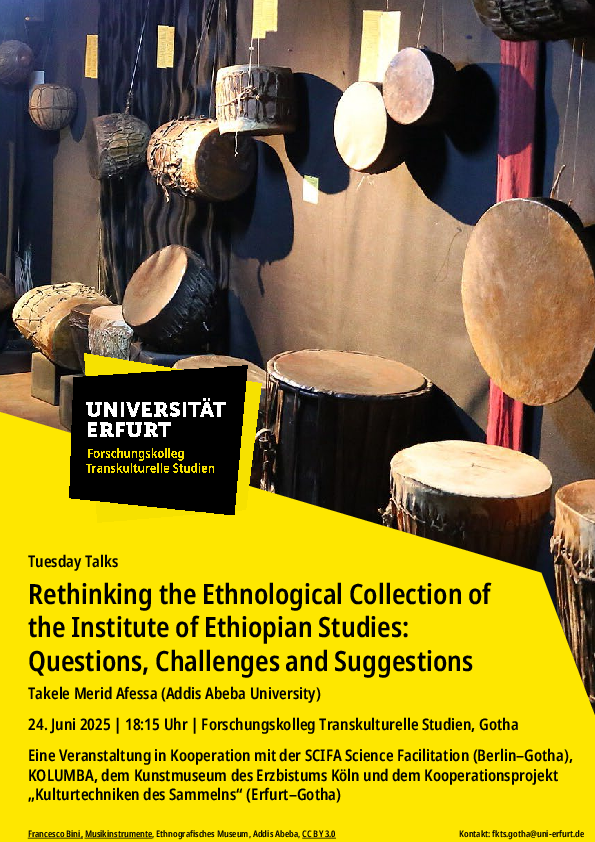
On June 24 2025, a workshop and an evening lecture with Takele Merid Afessa, director of the Institute of Ethiopian Studies from Addis Ababa University took place at the Centre for Transcultural Studies.
The workshop, which took place in cooperation with SCIFA Science Facilitation and the collaborative project "Kulturtechniken des Sammelns", was dedicated to the topic "The Ethiopian Pillow: Towards a New Cultural Mapping of Headrests - An Interventionist Approach".
In his lecture "Rethinking the Ethnological Collection of the Institute of Ethiopian Studies: Questions, Challenges and Suggestions", Takele Merid Afessa addressed the ethnographic collections of the Institute of Ethiopian Studies in Addis Ababa. He discussed not only the historical and cultural dimensions of these collections, but also the challenges associated with their preservation and presentation. In this context, he also raised the question of possible approaches and new ways of dealing with the collections.
The event was organised in cooperation with SCIFA Science Facilitation (Berlin-Gotha), KOLUMBA, the Art Museum of the Archdiocese of Cologne and the cooperation project "Kulturtechniken des Sammelns" (Erfurt-Gotha).

13th Map History Colloquium
The 13th Colloquium on the History of Cartography took place on May 9 and 10 2025 at the Centre for Transcultural Studies in Gotha. The regularly held event offers academics, especially those in the qualification phase, a forum to present projects on cultural-historical cartography from the Middle Ages to contemporary history and to discuss methodological concepts of ongoing work. The two-day, interdisciplinary and transepochal colloquium included discussions and a visit to the Gotha Perthes Collection (Gotha Research Library). The event was organised by Ingrid Baumgärtner (Kassel), Christoph Mauntel (Osnabrück), Ute Schneider (Essen), Martina Stercken (Zurich) and Iris Schröder (Erfurt).
The event was sponsored by the Freundeskreis der Forschungsbibliothek Gotha e.V. and the Research and Graduate Services Department of the University of Erfurt.
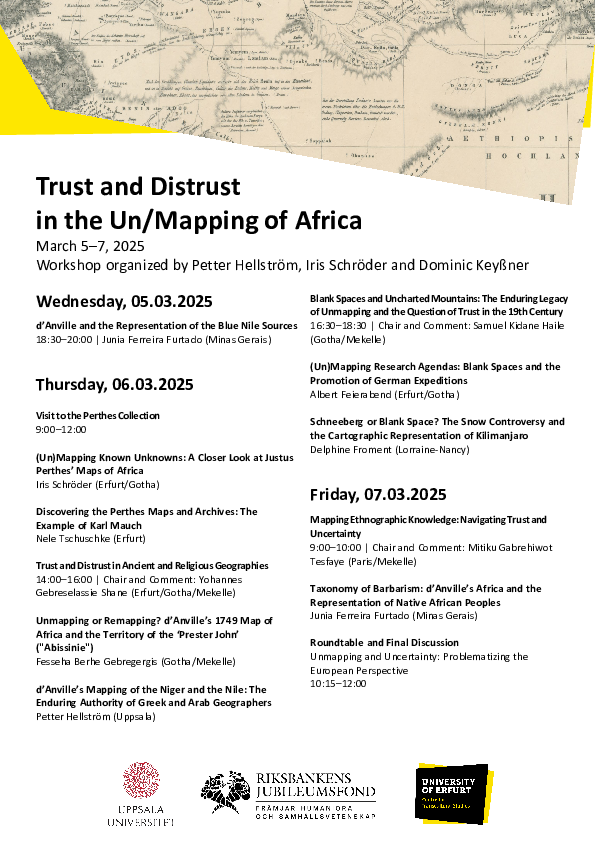
Workshop "Trust and Distrust in the Un/Mapping of Africa"
From March 5 to 7 2025, a workshop on "Trust and Distrust in the Un/Mapping of Africa" took place at the Centre for Transcultural Studies. The workshop brought together international scholars to critically scrutinise and reassess the European practice of "unmapping" the African continent. A visit to the Gotha Perthes Collection was also planned, whose valuable holdings of letters, sketches and hand-drawn maps were to be integrated into the discussion. These materials were meant to help to better define historical mapping practices and their connection to "unmapping". Scholars from various disciplines and institutions discussed the role of authentication and credibility practices in the context of the "unmapping" of Africa. The aim of the workshop was to initiate a dialogue between European and African researchers.
The workshop was organised by Iris Schröder (University of Erfurt), Dominic Keyßner (University of Erfurt) and Petter Hellström (University of Uppsala). It was supported by the Riksbankens Jubileumsfond for the promotion of the humanities and social sciences and by Professor Michael Wildt, who promotes academic exchange between African and European researchers, in particular between the University of Erfurt and the University of Mekelle.
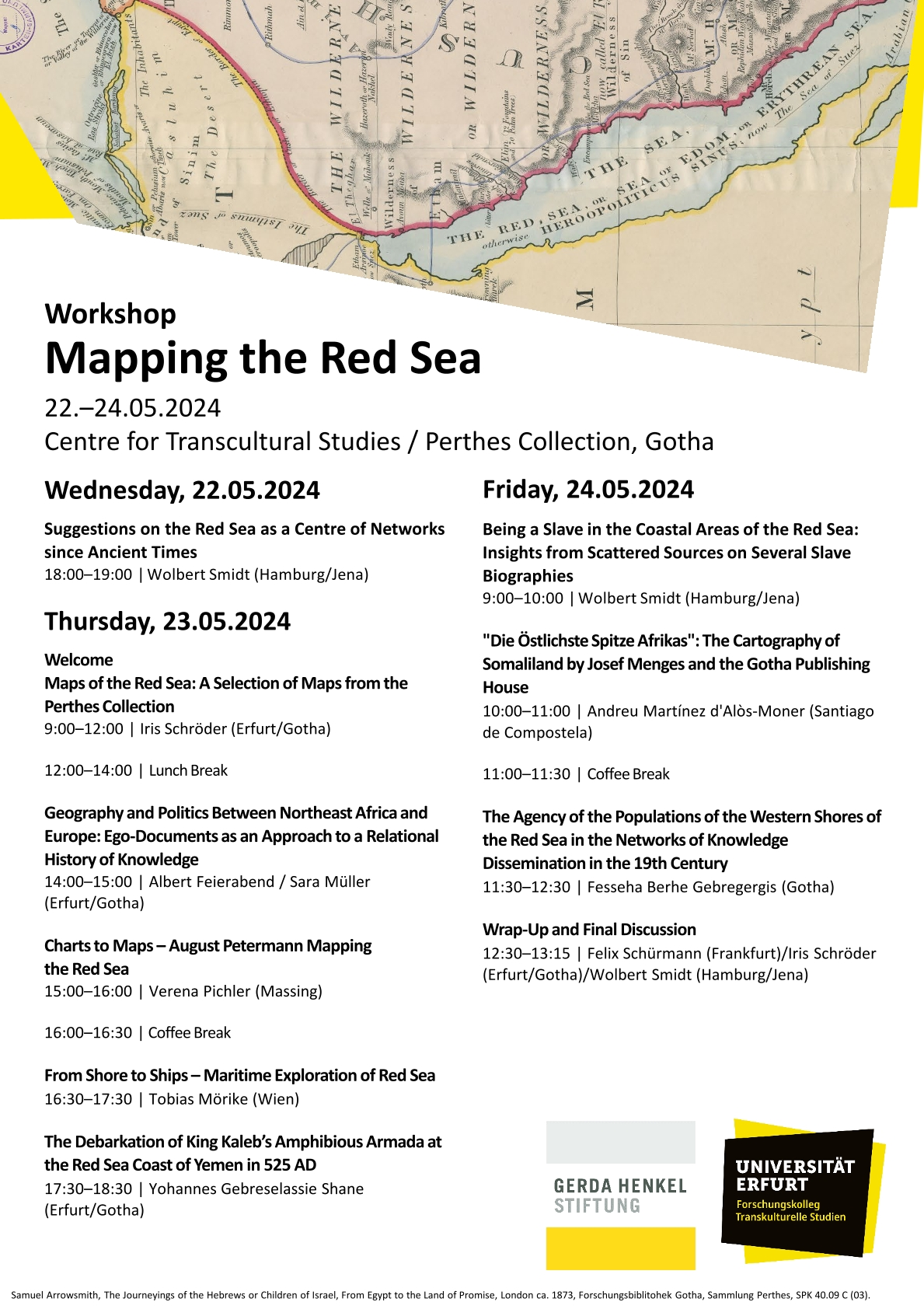
Workshop "Mapping the Red Sea"
From May 22 to 24, 2024, the workshop "Mapping the Red Sea" was held at the Centre for Transcultural Studies / Perthes Collection, with support from the Gerda Henkel Foundation.
The workshop focused on the cartographies of the Red Sea and its surrounding areas throughout the long 19th century. It commenced on May 22 with a lecture by Wolbert Smidt (Jena/Mekelle) titled "Suggestions on the Red Sea as a Centre of Networks since Ancient Times," which examined the region’s interconnected history from a longue durée perspective. The following day, the workshop continued with a visit to the Perthes Collection to discuss selected maps and materials related to the Red Sea. Subsequent presentations examined various dimensions of the Red Sea and its cartographies, addressing both the complexity of the region and the relationship between knowledge and cartography.

Second Annual Meeting of the German-Ethiopian Scholarship Initiative
From May 9 to 11, 2023, the Second Annual Meeting of the German-Ethiopian Scholarship Initiative took place at the Centre for Transcultural Studies in Gotha. The Centre hosted a networking event for fellows from various European universities and research institutions, organized as part of the scholarship initiative by the Gerda Henkel Foundation.
read more
Building Peace? Public Evening Event on the Peace Process in Ethiopia
The panel discussion took place on May 9, 2023, at 6.00pm at the Palace Chapel in Friedenstein Castle, Gotha. The roundtable addressed the Ethiopian civil war and the recently initiated peace process. The panel featured Ethiopian artist Michael Hailu, former German Ambassador to Ethiopia Brita Wagener, Dr. Alula Tesfay, and Erfurt-based international law expert Michael Riegner, who discussed the question, “How to Build Peace?” The event was part of the lecture series "Building Peace" organized by the Historical Seminar of Erfurt University and the Second Annual Meeting of the German-Ethiopian Scholarship Initiative. It was supported by the Gerda Henkel Foundation and the Freundeskreis GothAdua e.V.
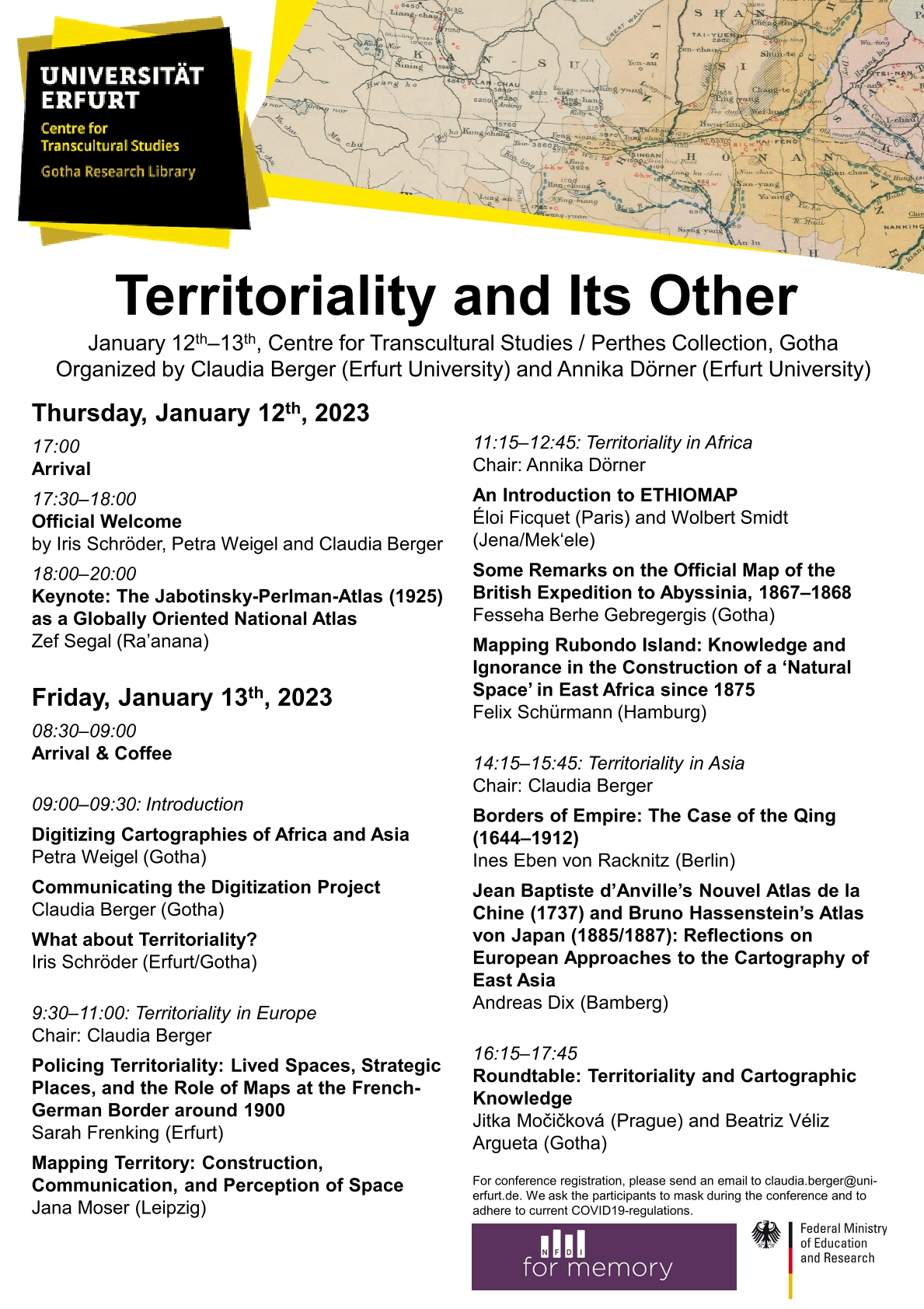
KarAfAs Final Conference "Territoriality and Its Other"
From January 12 to 13, 2023, the conference “Territoriality and Its Other” took place at the Centre for Transcultural Studies / Perthes Collection, marking the conclusion of the project “Cartographies of Africa and Asia (1800–1945). A Project for the Digitization of the Perthes Collection Gotha (KarAfAs)”. The KarAfAs project was funded by the Federal Ministry of Education and Research under the eheritage programme line.
The conference was opened on January 12 with a keynote by Israeli researcher Zef Segal on the Jabotinsky-Perlman Atlas (1925). It revisited key research discussions from the digitization project and explored new perspectives that went beyond its original scope. The conference placed special emphasis on the complex interplay between concepts of territoriality and cartography, which frequently challenge seemingly clear-cut definitions. The working group "Territoriality and Cartographic Knowledge" invited participants to delve into these issues.
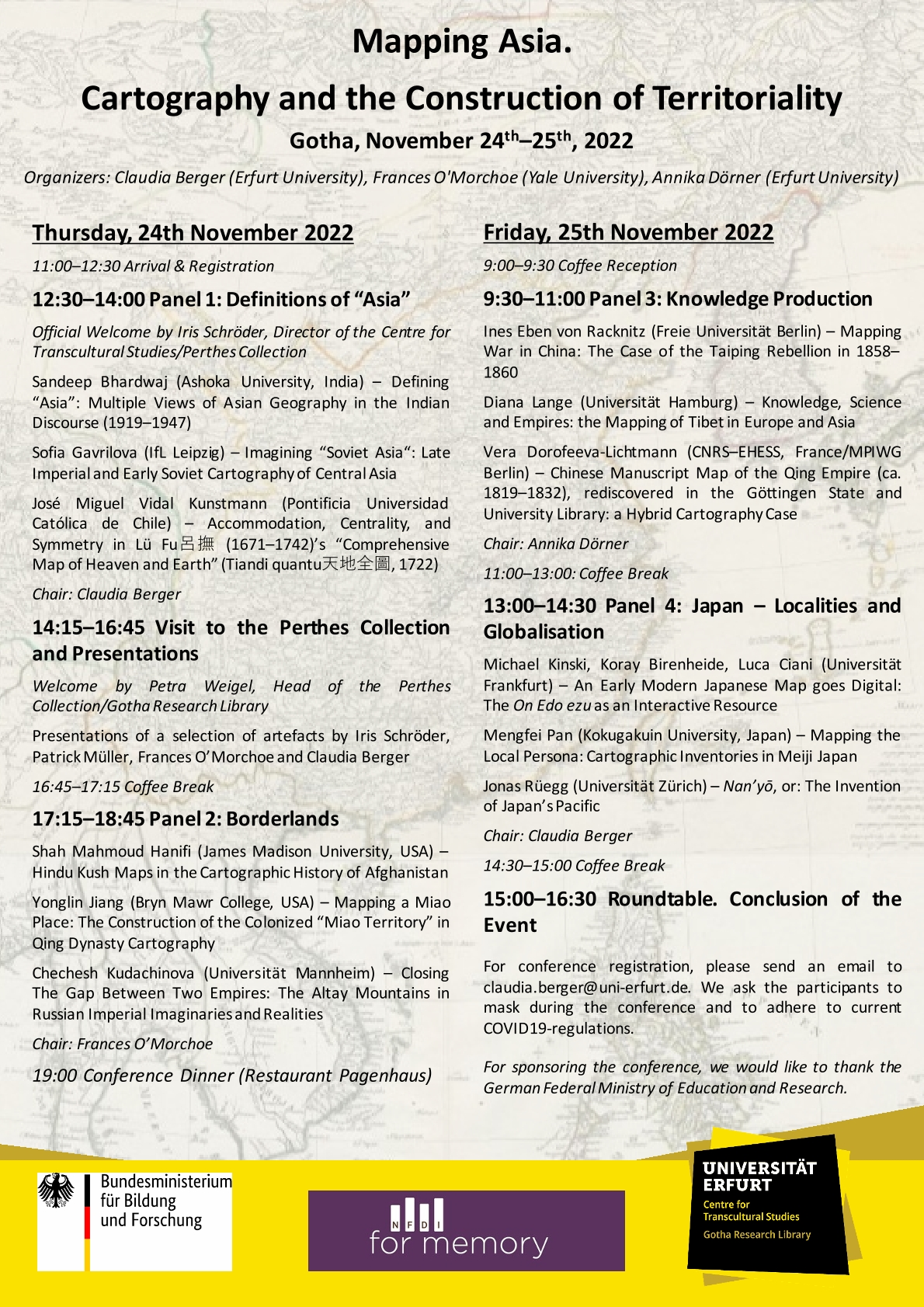
International Conference "Mapping Asia. Cartography and the Construction of Territoriality"
From November 24 to 25, 2022, the international conference "Mapping Asia: Cartography and the Construction of Territoriality" was held in Gotha. The event was organized as part of the BMBF-funded research project "Cartographies of Africa and Asia. A Project for the Digitization of Maps of the Perthes Collection Gotha (KarAfAs)" and hosted by the Centre for Transcultural Studies / Perthes Collection. International scholars examined how territoriality was constructed and challenged in Asian cartography from the late 18th to the 20th century. The conference also featured a visit to the Perthes Collection, showcasing selected highlights from the collection.
The program and further information can be found on the conference website. The event was open to the university community.
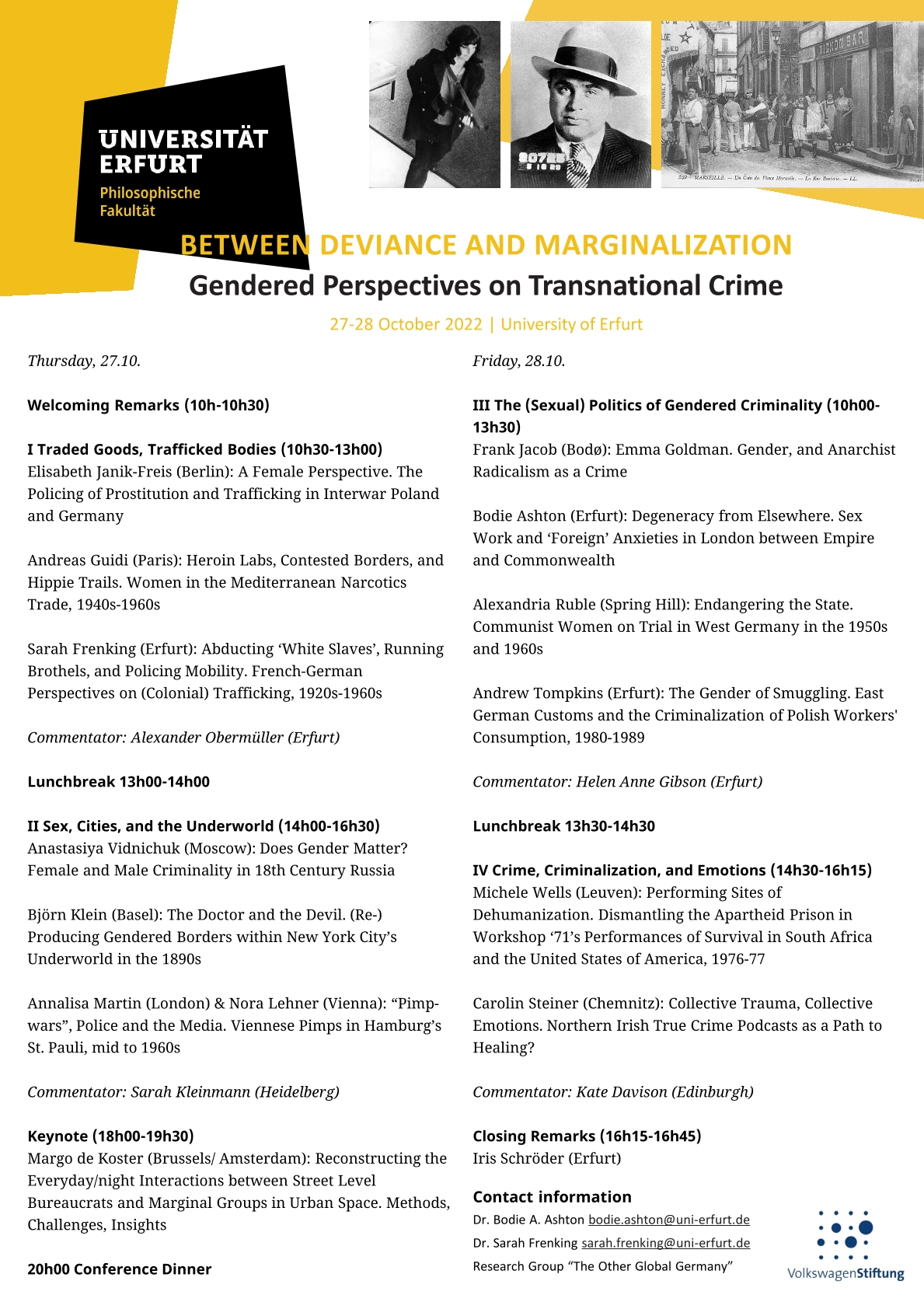
Workshop "Between Deviance and Marginalisation"
We welcome contributions that present transnational case studies and deal with questions about how media produced "sensations of crime and gender" or that reveal social aspects of crime and gender through the analysis of police and court files. We are especially interested in analyses of global circulation, networks, and perceptions, which centre the actors as active figures of agency. Given our focus on gender and crime, we especially welcome proposals that challenge the standard binary normativities of gender. Early career researchers are especially encouraged to contribute. We especially invite papers and presenters whose research explores areas underrepresented in the academe of the Global North and Western Europe. Though we anticipate many contributions concerning the broadly-defined era of modern history, we also welcome proposals from early modern history. The workshop is part of the project "The Other Global Germany: Transnational Criminality and Deviant Globalisation in the 20th Century," funded by the VW Foundation.
The workshop language will primarily be English, but there will be the possibility of spontaneous translation (short summaries e.g.) in German or French.
26 - 28 October 2022
Organisers:
Sarah Frenking (Erfurt)
Bodie A. Ashton (Erfurt)
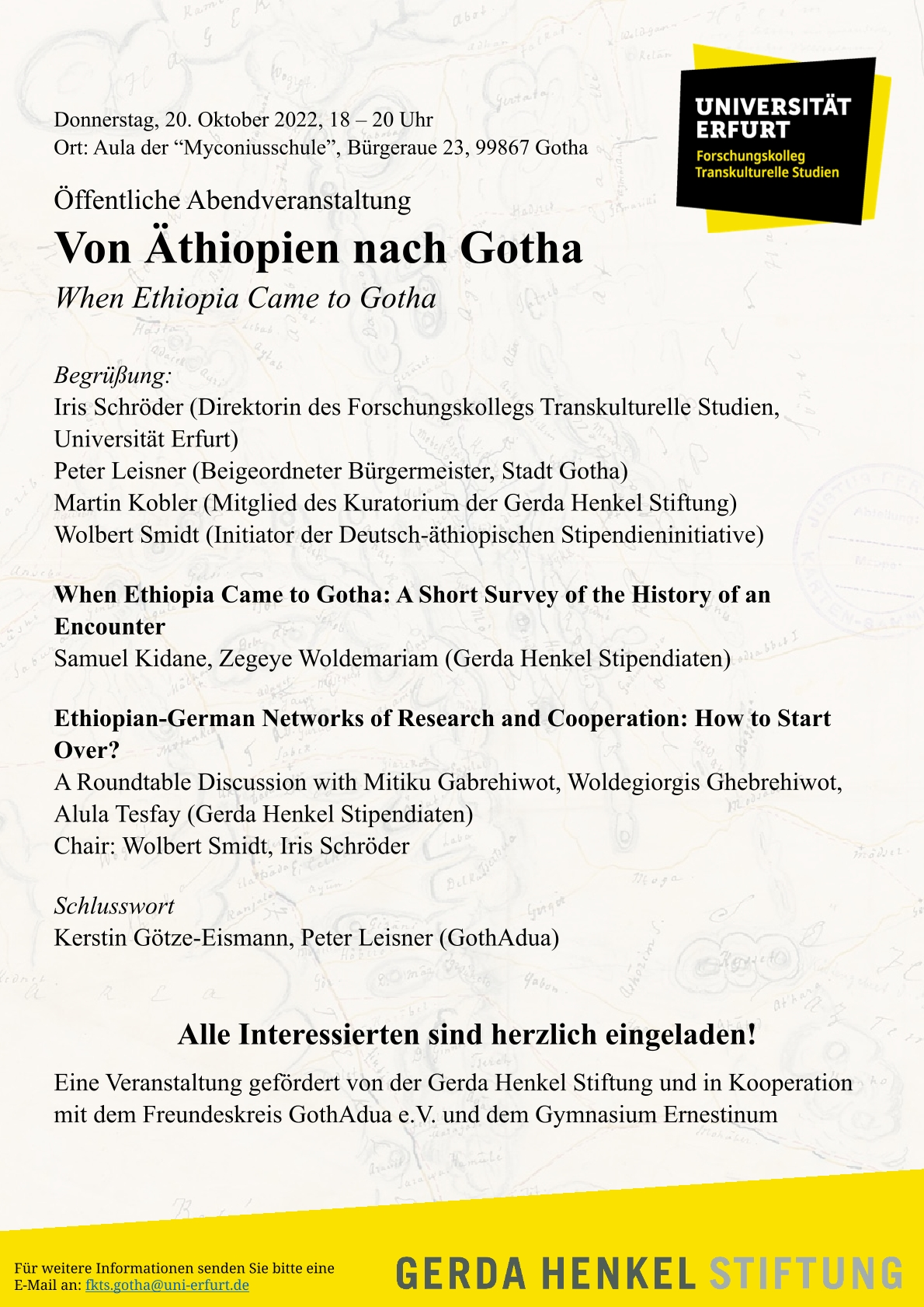
First Annual Meeting of the German-Ethiopian Scholarship Initiative
On October 20 and 21, 2022, the first annual meeting of the German-Ethiopian Scholarship Initiative, funded by the Gerda Henkel Foundation, took place at the Centre for Transcultural Studies in Gotha. Organized by scholars based in Gotha, the event featured a comprehensive program. All participants shared insights about their ongoing work in history, anthropology, geography, media studies, and their artistic projects.
read more
Public Evening Event: From Ethiopia to Gotha
Thursday, October 20, 2022, 6 to 8pm
Auditorium of the Myconiusschule, Gotha
In collaboration with the GothAdua e.V. Association and the Gymnasium Ernestinum
The conference was supported by the Gerda Henkel Foundation.

International Conference "Africa and the Global Cold War III"
This conference seeks to expand the scope of the global history of the Cold War and Africa's role in the competition of various actors to make and remake the post-war international order. To explore the struggle around the continuously contested international order, on the one hand we focus on conflicts about the international boundaries of the postcolonial nation states in Africa. On the other hand, we deal with the attempts to regulate and channel the flows and movements that went beyond those borders, be it refugee movements, the trafficking of arms, or knowledge transfers in education and media as well as in clandestine networks. This conference, the outgrowth of a longstanding Ethiopian-European academic collaboration, was originally scheduled for 2020, but postponed due to the pandemic.
22-24 September 2022 | Memorial and Educational Centre Andreasstraße, Erfurt
Organisers:
Aychegrew Hadera (Bahir Dar)
Christian Methfessel (Berlin)
Ned Richardson-Little (Erfurt)
Teferi Mekonnen (Addis Ababa)
Jan Záhořík (Pilsen)
Contact: christian.methfessel@uni-erfurt.de
For further information:
Programme_Conference_Africa_Cold_War_III
Funded by the Ernst-Abbe-Stiftung, the VolkswagenStiftung, the Faculty of Arts of the University of West Bohemia as well as the Research Department, the International Office, the Chair of Political Theory, and the Chair of Global History of Erfurt University.

Workshop "verboten, verrucht, verpönt"
This workshop aims to explore the internationalisation and transnationalization of ideas, conceptions and practices of criminality and deviance in Germany from the Imperial Era to the present. Since the late19th century, various forms of global interconnection have fostered new forms of criminalised cross-border movement and flows of goods, moral panics about imported forms of deviance, and innovative tactics for policing or containing these phenomena, both real and imagined. The workshop emphasizes the social and cultural production of conceptions of crime, deviance and the illicit, but also how international practices that would today be widely understood as deeply immoral and exploitative were legitimised in their respective historical periods. Tracing the shifting moral claims, systems of criminal enforcement and border systems enacted to realising competing visions of morality and criminality, this workshop seeks to illuminate new understandings of Germany's place in a globalising world. Themes covered include sex work, arms trafficking, transgender identities, trade in human remains, stolen goods, and petty black market trading. The workshop is part of the project "The Other Global Germany: Transnational Criminality and Deviant Globalisation in the 20th Century," funded by the VW Foundation.
07 - 08 July 2022 | Internationales Begegnungszentrum, Michaelisstraße 38, Erfurt
Organisers:
Ned Richardson-Little (Erfurt)
Sarah Frenking (Erfurt)
Bodie A. Ashton (Erfurt)
Contact:
ned.richardson-little@uni-erfurt.de
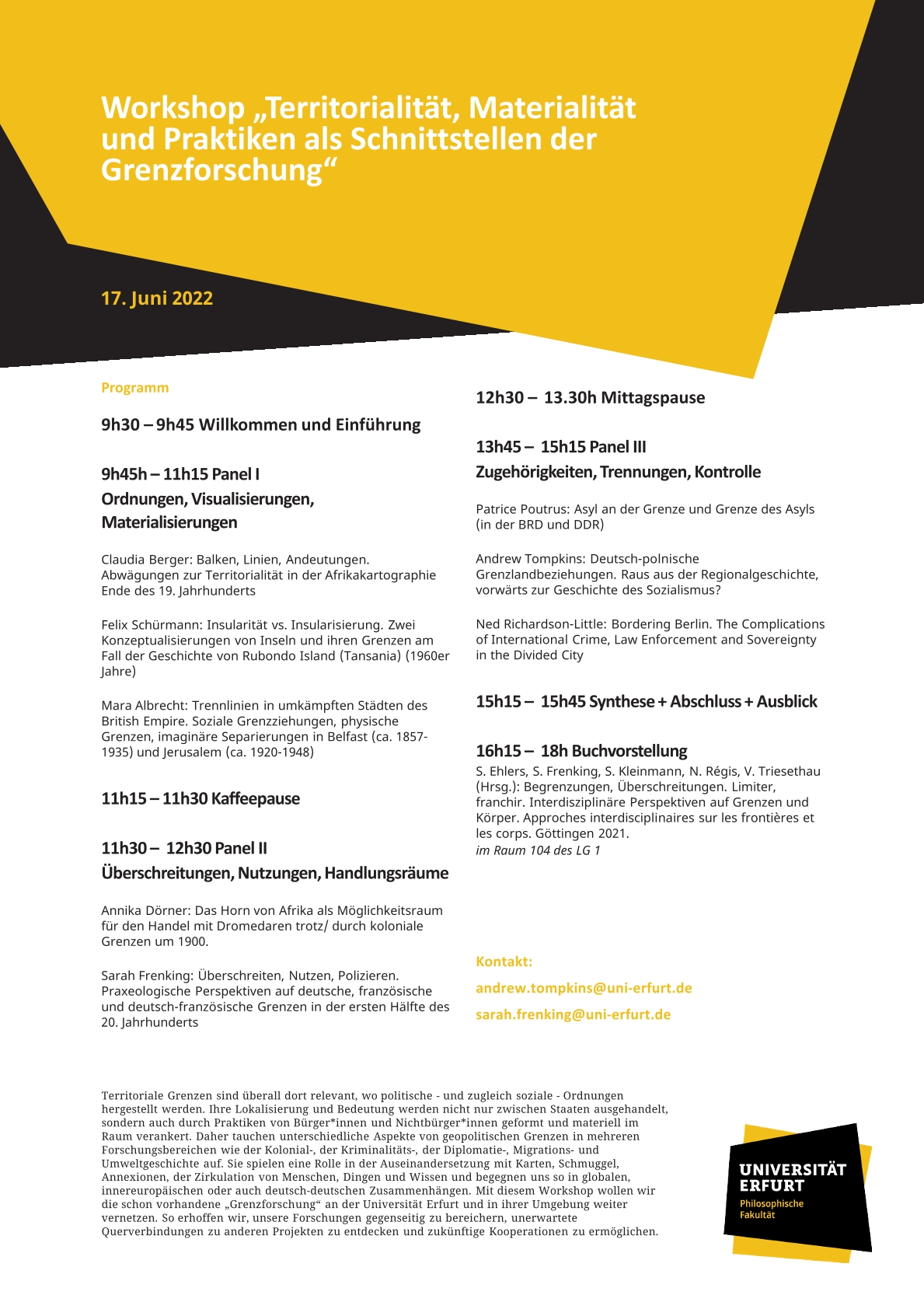
Workshop "Territorialität, Materialität und Praktiken als Schnittstellen der Grenzforschung" and book launch
Territorial borders are relevant wherever political - and at the same time social - orders are established. Their localisation and meaning are not only negotiated between states, but are also shaped by practices of citizens and non-citizens and materially anchored in space. Therefore, different aspects of geopolitical borders emerge in several fields of research such as colonial, criminal, diplomatic, migration and environmental history. They play a role in the examination of maps, smuggling, annexations, the circulation of people, things and knowledge and thus encounter us in global, intra-European or even German-German contexts. With this workshop, we want to further network the existing "border research" at the University of Erfurt and its surroundings. In this way, we hope to mutually enrich our research, discover unexpected cross-connections to other projects and facilitate future collaborations.
This will be followed by a presentation of the book Begrenzungen, Überschreitungen - Limiter, franchir. Interdisziplinäre Perspektiven auf Grenzen und Körper - Approches interdisciplinaires sur les frontières et les corps. The book launch will take place as a hybrid event. Interested parties can register in advance at lilu.kruspe@uni-erfurt.de
17 June 2022 | University of Erfurt KIZ/0.10 and LG1/104
Organisers:
Andrew Tompkins (Erfurt)
Sarah Frenking (Erfurt)

International Workshop "Entangling Histories of International Trafficking"
At the beginning of the 21st century, the United Nations Office on Drugs and Crime oversaw a complex network of international conventions that aimed to combat narcotics smuggling and the illicit trade in arms, and human trafficking for purposes of exploitation. Today, law enforcement organisations argue that these three fields are fundamentally linked together by transnational organised crime to support their demands for global police cooperation. At the beginning of the century, however, when activists and diplomats first created prohibition regimes aimed at addressing these issues, they understood them as distinctly separate problems, each requiring radically different solutions. This conference aims to answer the question: How did the trafficking in humans, arms and narcotics become entangled over the long 20th century - in terms of actual illicit flows of people, guns and drugs, but also in terms of public perceptions and prohibition regimes?
Dates:
June 25, 2021
July 2, 2021
July 9, 2021
Organisers:
Ned Richardson-Little ned.richardson-little@uni-erfurt.de
Sarah Frenking sarah.frenking@uni-erfurt.de
Bodie A. Ashton bodie.ashton@uni-erfurt.de
This conference has received funding via the VolkswagenStiftung as part of the Freigeist research project "The Other Global Germany".

International Workshop "New Transnational and Global Approaches to the GDR Border"
This workshop seeks to connect the GDR to wider debates about borders in the contemporary world through a focus on this much-contested border from a transnational and global perspective. The East German border was always more than just the product of German-German or Cold War superpower competition, and each of these presentations shows how it was also created by neighbouring states, international organisations and global phenomena. The presentations consider the border from multiple perspectives: the role of law enforcement and state bureaucrats, but also the role of those smuggling, trafficking, polluting, and illicitly crossing borders.
July 10-11, 2019 | University of Erfurt
Organiser: Dr Ned Richardson Little (Erfurt)
Funded by the VolkswagenStiftung.

Conference "Africa and the Global Cold War II"
Mekelle University, Adi-haqi Campus, Theatre Hall, 25-26 March 2019
Organisers:
Aychegrew Hadera Hailu (Mekelle)
Meressa Tsehaye Gebrewahd (Mekelle)
Christian Methfessel (Erfurt)
Seife Hailu Gebreslassie (Mekelle)
For further information:
Programme_Conference_Africa_Cold_War_II
Flyer_Conference_Africa_Cold_War_II
Conference Report: Africa and the Global Cold War II, 25/26 March 2019 Mekelle University; in: Global histories. A Student Journal 5 (2019), URL: https://www.globalhistories.com/index.php/GHSJ/article/view/314/163
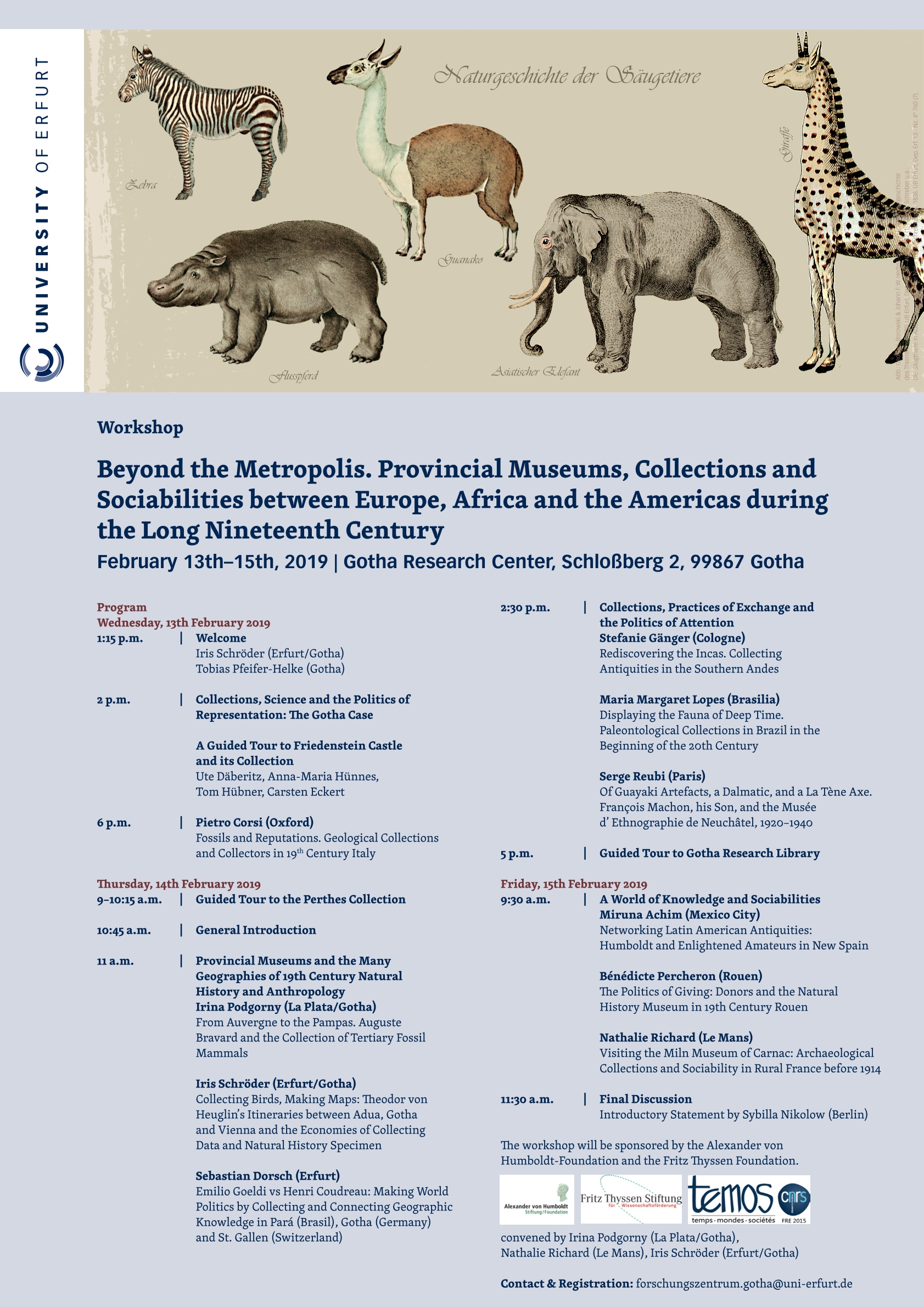
International Workshop "Beyond the Metropolis"
From February 13 to 15, 2019, the international workshop "Beyond the Metropolis: Provincial Museums, Collections, and Sociabilities between Europe, Africa, and the Americas during the Long Nineteenth Century" took place in Gotha. It was organized under the direction of Irina Podgorny, Nathalie Richard, and Iris Schröder.
The event was funded by the Alexander von Humboldt Foundation and the Fritz Thyssen Foundation.
Further information:

International Workshop "Africa and the Global Cold War"
IBZ Erfurt, Conference Room, 5-6 July 2018
Organisers:
Aychegrew Hadera Hailu (Mekelle)
Christian Methfessel (Erfurt)
Franziska Rantzsch (Erfurt)
Iris Schröder (Erfurt/Gotha)
Contact:
Dr Christian Methfessel christian.methfessel@uni-erfurt.de
For further information:
Programme_Workshop_Africa_Cold_War
Poster_Workshop_Africa_Cold_War
Flyer_Workshop_Africa_Cold_War
Conference Report: Africa and the Global Cold War, 05.07.2018 - 06.07.2018 Erfurt, in: H-Soz-Kult, 22.01.2019, URL: https://www.hsozkult.de/conferencereport/id/tagungsberichte-8061.
Funded by the Fritz Thyssen Foundation.
Due to copyright restrictions, it is not allowed to reupload the poster
and the flyer on other websites.

Conference "Geschichte(n) über Räume und Zeiten. Translocal Perspectives on Global Spacetimes"
On April 26 and 27, 2018, the conference "Geschichte(n) über Räume und Zeiten. Translocal Perspectives on Global SpaceTimes" was held at the Gotha Research Centre. The event was organized in collaboration with Erfurt University's SpatioTemporality Research Group and the "Arbeitskreis Außereuropäische Geschichte" (AAG) of the VHD. Its aim was to elaborate on and discuss how spatial and temporal dimensions intersect in historical research. For this occasion, the focus was particularly on the concept of translocality.
The conference was funded by the Ernst Abbe Foundation.

International Workshop "Transimperial Cooperation and Transfers in the Age of Colonial Globalisation. Towards a Triangular History of Colonialism?"
Gotha Research Centre and Erfurt University, 22-24 March 2018
This workshop explores to what extent transimperial cooperation and transfers shaped colonial governmentality in the 19th and 20th centuries. Going beyond the conceptual and ideological similarities between empires, the focus is on colonizers and colonized who used cooperation and transfers to increase their agency. Referring to the concept of "triangulation" we ask whether shifting networks and solidarities among three groups led to the reinforcement of colonial domination (two colonizing powers against the colonized) or the subversion of colonial hierarchies (indigenous solidarity against the colonizer). In a long-term perspective, the workshop seeks to examine how imperial and anti-colonial forms of cooperation were institutionalized and thus impacted the development of international organisations in the 20th century.
Organisers:
Florian Wagner (Erfurt) and Christian Methfessel (Erfurt)
Gotha Research Centre (22 March) and
Augustinerkloster Erfurt (23-24 March)
Funded by the Forum for the Study of the Global Condition and the Ernst Abbe Foundation.
For further Information:
Public Evening Lecture
Corey Ross (Birmingham): The Nature of Trans-imperialism: Ecological Interconnections and Colonized Environments
Conference room, Gotha Research Center, 22 March 2018, 5pm
For further information: Announcement

Special Presentation at Mekelle University
Christian Methfessel: "Depictions of the Battle of Adwa in the English and German Press"
College of Social Sciences and Languages
Department of History and Heritage Management
Thursday, 8th March 2018
9:00 local time (3:00 p.m.)
Adi Haqi Campus, Theatre Hall
Image: View of the Mekelle University campus © A.Savin, Wikimedia Commons.

Workshop/Journée d'étude "Die ganze Welt in Gotha. Räumliche Konstruktionen und kartographisches Wissen im 19.-20. Jahrhundert/Le monde entier à Gotha. Constructions spatiales et savoirs cartographiques, XIXe-XXe siècle"
Tuesday, March 6, 2018, 9h45-17h, Perthes Forum, Gotha
Mardi 6 mars 2018, 9h45-17h, Perthes Forum, Gotha.
Led by Iris Schröder and Marie de Rugy, the workshop "Die ganze Welt in Gotha. Räumliche Konstruktionen und kartographisches Wissen im 19.-20. Jahrhundert / Le monde entier à Gotha. Constructions spatiales et savoirs cartographiques, XIXe-XXe siècle" took place.

Workshop: "Peace and Conflict in the Horn of Africa"
Friday, 9 June 2017, 2 - 4 pm, University of Erfurt
Teaching building 4, room D 02
With introductory notes by Aychegrew Hadera Hailu (Mekelle) on the on the role of NGOs in peace, conflict and development discourses, Haile Muluken Akalu (Mekelle) on international diplomacy, Meressa Tsehaye Gebrewahd (Mekelle) on nation building, political ethnicity and regional conflicts, Jalale Getachew Birru (Erfurt) on building peace through hybrid systems, Steve Wakhu (Erfurt) on the nexus between counter-terrorism and compliance to human rights, and Florian Wagner (Erfurt) on colonial legacies in the Horn of Africa.
Chair: Iris Schröder (Erfurt/Gotha)
Organisers: Haile Muluken Akalu (Mekelle), Christian Methfessel (Erfurt)
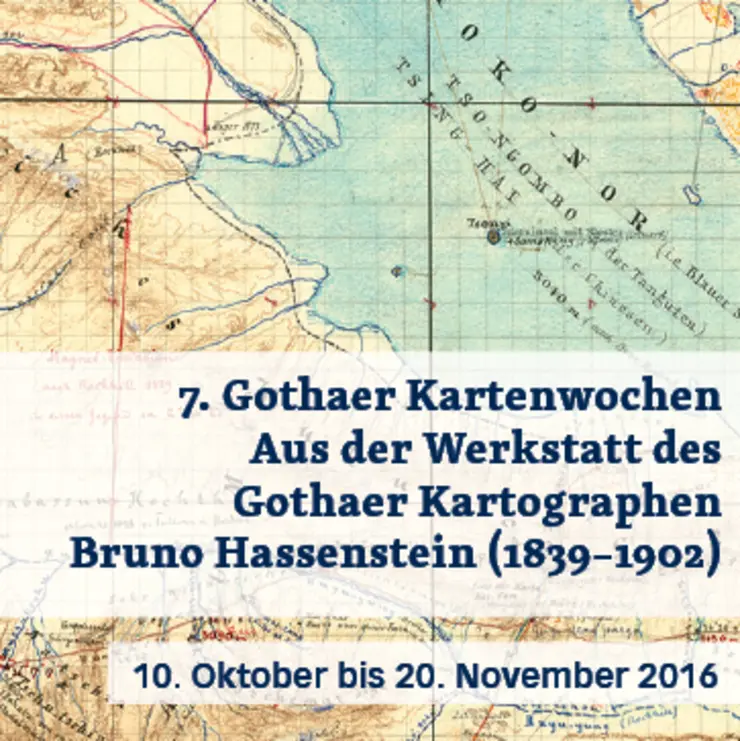
International Workshop "Im Kopf des Kartographen. Arbeitsweisen der Kartographie des 19. Jahrhunderts"
From November 16-17, 2016, as part of the 7th Gotha Map Weeks, the International Workshop "In the Cartographer's Head. Working methods of 19th century cartography" took place.
Location: Ahnensaal in the Perthes Forum Gotha.
For more information, please see the programme.
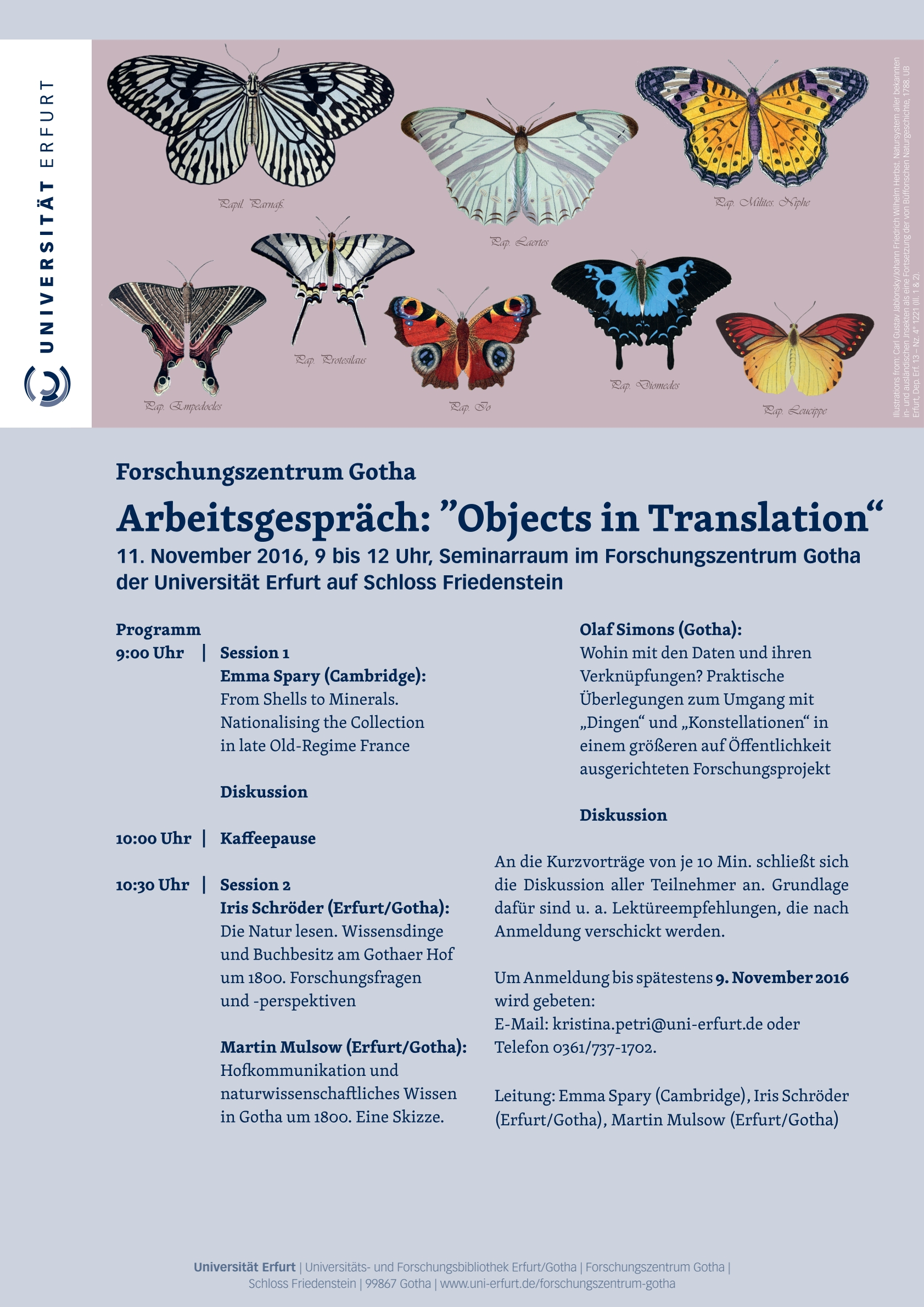
Research Discussion: "Objects in Translation"
On Friday, November 11, 2016 , the colloquium of the EPPP Knowledge History of the Modern Era included the research discussion: "Objects in Translation" with Emma Spary (Cambridge), Iris Schröder (Erfurt/Gotha) and Martin Mulsow (Erfurt/Gotha).
9-12 a.m., Seminar Room at the Gotha Research Centre
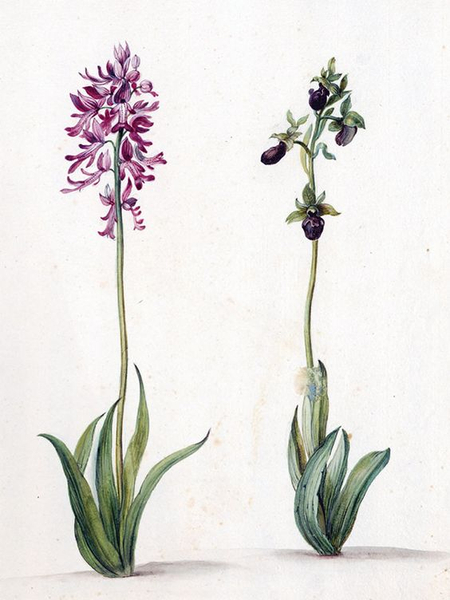
Workshop "Wissensdinge"
Under the direction of Prof. Dr. Iris Schröder (Erfurt/Gotha), the workshop "Wissensdinge" took place from June 30-July 1, 2016 in cooperation with the German Maritime Museum Bremerhaven and the Göttingen Graduate School "Materialität des Wissens" in the seminar room of the FZG.
For more information, please see the programme.
Picture: Workshop Breyne. Hyacinth and lady's slipper © Gotha Research Library, Chart. A 783a, p. 94.
Interdisziplinäre (Süd)Sudankonferenz
The ethnological seminar "Sudan/South Sudan" organised by the university group SOS-Darfur took place on 25 June 2016.
This time, the focus was on the ways of life of the Sudanese and South Sudanese, their economy, social organisation, religion and cultural heritage. In order to provide as close and multi-layered an overview as possible, the ethnological conference was attended by scientists from various subject areas as well as field researchers who presented their current research findings.
Further information can be found in the programme.

Workshop "Kartographien zeitlicher Dynamik" (at the same time 10th Workshop of the Erfurt SpatioTemporality Research)
From 2-3 June 2016, the workshop "Cartographies of Temporal Dynamics" took place in Gotha under the direction of Christian Holtorf (Coburg), Iris Schröder (Erfurt/Gotha) and Sebastian Dorsch (Erfurt/Gotha), kindly supported by the Ernst Abbe Foundation in Jena.
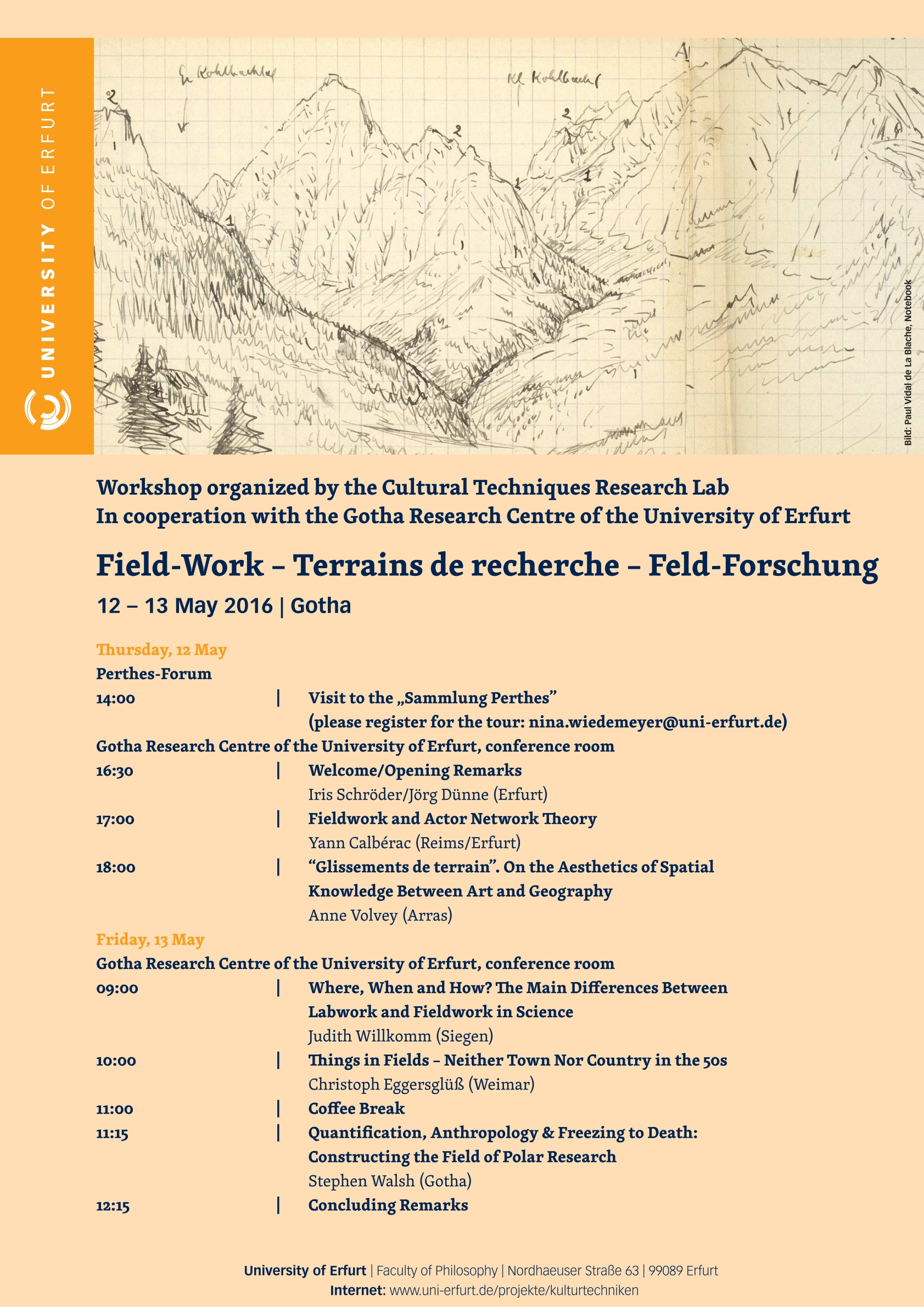
Workshop Field-Work - Terrains de recherche - Field research
Under the direction of Yann Calbérac (Reims), Jörg Dünne (Erfurt) and Iris Schröder (Erfurt/Gotha) in cooperation with the Erfurt Cultural Techniques Laboratory Group, the workshop "Field-Work - Terrains de recherche - Feld-Forschung" took place in Gotha from 12-13 May 2016 in English.
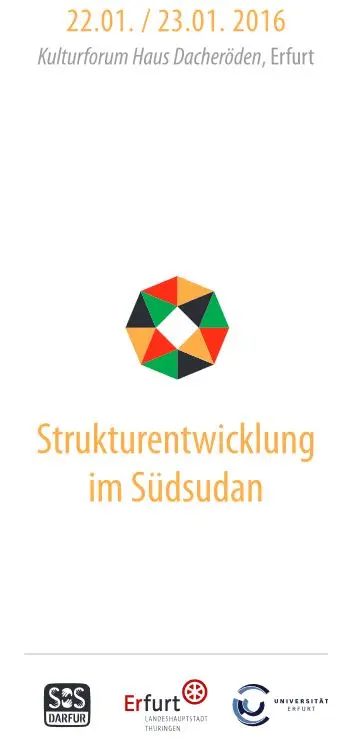
Conference "Strukturentwicklung im Südsudan"
The "Strukturentwicklung im Südsudan" event organised by the SOS-Darfur university group took place on 22/23 January 2016. The aim was to take stock of the first years of structural development in South Sudan and to provide an outlook on further development approaches.
Further information:

Lecture and workshop "Globalgeschichte der Ernährung"
As part of the colloquium "Scaling: Globalgeschichte und das Spiel der Maßstäbe", the event "Globalgeschichte der Ernährung", organised jointly with the Chair of North American History, took place.
It began on 13 January 2016 with the lecture "Die Globalisierung des Hungers. Geschichte eines Armbands (1958–2015)" by Joel Glasman; this was followed on 14 January 2016 by the workshop "Wir sind nie global gewesen. Kann die Globalgeschichte von Bruno Latour lernen?".

Workshop "Militärisches Wissen vom 16. bis zum 19. Jahrhundert"
On September 24/25, 2015, the workshop "Militärisches Wissen vom 16. bis zum 19. Jahrhundert" took place in the seminar room of the Gotha Research Centre.
Until now, the relationship between the military and knowledge has played only a minor role in historical research. Although individual fields of knowledge, such as medicine and engineering, have repeatedly been considered, especially for warfare during both world wars, this approach is too narrow from the perspective of the history of knowledge in several respects: First, it reduces military affairs to the state of war; second, it reduces knowledge to sciences and thus neglects other learned as well as administrative, social, or experiential bodies of knowledge; and third, it sets the temporal focus solely on modernity. Recently, the conference "Military Cultures of Knowledge in the Early Modern Period" illustrated the fruitfulness of knowledge-historical approaches to the field of the military in the pre-modern period, although the focus was primarily on educational and expert knowledge and its professionalization. Following on from this, the workshop, which emerged from the doctoral program "History of Knowledge in the Modern Era" at the Gotha Research Centre of the University of Erfurt, strives for a more knowledge-praxeological approach, which also deliberately transcends the epochal boundary around 1800 and includes the 'long 19th century'.
Further information:
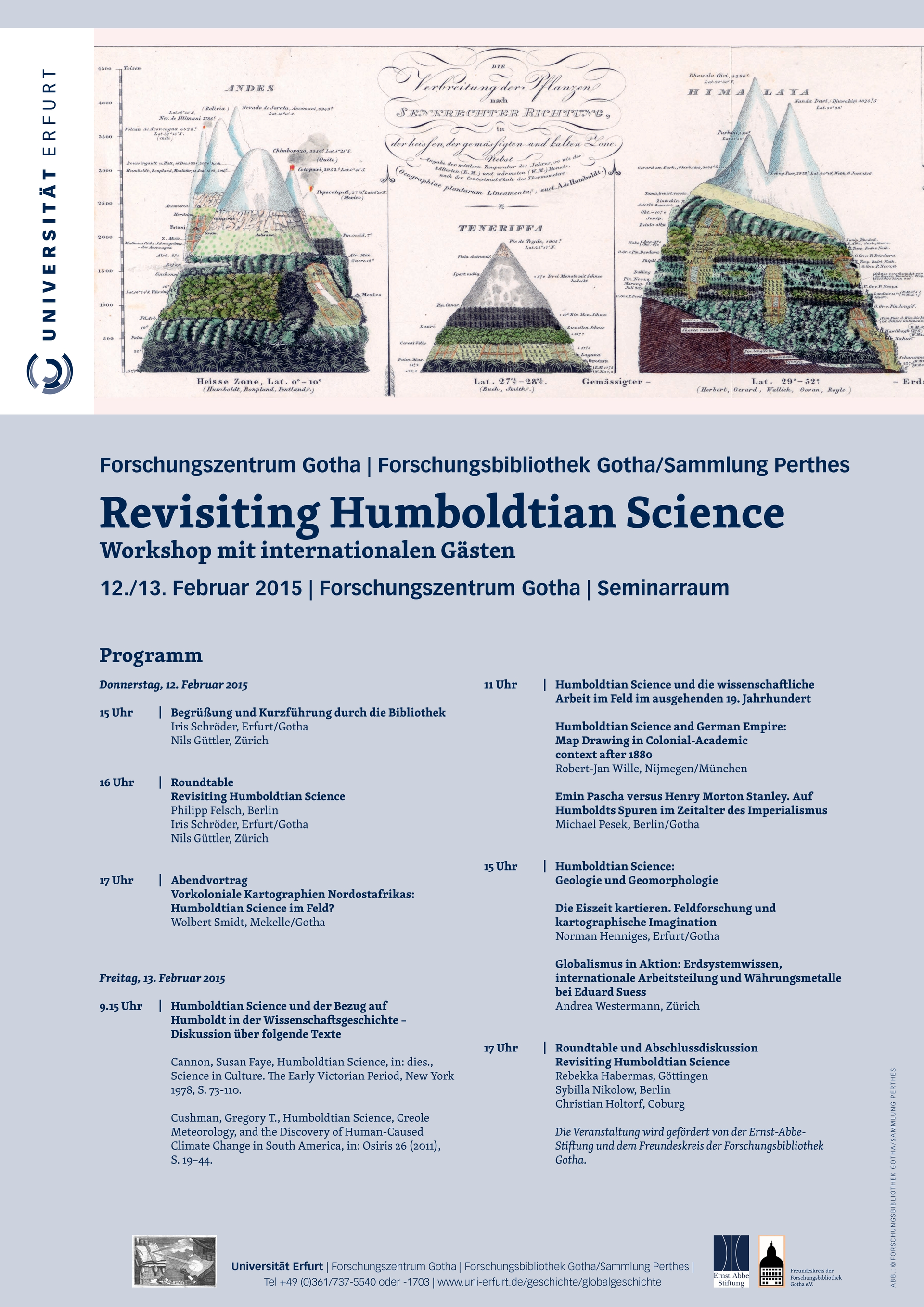
Workshop "Revisiting Humboldtian Science"
On February 12/13, 2015, the workshop "Revisiting Humboldtian Science" took place in the seminar room of the Gotha Research Centre.
The talk of "Humboldtian Science" is very familiar in the history of science of the 19th century. "Humboldtian Science," as Michael Dettelbach and Sue Faye Cannon argue, refers to a specific ethic of precision and observation that was widely shared by 19th century naturalists. By combining measurement and mapping with romantic sensibility, the boundary between academic and popular science became blurred in natural history fieldwork. Moreover, "Humboldtian Science" always remained linked to Humboldt as a person: Humboldt was not only the inventor of "Humboldtian Science", but at the same time he embodied it in an almost ideal-typical way. Those who followed him, on the other hand, stood in his shadow and were to be forgotten.
It is only recently that historians have begun to analyze more precisely the multi-layered and complex afterlife of Humboldt and his numerous undertakings. Following on from these approaches, the simple but as yet unanswered question arises: How "Humboldtian" was "Humboldtian Science"? The workshop explores this question and thus addresses the hitherto little researched interaction of professional and amateur scientists and furthermore attempts to productively link European and non-European perspectives. The aim is to define the much-cited reference to "Humboldtian Science" more precisely in order to focus on the various networks of knowledge involved, their practices, and, not least, the geography of the "scientific age" in general.
Further information:
Concept and programme
Poster Evening Lecture
Conference report

Workshop "Internationale Organisationen und Räume des Wissens"
On July 24/25, 2014 , the workshop "International Organizations and Spaces of Knowledge" took place in the seminar room of the Gotha Research Centre.
Both international history and the history of knowledge are booming. However, the two approaches are rarely connected, although they often address similar questions and are interested in experts, networks, and the global and spatial historical references of their subject areas. The aim of the workshop has been to discuss how international history can be consistently written as knowledge history. The focus will be on questions of knowledge production and archiving, knowledge transfer, the politicization of knowledge, and the relationship between spatiality and knowledge.
Direction:
Iris Schröder (Erfurt/Gotha)
Hubertus Büschel (Gießen)
Julia Hauser (Göttingen)
Christian Methfessel (Erfurt)
Jonas Brendebach (Florence).
A collaborative project of the Gotha Research Centre at the University of Erfurt (FZG), the International Graduate Centre for the Study of Culture (GCSC) at the Justus Liebig University Giessen, the Graduate School for the Humanities Göttingen (GSGG) and the Department of History and Civilization (HEC) at the European University Institute, Florence.
Further information:

6th Workshop of the Erfurt SpatioTemporality Research
On December 2, 2013, in the seminar room of the Gotha Research Centre , the workshop "Working on Location, Working on Space. Geographical Expertise between World Regions" took place.
The 6th workshop of the Erfurt SpatioTemporality Research Group ERZ, founded in 2011, explored the question of how on-site experience "in the field" is inscribed in scientific, geo/mapping practices. The empirical starting point was the collection of the Perthes publishing house, which is kept in the Gotha Research Library. The tradition of this collection makes it possible to follow more closely both explorers in the field and the genesis of geo/cartographic knowledge and the production of the corresponding geo/cartographies.
Case studies of explorers, geographers, and cartographers of the late 19th century were discussed alongside foundational texts from Ethnology, Philosophy, and Cultural Studies. Regional points of reference were Africa and Latin America as well as the "project area Arctic".
Further information:
![[Translate to English:] facebook icon](/fileadmin/SocialMediaIcons/iconfinder_06-facebook_white.svg)

![[Translate to English:] instagram icon](/fileadmin/SocialMediaIcons/iconfinder_38-instagram_white.svg)
![[Translate to English:] YouTube icon](/fileadmin/SocialMediaIcons/iconfinder_18-youtube_white.svg)
![[Translate to English:] xing icon](/fileadmin/SocialMediaIcons/iconfinder_xing_white.svg)
