So what can you do with it? What’s the point? Can’t AI do it all?
All these questions might cross your mind when you’re considering studying (Applied) Linguistics. Some of them are answered during the course of your studies, whilst others only become clear in hindsight.
On this page, former students talk about their career paths: the ups and downs of their time at university, their current field of work, and the connections between the two. This highlights the wide range of career paths that studying Applied Linguistics can open up.
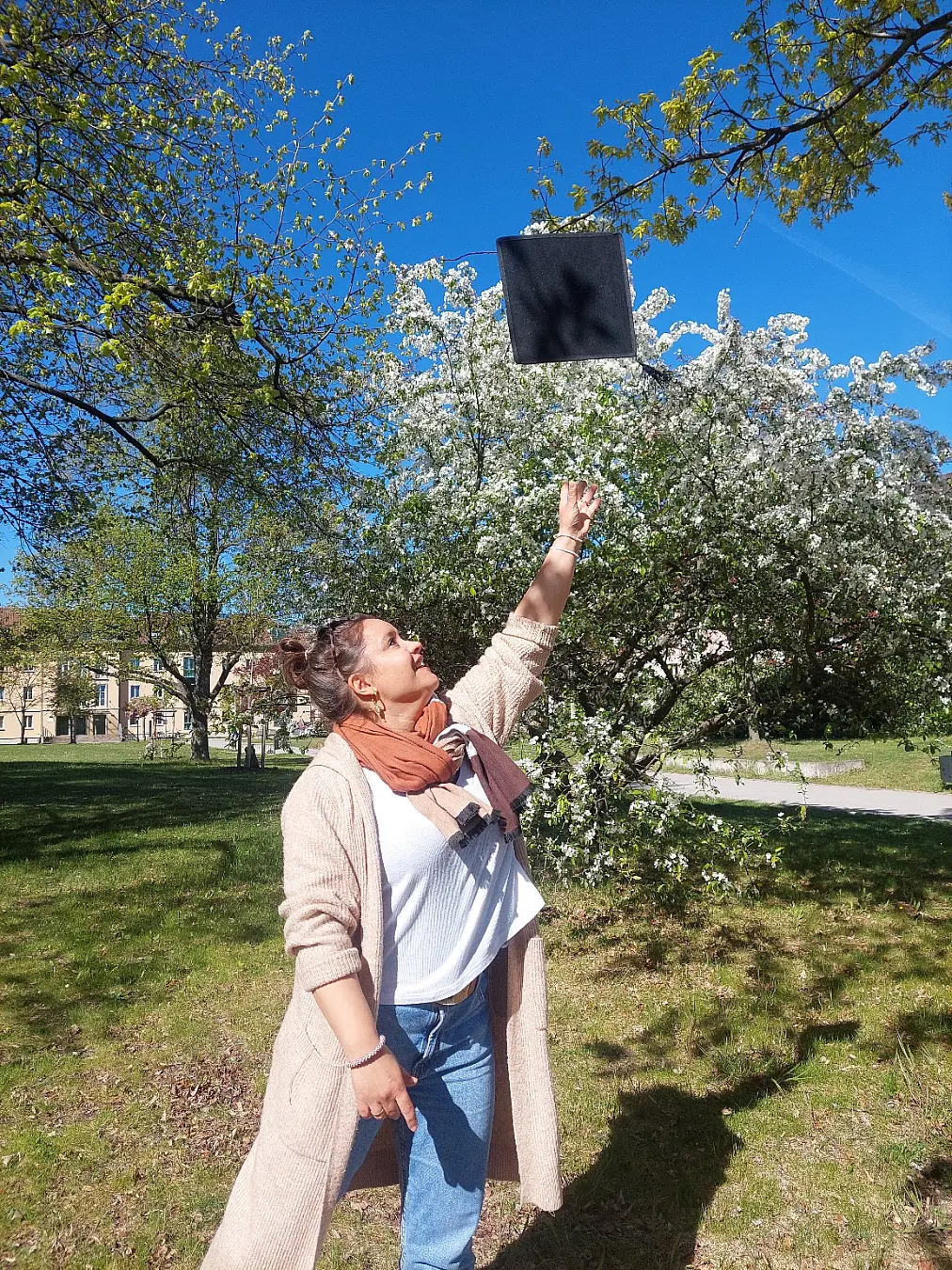
Sandra Schmidt was one of the very first students: she began studying Applied Linguistics just as the degree programme was being introduced. She stayed at the university and now works in the International Office. She was the first to answer our questions. We hope you enjoy reading her answers!
Sandra Schmidt
Who are you?
Hello! My name is Sandra. I studied for a Master’s in Applied Linguistics in the first cohort and graduated in 2017. I’m originally from Berlin, but I’ve been living in Erfurt for a really long time. I’m a huge fan of Spain and Greece. In my spare time, I enjoy bouldering, playing table tennis and, at times, reading absurd amounts of books. We also have four chatty little birds living with us who are remarkably keen on chattering away at everything and everyone – so there’s always something going on!
What do you do for a living?
I have been working at the International Office at the University of Erfurt , mainly as an advisor for incoming students who come to Erfurt for a semester or a full academic year. Although the International Office is part of the administration, I would say that the work there isn’t quite a traditional administrative job. Overall, however, you should enjoy office work. I’d also like to take this opportunity to speak up for administration, as it is indispensable for institutions such as universities!
What are your responsibilities?
I support and advise international exchange students before and during their semester abroad at the University of Erfurt! Every year, I meet around 60 to 80 new people who come to Erfurt from a wide range of countries and our partner universities. How cool is that?! I review the exchange students’ applications and issue their admission letters for the exchange programme. I also organise their arrival, various Q&As and information sessions, onboarding, excursions, part of the matriculation and registration process and their departure. Every semester, I work with a new, diverse group of people, and I have to adapt to them each time. That can be challenging! Arrivals don’t always go to plan. Visa delays do occur. Some students even have to cancel their studies with us. You have to be able to react as calmly as possible to dynamic situations and learn that some factors are simply beyond your control. Of course, this isn’t a realisation that applies solely to the International Office. The exchange students are very grateful and I receive excellent feedback on my work – sometimes postcards or little thank-you notes when they leave. What’s more, I work in a brilliant team!
I coordinate the buddy programme for international exchange students! Shortly before the start of the semester, I match the registered local student buddies with the international exchange students. I then brief the buddies on their tasks. I want to ensure that both the buddies and the exchange students are happy with the match and provide the best possible support to both groups – which isn’t always that easy! Monitoring throughout the semester is a process we try to optimise every term.
Over time, you get a feel for who might make a good buddy match with whom. You get to know the local students better and are constantly meeting new people on campus! Without the buddies, it would be really difficult to provide the level of onboarding support that we do. So, a huge thank you to any of our buddies reading this!
I manage our Instagram account @unierfurtinternational: I enjoy creating content and posts and being creative from time to time. However, I often don’t have the time to put my ideas into practice. Fortunately, we work closely with the University Communications @unierfurt , who is always on hand to offer advice and support!
I process applications from prospective international BA students. This is the area of my work where I’ve learnt the most from a professional perspective. I assess certificates according to specific guidelines and draft the decision letters. During peak periods – particularly from May to July – I mainly process applications. That can sometimes feel like quite a lot of administrative work. Personally, though, I enjoy it, and every now and then – when I have a basic or advanced knowledge of the language of a certificate – I prefer to read it in the original. So every now and then, it’s perfectly fine to let my inner linguistics nerd shine through.
Conferences and training courses are all part of the job! I regularly take part in conferences and training courses. Every now and then I go abroad too. I have particularly fond memories of my Erasmus-funded staff training in Madrid a few years ago, where I was able to brush up on my Spanish and met lots of new people. It was brilliant, and Madrid is such a beautiful and lively city!
Conferences and training courses are very interesting, but they also require good planning skills. Work may need to be put on hold or handed over as best as possible. There are, of course, times of the year when we in the International Office are particularly busy. These are mainly the two onboarding phases, one in the winter semester and one in the summer semester. In October, for example, when all the new international exchange and full-time students arrive, our team is practically in marathon mode – I’m pretty sure my colleagues would agree with me on that :D
Some skills I have learnt at university that are relevant to my job
Sensitivity to intercultural contexts and intercultural communication. During my degree, I attended several seminars that dealt with intercultural and multicultural issues. This continues to help me to this day to handle potential critical incidents and to better understand our students’ perspectives.
I enjoy working with languages. I use English every day – in emails, consultations, phone calls and presentations. However, the language is so ubiquitous that my skills in other languages do tend to get a bit rusty from time to time. Furthermore, translation tools have become an indispensable part of my daily work, although I do find it a bit of a shame to do less translating myself. It does, however, save an incredible amount of time.
Planning and organisational skills/multitasking. These skills are helpful when coordinating the exchange programme and organising events.
Sociolinguistic sensitivity. Knowledge of linguistic diversity and social factors can have a positive influence on communication.
Discourse analysis. That might sound a bit far-fetched at first, but the ability to analyse communicative contexts and linguistic interactions has already helped me to avoid quite a few misunderstandings in my job.
How do you actually get the job?
Experience abroad is very important. If you can make it happen, I strongly urge you to go abroad if you haven’t already done so during your Bachelor’s degree. One option, of course, is a semester abroad, but you can also go for a shorter period – for an internship . The Erasmus+ programme offers great funding opportunities for a stay abroad in Europe! It will never be as easy to go abroad as it is whilst you’re at university – that’s really true!
In addition, a very good command of English and knowledge of at least one other foreign language are required (depending on the vacancy).
Essential soft skills include the ability to work in a team, adaptability, flexibility, empathy and resilience to stress. You should also enjoy working with people.
A plus point for working in the International Office is, of course, previous internship experience in this field. Why not start with us?! We normally advertise the position in the spring – stay tuned @unierfurtinternational
What advice do you have for (soon-to-be) M-ALi graduates?
Make sure you take breaks whilst working on your master's thesis!
Then be extremely proud of your master's thesis!!!
I also wish you every confidence in the job market! Linguistics is a diverse subject within the humanities, and you’ve received an excellent education. You’ll be able to apply the academic polish you’ve gained from your Master’s degree in all sorts of fields.
Further questions
- Which seminar or seminar paper still haunts you to this day?
Oh my goodness, my master's thesis! I’d set myself a massive project and it still makes me gasp for breath just thinking about it, haha! My project was really exciting, but it was also a real academic and mental challenge. - What was your biggest ‘aha moment’ during your studies?
Time management is your best friend. - Which skill from your studies did you underestimate back then, but now find yourself needing all the time?
Resilience to stress! - University of Erfurt in three words?
I love it! - Your degree as a film title?
Bibgerton - What is/was your favourite place in Erfurt?
At the moment, I particularly like the Nordwand climbing centre.
![[Translate to English:] facebook icon](/fileadmin/SocialMediaIcons/iconfinder_06-facebook_white.svg)

![[Translate to English:] instagram icon](/fileadmin/SocialMediaIcons/iconfinder_38-instagram_white.svg)
![[Translate to English:] YouTube icon](/fileadmin/SocialMediaIcons/iconfinder_18-youtube_white.svg)
![[Translate to English:] xing icon](/fileadmin/SocialMediaIcons/iconfinder_xing_white.svg)
