

Development and Socio-Economic Policies
Research Profile
In the policy world, there is a hard to overcome but increasingly obsolete distinction between rich countries and the developing world. This distinction has led to bifurcations in policy and academic research. An example is the breach between studying international means to fighting poverty and inequality and domestic means to fighting poverty and inequality. At the Brandt School we question the logic of ‘them and us’ and aim at combining perspectives, looking for coherence and incoherence between the domestic and international level.
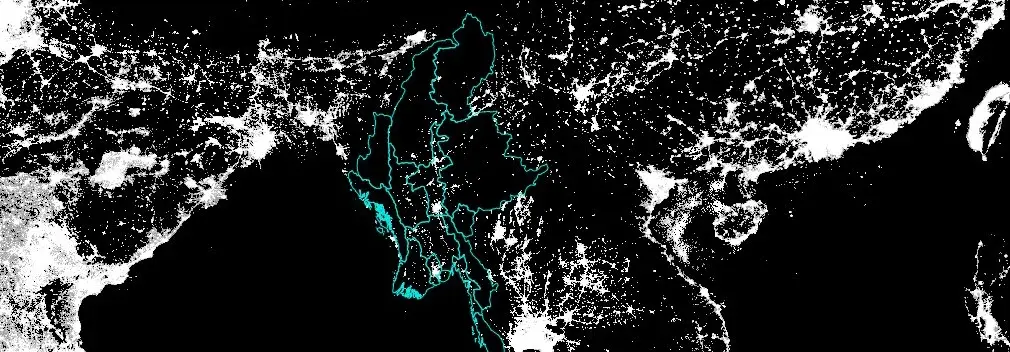
In this specialization we look at how national social policy links up with international efforts of reducing poverty through development aid. We identify trade-offs in policy design of anti-poverty measures (e.g. read more here and here). Similar, we look at how aid and domestic social policies deal with new and growing spatial inequalities in countries such as Myanmar (find out more here and here).
‘Development’ itself is a contested but still dominant concept having a strong and particular resonance with economics. In the specialization, we broaden the perspective by looking at the political and social context of socio-economic policies: how do they arise and what effects do they have beyond the narrow scope of economic growth? In a similar vein, we highlight the fact that knowledge exchange is not a North-to-South one-way lane. Policy learning happens in many directions, though often somewhat underacknowledged.
We also look at specific policy design issues in domestic attempts to reduce poverty and inequality ranging from taxation to social and labour market policies. For instance, there are chronic policy problems in the field in many different regions (e.g. the recent re-nationalizations of private pension systems in Latin America and Eastern Europe. More specifically, we investigate a particular type of policy failure in these areas: instability and boom-and-bust cycles. Why do hopes and expectations in policy interventions sometimes overshoot? Why do good ideas such as microfinance implode after a short time?
Finally, we are interested in addressing new challenges to the welfare regime across the globe. How do social and labour policies respond to international and national migration. What does digitalization and automation do to established systems of social protection and how does it shape new or innovative policies (read more about our Research Project PolDigWork here).
People
-
Vice Director (Willy Brandt School of Public Policy)Gerhard Haniel Professor for Public Policy and International Development (Willy Brandt School of Public Policy)
-
Secretary Gerhard Haniel Professor for Public Policy and International Development (Willy Brandt School of Public Policy)
-
-
-
Doctoral Student (Willy Brandt School of Public Policy)
-
-
-
-
Carmen Niethammer
 Senior Brandt Fellow (Willy Brandt School of Public Policy)
 -
Achim von Heynitz
 Senior Brandt Fellow (Willy Brandt School of Public Policy)








-
Jochen Hauff
 Senior Brandt Fellow (Willy Brandt School of Public Policy)
 -
Marie Gonser

-
Kenny Tam

Special Issue on Policy Innovation in the Global South and South-North Policy Transfer
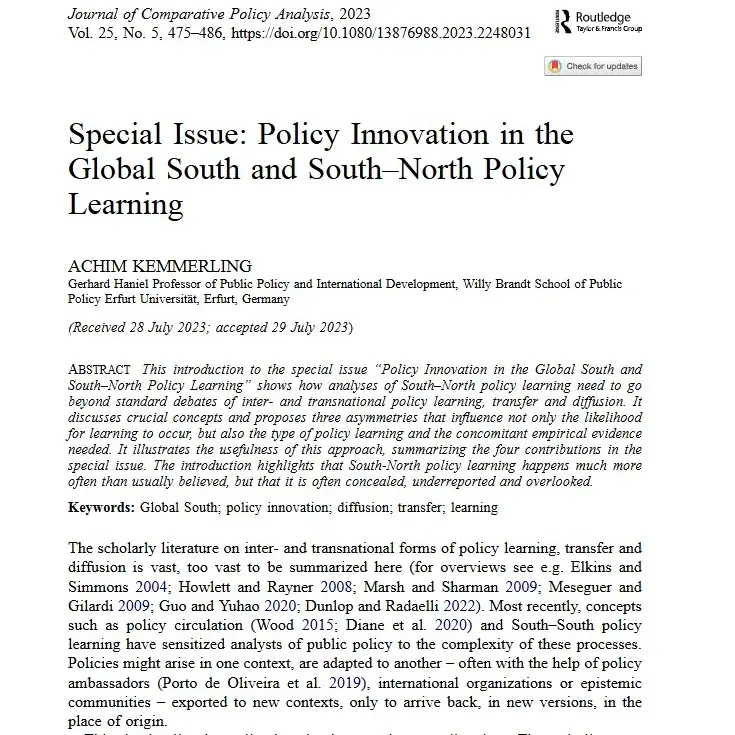
In a new special issue of the Journal of Comparative Policy Analysis: Research and Practice, Prof. Dr. Achim Kemmerling shines a light on the importance of recognizing the policy innovation potential in the Global South and what the Global North can learn from these innovations. Consisting of four contributions from scholars around the world, this special issue covers cases from Latin America, Asia, and Africa to examine instances of South-to-North policy learning. This this type of policy learning occurs more often than one might think, however, it is generally underreported or misrepresented.
Citation: Kemmerling, A. (2023). Special Issue: Policy Innovation in the Global South and South-North Policy Learning. Journal of Comparative Policy Analysis: Research and Practice, 25(5), 475-486
Video: In-Depth with Authors, Journal of Comparative Policy Analysis: Research and Practice
Output
Publications
- Busemeyer, M., Carstensen, M.B., Kemmerling, A., Tosun, J. (2025). Foundations for a green economy: how institutions shape green skills. npj Clim. Action, 4(27).
- Awuni, E.T., & Kemmerling, A. (2023). Taking Gerschenkron to the Field: Attitudes toward Digitalization Hopes and Fears about the Future of Work in Ghana. Telecommunications Policy, 48(2), 102680.
- Awuni, E. T., Malerba, D., & Never, B. (2023). Understanding Vulnerability to Poverty, COVID-19’s Effects, and Implications for Social Protection: Insights from Ghana. Progress in Development Studies, 23(3), 246-274.
- Bokhari, H., & Awuni, E. T. (2023). Digital inequalities in North Africa: Examining employment and socioeconomic well-being in Morocco and Tunisia. Convergence, 30(3), 1149-1169.
- Kemmerling, A., & Makszin, K. (2023). Repackaging in South–North Policy Learning: The Chilean Model of Pension Reform as a Lopsided Exportschlager. Journal of Comparative Policy Analysis: Research and Practice, 25(5), 528–545.
- Kemmerling, A., Altamirano, M. & Rosales, Ma. S. (2023). THE FUTURE OF WORK IN MEXICO: Exploring Key Actors’ Perceptions on the Socio-Economic and Policy Implications of Workplace Transformations. With the Friedrich Ebert Stiftung. (Spanish version)
- Mwonzora, G. (2023). ‘Too many parties and still counting’: in defense of multiparty democracy in Zimbabwe. Politikon, 1-24.
- Mwonzora, G. (2023). ‘Who is patriotic, who is not’? Enactment of patriotism law in Zimbabwe. African Identities, 1-16.
- Fumagalli, M. & Kemmerling, A. (2022). Development aid and domestic regional inequality: the case of Myanmar. Eurasian Geography and Economics, 65(4), 486-515.
- Busemeyer, M., Kemmerling, A., Marx, P. & van Kersbergen, K. (2022). Digitalization and the welfare state. Oxford University Press.
- Iversen, T. & Rehm, P. (2022). Commissioned Book Review: Big Data and the Welfare State: How the Information Revolution Threatens Social Solidarity, Political Studies Review.
- Busemeyer, M., & Kemmerling, A. (2020). Dualization, stratification, liberalization, or what? An attempt to clarify the conceptual underpinnings of the dualization debate. Political Science Research and Methods, 8(2), 375-379.
- Kemmerling, A., Gast Zepeda, S. & Volkmann, S. (2020). On labour market impact of COVID-19.
- Kemmerling, A., Richter, S., & Robiatti, R. (Eds.) (2020). Populism and a new age of international fragility: seeking policy innovations 40 years after the Brandt Report. Erfurt: Willy Brandt School of Public Policy at the University of Erfurt.
- Duman, A. & Kemmerling, A. (2019). Do you feel like an insider? Job security and preferences for Flexibilization across Europe. Social Policy and Administration, 54(5), 749-764.
- Angeles, R. & Kemmerling, A. (2019). How redistributive institutions affect pay inequality and heterogeneity among top managers. Socio-Economic Review, 18(1), 3-30.
- Häusermann, S., Rueda, D. & Kemmerling, A. (2019): Special Issue on New Labour Market Divides in Political Science Research Methods 8(2)
Introduction: How Labor Market Inequality Transforms Mass Politics (with Silja Häusermann and David Rueda), pp. 344-355. - Berens, S., & Kemmerling, A. (2019). Labor Divides, Informality,and Regulation: The Public Opinion on Labor Law in Latin America. Journal of Politics in Latin America, 11(1), 23-48.
- Kemmerling, A., & Neugart, M. (2019). Redistributive pensions in the developing world. Review of Development Economics, 23(2), 702-726.
![[Translate to English:] Facebook Icon](/fileadmin/SocialMediaIcons/iconfinder_06-facebook_104498.svg "Fakebookseite der Staatswissenschaftlichen Fakultät")
![[Translate to English:] Youtube Icon](/fileadmin/SocialMediaIcons/iconfinder_18-youtube_104482.svg)



![[Translate to English:] facebook icon](/fileadmin/SocialMediaIcons/iconfinder_06-facebook_white.svg)

![[Translate to English:] instagram icon](/fileadmin/SocialMediaIcons/iconfinder_38-instagram_white.svg)
![[Translate to English:] YouTube icon](/fileadmin/SocialMediaIcons/iconfinder_18-youtube_white.svg)
![[Translate to English:] xing icon](/fileadmin/SocialMediaIcons/iconfinder_xing_white.svg)
