
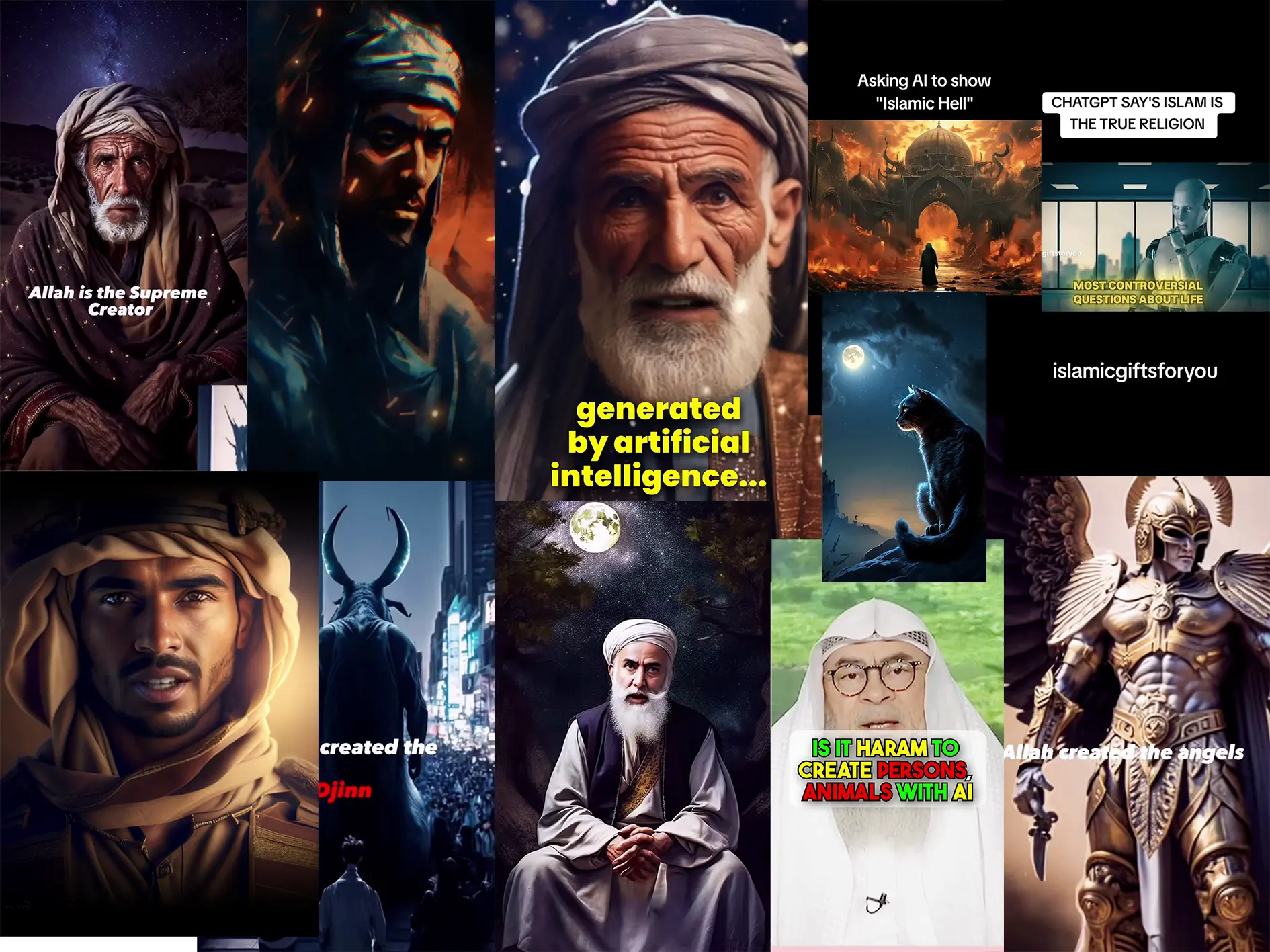
In February, Dr Christoph Günther had been invited by the Global Islamic Studies Center at the University of Michigan to present his research on AI image tools and Islam on social media platforms. Dr Günther is currently a Visiting Research Fellow at the Department of History of Art at the University of Michigan. He presented two case studies to the ways in which Muslim content creators utilize AI-generated texts and images to illustrate Qur’anic passages and hadith narrations, creating visually engaging content to promote ethical guidance and encourage people to a more pious conduct. Dr Günther argues that these actors blend sacred narratives with non-Islamic visual frameworks, hence proposes to understand such AI-generated or AI-enhanced (moving) images as a 21st-century update of the illustrations of Islamic knowledge for an audience that is familiar with the visual language used. His lecture offered insights into how AI technologies mediate religious expression in the digital age and challenges audiences to consider the implications of blending sacred and secular visual vocabularies in the pursuit of piety.
What does the concept of digitality mean and how can we analytically grasp cyberspace? To what extent can hadiths be a medium for a dialogue-based encounter with the Prophet? To discuss these and other questions, the two AIWG research groups ‘Hadith’ and ‘Digitality’ with scholars located at different German Universities, recently met in Erfurt and Giessen for an intensive exchange.
In mid-November, scholars of the AIWG research group ‘Islam and Digitality: Media, Materiality, Hermeneutics’ convened for their first collaborative project meeting in Erfurt. The first part of the workshop focused on theoretical examinations of the concepts of digitality and religion. As part of their exchange, a fruitful discussion on the relationship between orality, literacy and digitality took place. Particularly in European thought, literacy is regarded as a more progressive and credible form of communication. In the religious context of narrating hadiths the tables turn – here, personal oral communication usually counts as ‘gold standard’. Digital communication enables both oral and written communication of religious content, whereby both forms of communication transform. In the second part of the workshop, project scholars presented specific examples from their research. Together with invited expert Markus Brodthage from Martin Luther Universität Halle-Wittenberg, participants tested the documentary method for analyzing religious content on social media platforms such as Instagram and TikTok.
The project module at the Goethe-University Frankfurt focuses on historical narratives in online discourse. Examples from their research included the role of female companions of the Prophet Muhammad in content created by Muslim influencers and the depiction of early Islamic power struggles and civil wars to construct a specifically Shiite historical perspective. The Erfurt sub-project analyses the aesthetics of audiovisual media. Both researcher presented research material on the online presence of Ahmadiyya Muslim Jamaat as well as Muslim online content created by using artificial intelligence. The sub-project on hadith in digital spaces at the Humboldt University Berlin and will organize the next project meeting in May 2025.
The collaborative research project ‘Islam and Digitality’ is based at the universities of Frankfurt am Main, Berlin and Erfurt. For the first time, it deals with questions that have that have so far rarely been the subject of Islamic studies and theology. In addition to asking how digitalisaton affects the shaping of religious practices and the construction of religious knowledge, the researchers explore the following aspects in their multi-year research project: What effects does the use of digital research tools and resources have on Islamic theology as an academic discipline? How do digitally constructed and mediated historical perceptions of Islam relate to current discourses on religious identity and remembrance? How does digitalisation affect hadith collections and their interpretations? How do Muslim theologians use social media to convey their views on what Islam is and how it should be lived, as interpreted, and proclaimed in podcasts, images, and videos?
The research group will present current contributions and news from the project on its website www.islamdigitality.com.

![[Translate to English:] facebook icon](/fileadmin/SocialMediaIcons/iconfinder_06-facebook_white.svg)

![[Translate to English:] instagram icon](/fileadmin/SocialMediaIcons/iconfinder_38-instagram_white.svg)
![[Translate to English:] YouTube icon](/fileadmin/SocialMediaIcons/iconfinder_18-youtube_white.svg)
![[Translate to English:] xing icon](/fileadmin/SocialMediaIcons/iconfinder_xing_white.svg)
