The University of Erfurt is a partner of the Thuringian Competence Network for Research Data Management, which provides information and materials on the subject of "Research data management in Thuringia" on its website. Here on site we advise all members of the University of Erfurt as well as members of the Thuringian universities of applied sciences from the areas of humanities, economics and pedagogy on all aspects of research data management that emerge during research.
The Research Data Management Service located at the library works closely with the Research and Graduate Service and the URMZ. We cooperate with the data protection officer and establish the contact for the publication services of the Electronic Text Center.
For your project, we would be happy to bring the right partners together.
We offfer consultation services on the following topics
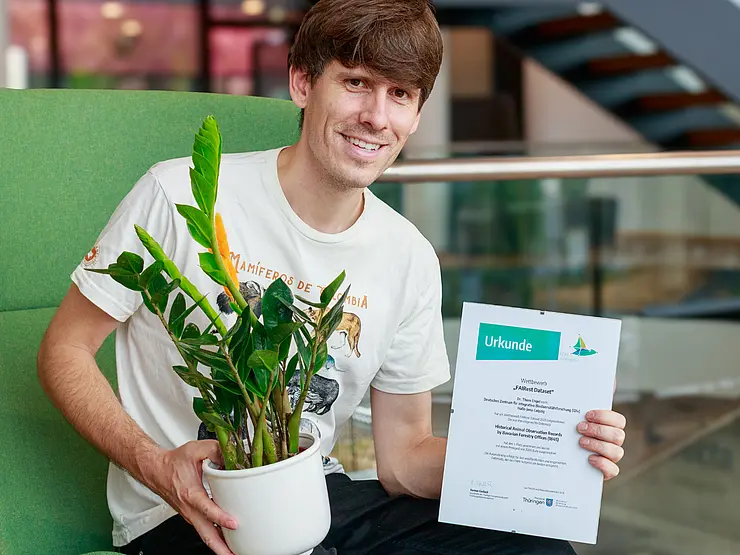
Dataset for biodiversity research honoured with the FAIRest Dataset Award.
Further information on the winning dataset is available on the TKFDM website…
Ordnung der Universität Erfurt zur Sicherung guter wissenschaftlicher Praxis (Ethikkodex)
Research Data Management Policy of Erfurt University (German)
Practical Guidelines on Research Data Management at Erfurt University (German)
DFG Guidelines on the Handling of Research Data
HRK Management of Research Data - a Key Strategic Challenge for University Management(pdf)
Good Research Practice - Guidlines for Sacfeguarding Good Research Practice
Information about the german national research data infrastructure Nationalen Forschungsdateninfrastruktur
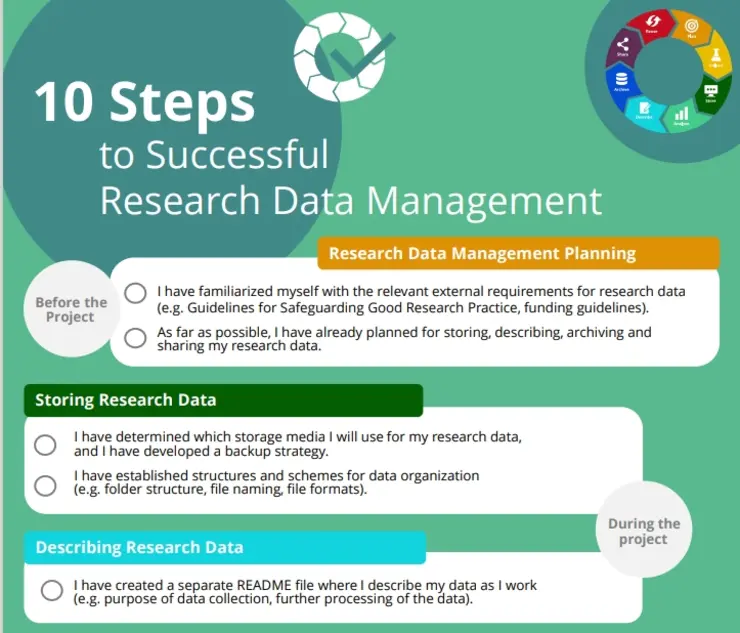
The Technical University of Berlin has published a document with 10 steps to successful research data management.
It links to six additional checklists which explore specific aspects of research data management in greater depth.
TKFDM has adapted these materials for the state of Thuringia and makes them available for reuse.
The TKFDM website with all checklists can be found here.
The checklist “10 steps to successful research data management” provides a general overview of the necessary considerations for an effective research data management strategy. The six individual checklists below each focus on a specific aspect of RDM and provide additional useful sources of information. All checklists are also linked as PDF files behind the images.
We hope you enjoy browsing through them!

Since November 1, 2024, researchers at Thuringian universities have had access to a new service for the publication and long-term storage of their research data. The Repository for Research Data Thuringia ( REFODAT for short) is a generic publication platform for data from all subject areas, especially for those for which no suitable subject-specific repository is available. The publication of research data is free of charge for all researchers at Thuringian universities.
Data sets can be submitted at any time via the refodat.de website. An editorial team supports the submission process and ensures, among other things, that data complies with the FAIR principles as far as possible. In addition, the repository provides interfaces that make it possible to transfer collected and possibly curated holdings from other systems (e.g. work platforms) that cannot guarantee permanent availability. The assignment of a DOI, the linking of data authors and datasets with additional identifiers and resources (including ORCIDs, ROR, GND) as well as export and citation functions (such as JSON-LD or BibTeX) are supported. Data sets from researchers at Thuringian universities that have already been published in other subject repositories can be registered in the repository and the metadata transferred.
The service was developed by the Thuringian Competence Network for Research Data Management (TKFDM), the Thuringian Library Service Centre (BSC) and the IT Centre of the Thuringian Universities (HS-ITZ) and funded as part of the strategy for digitization in the higher education sector (2021-2025). Permanent operation is ensured by the participating organizations.
Further information on the service can be found on[nbsp] our activities page on REFODAT.
An initial overview of how the repository works was given in a 30-minute coffee lecture on December 10, 2024. Slides and video recording of this event can be found on the event website. Further introductory events will follow in the course of 2025 and will be announced here and on the TKFDM's event websites.
Are you a member of the University of Erfurt and would like to better manage and process the data in your research or working group?
Benefit from the Data Steward Pilot Project of the Thuringian Competence Network for Research Data Management (TKFDM)!
On the TKFDM website you will find all the information you need on
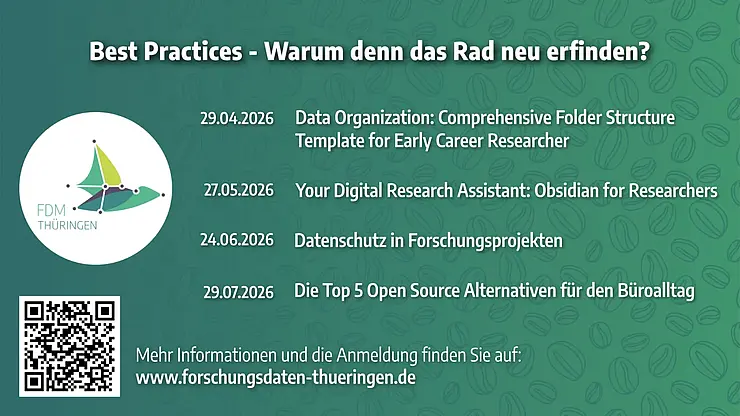
The Thuringian Competence Network for Research Data Management will present the new series of our popular Coffee Lecture series in April 2026!
Every month, an event will take place online via Zoom on a Wednesday. Under the motto "Best Practices – Why reinvent the wheel?", we will introduce you to practical tools and templates that will take your daily work and knowledge management a big step forward.
Among other things, we offer practical tips for solution-oriented discussions on data protection in research projects, Obsidian as a knowledge management tool, a template for folder structure and the Weimar Open Source Initiative.
So find some hot beverage and drop by virtually! It's worth it!
For further information on the topics and registration please refer to the event announcements of the TKFDM.
Text+, the NFDI consortium for text- and language-based research data, offers an open virtual consultation hour in addition to its regular advisory services. During the “Research Rendezvous,” held every two weeks, you can discuss questions, concerns, and ideas related to research data management, language and text data, collections, editions, lexical resources, and the associated software tools directly with Text+ staff at set times (Tuesdays 9–10 a.m. or Thursdays 10–11 a.m.). For more extensive questions, individual (follow-up) appointments can be arranged. Once a month, Text+—in collaboration with NFDI4Culture, NFDI4Memory, and NFDI4Objects—offers a joint FDM consultation session as part of Humanities@NFDI. No prior registration is required. The virtual room is open for the entire hour.
An overview of upcoming events:
Complete the application for travel expense reimbursement (Application in German) in full and submit it to NFDI4Objects, along with the required original supporting documents, by the deadline (cf. application form). Before booking train tickets and accommodations, please be sure to review the instructions regarding travel expense reimbursement on page 3 of the application.
If you are interested in further consortium news you can subscribe to the NFDI4https://www.listserv.dfn.de/sympa/info/n4o-newsletterObjects newsletter (in German).
The historical Vornamentool [hivoto]can be used, among other things, for the identification, data enrichment, and standardization of first names by assigning a probable gender and a standardized spelling to historical spellings.
![[Translate to English:] facebook icon](/fileadmin/SocialMediaIcons/iconfinder_06-facebook_white.svg)

![[Translate to English:] instagram icon](/fileadmin/SocialMediaIcons/iconfinder_38-instagram_white.svg)
![[Translate to English:] YouTube icon](/fileadmin/SocialMediaIcons/iconfinder_18-youtube_white.svg)
![[Translate to English:] xing icon](/fileadmin/SocialMediaIcons/iconfinder_xing_white.svg)

University of Erfurt (Campus)
Nordhäuser Str. 63
99089 Erfurt