Meike Katzek auf der Jahrestagung der ESHS/HSS in Edinburgh
Auf dem Joint Meeting der European Society for the History of Science/History of Science Society (ESHS/HSS) in Edinburgh präsentierte die Erfurter Doktorandin den neusten Stand ihrer Forschung.
Gemeinsam mit Martin Babička, (Institute of Contemporary History of the Czech Academy of Sciences) und Natacha Demoule (Université Paris-Cité - SPHere laboratory) präsentierte Doktorandin und Lehrstuhlmitglied Meike Katzek auf der größten wissenschaftsgeschichtlichen Konferenz des Jahres.
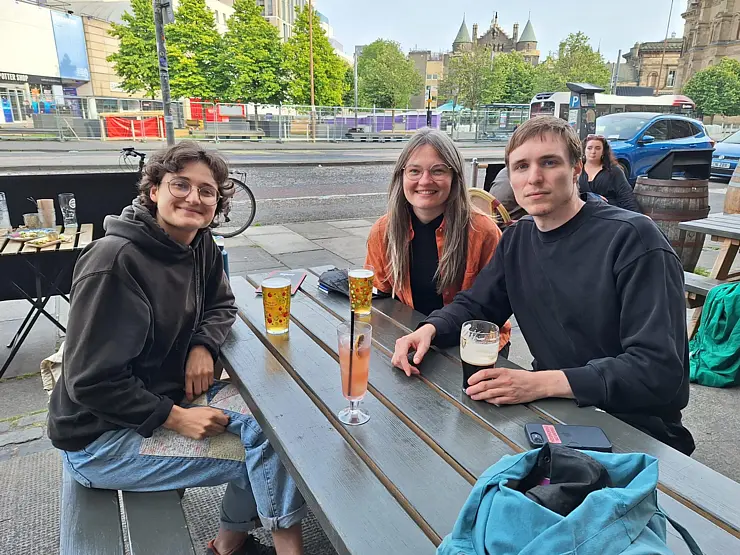
v.l.: Natacha Demoule, Meike Katzek & Martin Babička
Im Panel “Lost in Translation? Science Wars from a Transnational Perspective” am 15. Juli 2026 sprach sie zu “Remembrance, Reunification, and Relativism. Situating the Science Wars in the German Post-Reunification Moment” als Teil ihres eigenen Promotionsprojekts zu den Science Wars:
“The second paper analyses the discursive engagement with the Science Wars and its central issues of scientific objectivity, purity, and the (dis-)unity of science’s in public intellectual debates in 1990s Germany. It engages a perspective of political epistemology, situating the Science Wars in its postCold War 1990s political and cultural moment to tie the philosophical arguments of the debate back to socio-political realities. While politicized accusations were very popular among the debate’s participants, and the political relevance of the Science Wars had been acknowledged early on (Jardin and Frasca-Spada 1997), the historical analysis of the Science Wars focusing on its socio-political contexts and ramifications has not gone beyond analytical reflections by former active participants in the early 2000s (Segerstråle 2000). By reviewing the reception of the Science Wars in post-reunification Germany and situating the epistemological struggles in Germany’s 1990s public debates, more detailed insights into the politics of the Science Wars epistemological arguments can be gained. The reception and discussion of the Science Wars in Germany fell into ongoing public debates about the politics and culture of remembrance of Germany’s national-socialist past and the question on how to integrate the history of East Germany’s authoritarian state into the nation’s history. In these politically heated struggles, for example the Goldhagen-debate (1996) and the debate about the Wehrmacht-exhibition (1995), questions about truth, objectivity, and the role of relativism in academic scholarship – particularly historical scholarship – played a fundamental role. The public intellectual debate is complemented and contrasted by the contemporary academic discussions among German historians of science in literature (Scharping 2001, Carrier 2004) and its two central journals NTM Journal of the History of Science, Technology and Medicine (1960-) and Berichte zur Wissenschaftsgeschichte (1978-).”