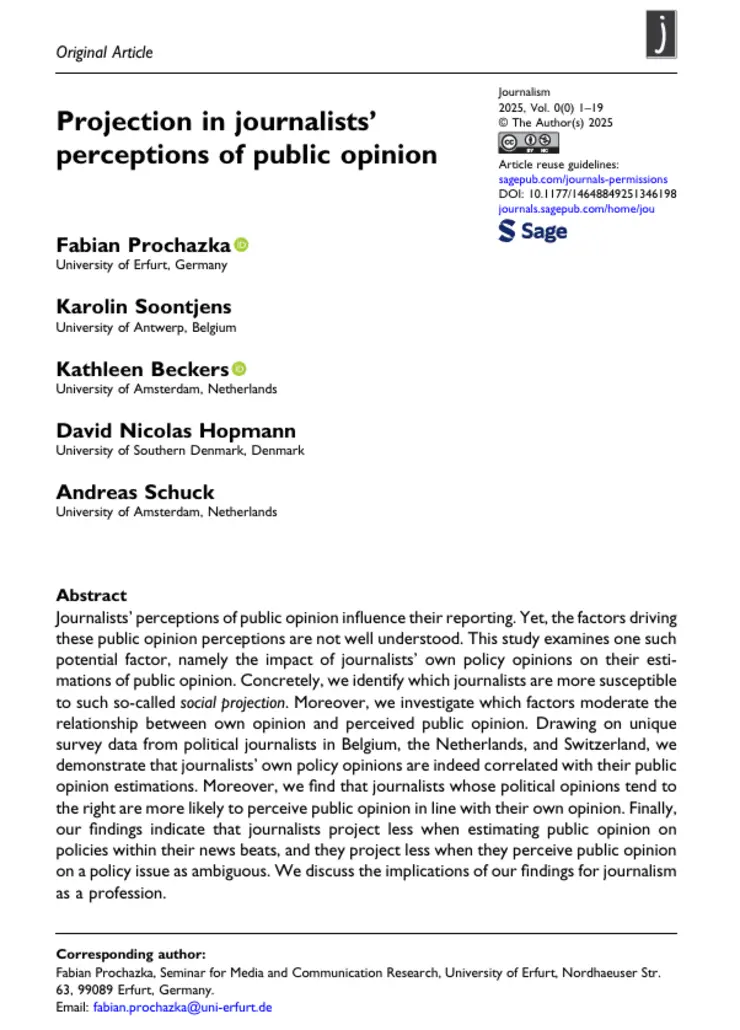
Prochazka, F., Soontjens, K., Beckers, K., Hopmann, D. N., & Schuck, A. (2025). Projection in journalists’ perceptions of public opinion. Journalism, 0(0). https://doi.org/10.1177/14648849251346198
Journalists’ perceptions of public opinion influence their reporting. Yet, the factors driving these public opinion perceptions are not well understood. This study examines one such potential factor, namely the impact of journalists’ own policy opinions on their estimations of public opinion. Concretely, we identify which journalists are more susceptible to such so-called social projection. Moreover, we investigate which factors moderate the relationship between own opinion and perceived public opinion. Drawing on unique survey data from political journalists in Belgium, the Netherlands, and Switzerland, we demonstrate that journalists’ own policy opinions are indeed correlated with their public opinion estimations. Moreover, we find that journalists whose political opinions tend to the right are more likely to perceive public opinion in line with their own opinion. Finally, our findings indicate that journalists project less when estimating public opinion on policies within their news beats, and they project less when they perceive public opinion on a policy issue as ambiguous. We discuss the implications of our findings for journalism as a profession.
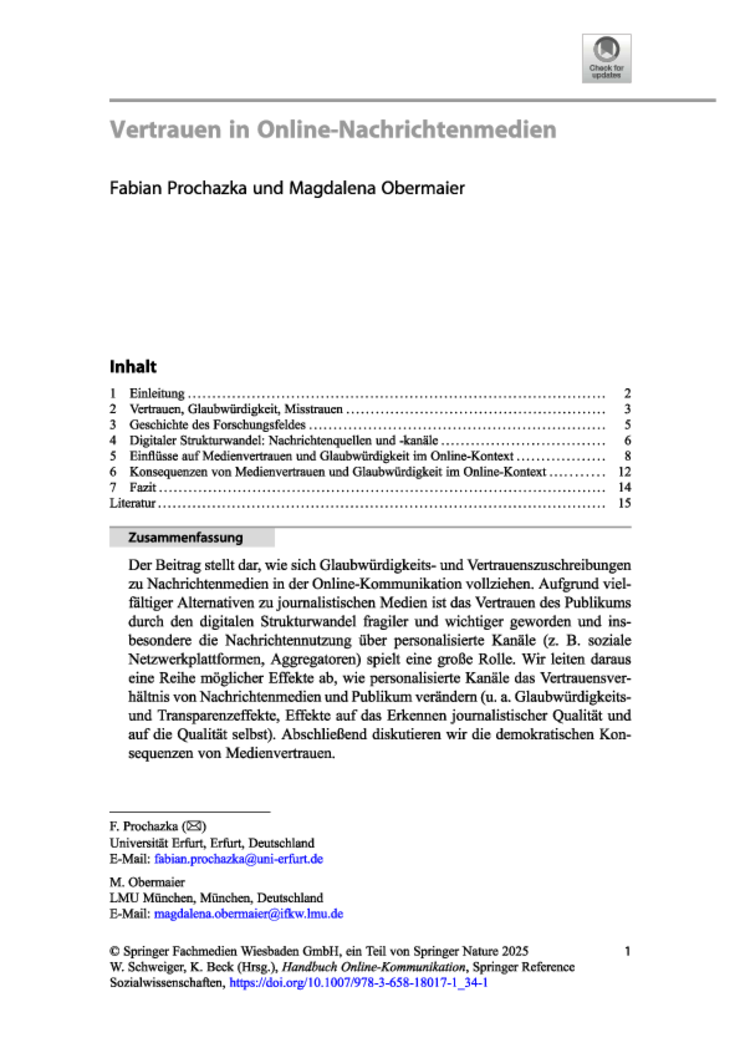
Prochazka, F., & Obermaier, M. (2025). Vertrauen in Online-Nachrichtenmedien. In W. Schweiger, K. Beck, & V. Karnowski (Hrsg.), Handbuch Online-Kommunikation (S. 1–21). Springer Fachmedien Wiesbaden. https://doi.org/10.1007/978-3-658-18017-1_34-1
Der Beitrag stellt dar, wie sich Glaubwürdigkeits- und Vertrauenszuschreibungen zu Nachrichtenmedien in der Online-Kommunikation vollziehen. Aufgrund viel fältiger Alternativen zu journalistischen Medien ist das Vertrauen des Publikums durch den digitalen Strukturwandel fragiler und wichtiger geworden und ins besondere die Nachrichtennutzung über personalisierte Kanäle (z. B. soziale Netzwerkplattformen, Aggregatoren) spielt eine große Rolle. Wir leiten daraus eine Reihe möglicher Effekte ab, wie personalisierte Kanäle das Vertrauensver hältnis von Nachrichtenmedien und Publikum verändern (u. a. Glaubwürdigkeits und Transparenzeffekte, Effekte auf das Erkennen journalistischer Qualität und auf die Qualität selbst). Abschließend diskutieren wir die demokratischen Konsequenzen von Medienvertrauen.
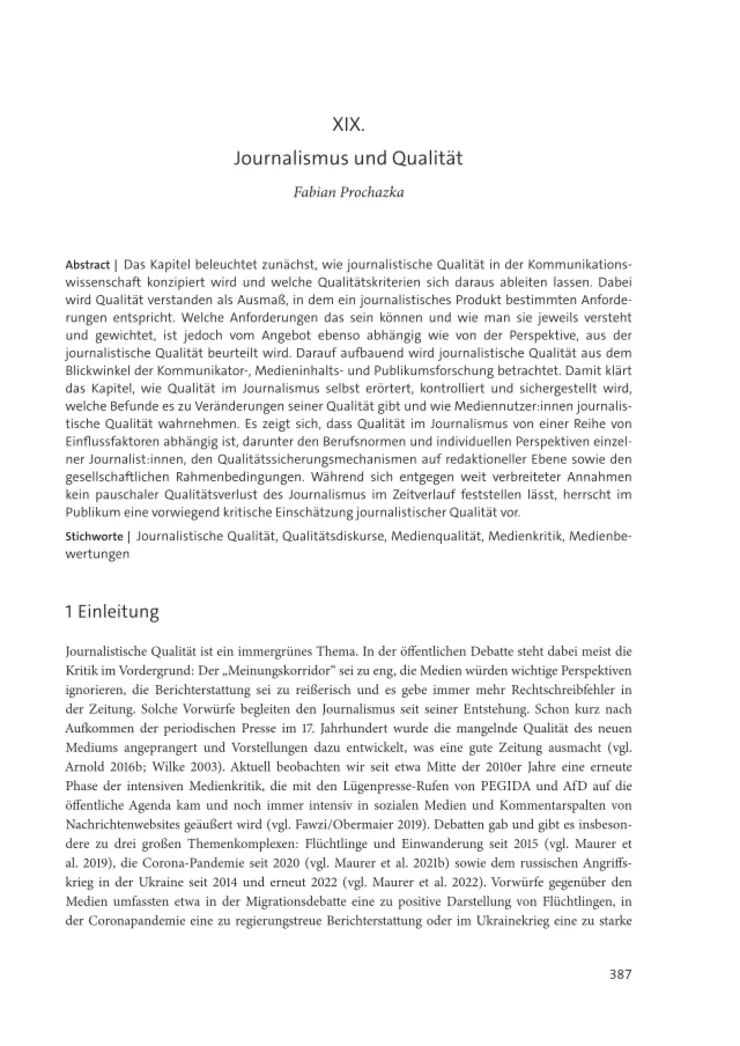
Prochazka, F. (2025). Journalismus und Qualität. In T. Hanitzsch, W. Loosen, & A. Sehl (Hrsg.), Journalismusforschung (S. 387–406). Nomos Verlagsgesellschaft mbH & Co. KG. doi.org/10.5771/9783748932291-387
Der Beitrag beleuchtet zunächst, wie journalistische Qualität in der Kommunikationswissenschaft konzipiert wird und welche Qualitätskriterien sich daraus ableiten lassen. Darauf aufbauend wird journalistische Qualität aus dem Blickwinkel der Kommunikator-, Medieninhalts- und Publikumsforschung betrachtet. Damit klärt der Beitrag, wie Qualität im Journalismus selbst erörtert, kontrolliert und sichergestellt wird, welche Befunde es zu Veränderungen seiner Qualität gibt und wie Mediennutzer:innen journalistische Qualität wahrnehmen.
Prochazka, F., Cantzler, J., Göthert, H., Hartung, S., Konermann, S., Lotz, J., Neureither, E., & Nittel, R. (2025). Self-effects of online commenting in different opinion environments. Communication Research Reports. https://doi.org/10.1080/08824096.2025.2462594
We investigate how commenting on policy-relevant posts in social media affects the opinions of the commenters themselves (“self-effects”). Specifically, we examine whether writing comments affects the valence and strength of preexisting opinions, and how commenting in congruent or incongruent opinion environments influences these self-effects. An online survey experiment shows that writing comments reinforces prior opinions. Self-effects were strongest for participants who had no clear previous opinion, but commenting in congruent or incongruent opinion environments did not influence self-effects. The findings advance our understanding of online discourse and its implications for public opinion, showing that online expression shapes beliefs about socially relevant issues. Open scholarship.
Prochazka F. & Obermaier, M. (2022). Trust through Transparency? How Journalistic Reactions to Media-Critical User Comments Affect Quality Perceptions and Behavior Intentions. In Digital Journalism, DOI: 10.1080/21670811.2021.2017316
User comments to digital news often contain media criticism, detrimentally affecting how others perceive the quality of news and possibly lowering media trust.
It remains an open question, however, how journalistic reactions can mitigate these effects.
Based on premises of engagement moderation, accountability, and transparency in digital journalism,
we conducted an online experiment investigating how critical user comments and journalistic reactions affect quality perceptions and behavioral intentions towards a news media brand.
Results show that media-critical comments lower perceived brand quality, but only among media cynics, whereby increasing it among media supporters.
Journalists admitting mistakes only enhances perceived brand quality for media cynics, while denying does so for everyone and decreases cynics’ intention to comment negatively.
Lastly, explaining why a mistake was made or not boosts brand quality perceptions overall, suggesting that transparency is a viable strategy for improving media trust in the long run


Universität Erfurt (Campus)
Nordhäuser Str. 63
99089 Erfurt