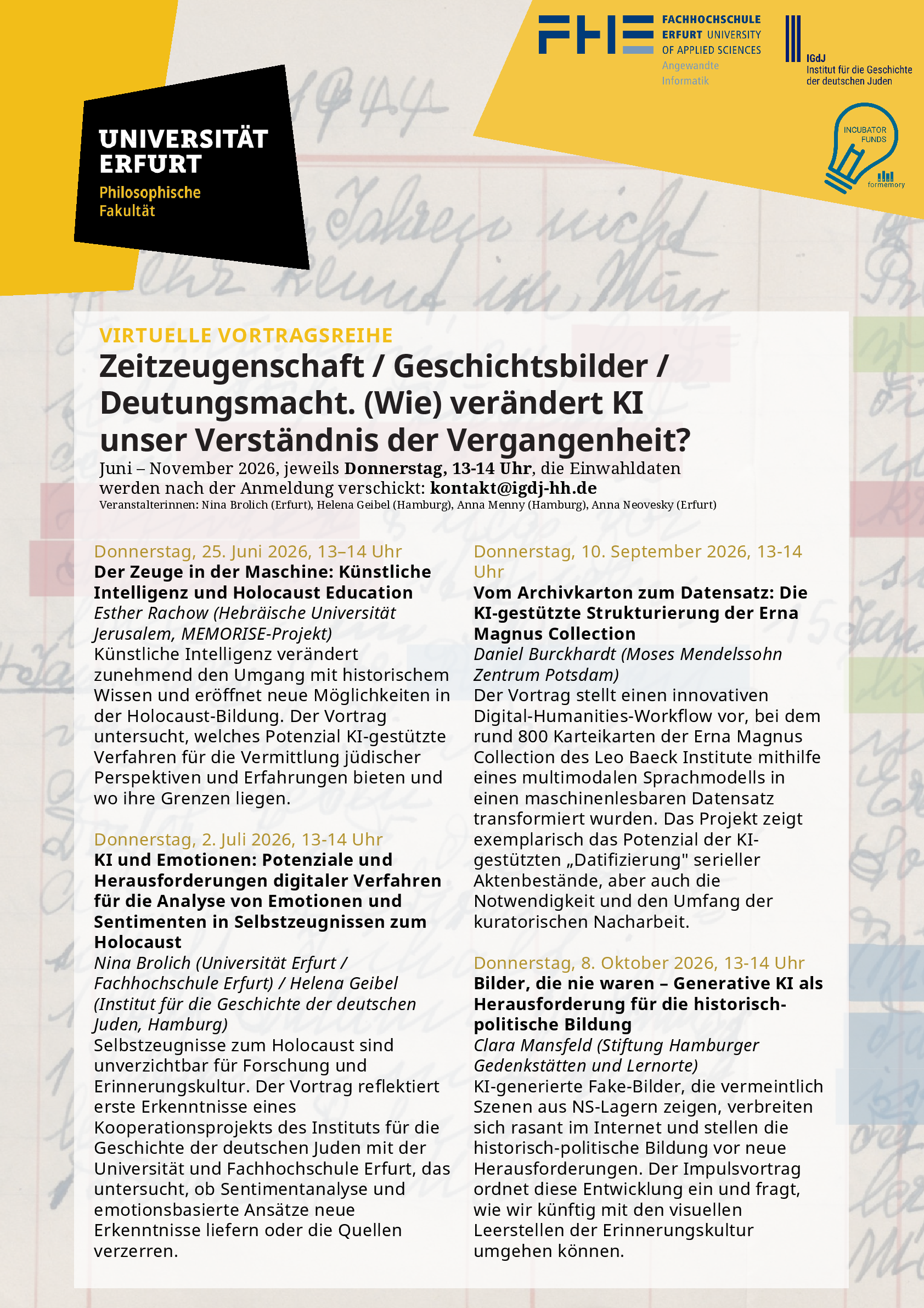
Digitalisation and artificial intelligence are fundamentally changing how we research and understand the past. The automatic analysis of huge amounts of data, pattern recognition in texts and images and the generation of content are opening up new forms of knowledge production and changing our understanding of sources. The use of AI requires new forms of source criticism and an awareness of the limits and power of algorithmic systems.
Various aspects will be considered as part of the lecture series: AI and Holocaust education, the potential of machine learning in analysing emotions in self-testimonies about the Holocaust, the use of AI in structuring historical research data and AI-generated images in the context of Jewish history and the Holocaust on social media.
The guiding questions are: What new possibilities arise for knowledge production? How is our understanding of sources changing? What challenges and dangers arise? How are images of history changing and how is our understanding of the past changing?
Programme
Thursday, 25 June 2026, 1–2 pm
The Witness in the Machine: Artificial Intelligence and Holocaust Education
Esther Rachow (Hebrew University of Jerusalem, MEMORISE project)
Thursday, 2 July 2026, 1–2 pm
AI and emotions: Potentials and challenges of digital methods for analysing emotions and sentiments in self-testimonies on the Holocaust
Nina Brolich (University of Erfurt / University of Applied Sciences Erfurt) / Helena Geibel (Institute for the History of German Jews, Hamburg)
Thursday, 10 September 2026, 1–2 pm
From archive box to data set: The AI-supported structuring of the Erna Magnus Collection
Daniel Burckhardt (Moses Mendelssohn Centre Potsdam)
Thursday, 8 October 2026, 1–2 pm
Images that never were – Generative AI as a challenge for historical-political education
Clara Mansfeld (Stiftung Hamburger Gedenkstätten und Lernorte)
The dial-in details for the lectures will be published after registration at kontakt@igdj-hh.de after registration.

![[Translate to English:] facebook icon](/fileadmin/SocialMediaIcons/iconfinder_06-facebook_white.svg)

![[Translate to English:] instagram icon](/fileadmin/SocialMediaIcons/iconfinder_38-instagram_white.svg)
![[Translate to English:] YouTube icon](/fileadmin/SocialMediaIcons/iconfinder_18-youtube_white.svg)
![[Translate to English:] xing icon](/fileadmin/SocialMediaIcons/iconfinder_xing_white.svg)