Catholic Theology
Degree Profile
Subject of the degree programme
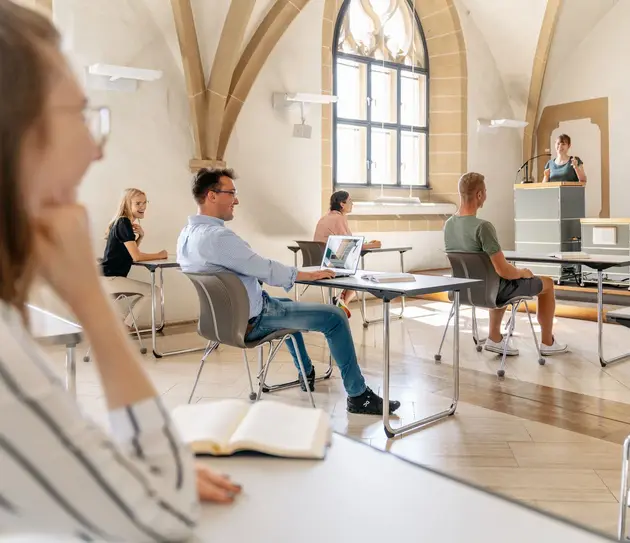
Studying theology involves engaging intensively with the foundations of culture and the sources of one’s own faith. The Master’s degree programme in Catholic Theology, as an undergraduate programme lasting ten semesters (i.e. not building on a Bachelor’s degree) offers an academic education covering the full breadth of the subject within a broad humanities, cultural and social sciences framework.
The programme imparts comprehensive specialist knowledge in biblical, historical, systematic and practical theology. By specialising in particular areas, students qualify for pastoral, cultural or social roles within the Church or wider society.
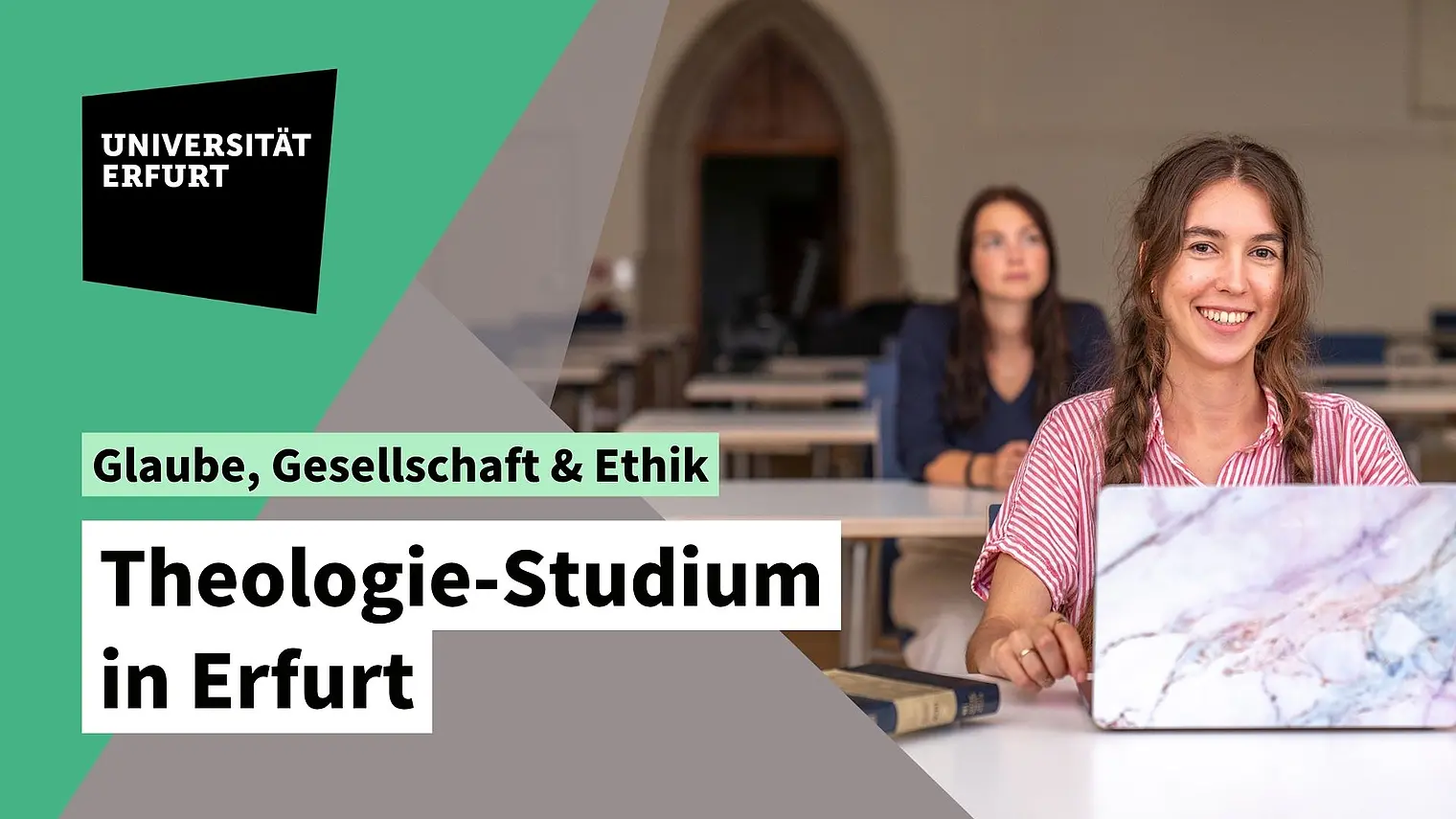
Theology + X = Your degree at the University of Erfurt!
Please note: Once you watch the video, data will be transmitted to Youtube/Google. For more information, see Google Privacy.
Career prospects in theology
The Master’s programme prepares students both for further academic qualifications and for non-academic professional roles within the Church and society, e.g. pastoral work and preaching as part of a church appointment, theological work in the media and in the education sector, etc. Furthermore, the programme’s broad range of topics and methodologies, combined with its clear practical focus, opens up employment opportunities in many areas of culture, education and social work.
Careers outside the church ministry:
- Member of the State Parliament, Head of Office to a Member of the Bundestag or a Lord Mayor, staff member at a state ministry
- Press office clerk, newspaper/radio editor, journalist, PR consultant, press officer, bookseller
- Librarian, staff member/coordinator at foundations
- Municipal housing management, staff member at a social services office
- Head of HR/Head of Department/Managing Director
A career in the church ministry
- Cardinal, bishop, priest, Protestant and Old Catholic ministers, pastoral assistant
- Chaplains for the police, hospitals, prisons, universities, schools and families
- Theological assistant in a university parish or parish worker
- Head of an educational centre, family centre or further education institution
- Religious education teacher, headteacher or lecturer
- Officer in an archdiocesan curia or similar church authority
- Officer responsible for issues relating to sects and world views
- Church musician
- Cathedral guide
Catholic Theology in Detail
Structure of the Master’s programme
The Magister degree programme is a single-subject programme. The standard duration of study is ten semesters, of which two semesters are allocated to the orientation phase, four to the qualification phase and four to the Magister phase. The programme is structured into modules, each consisting of various learning and assessment units.
Orientation phase
The aim of the orientation phase is to provide an introduction to the four subject areas:
- Biblical Theology,
- Historical Theology,
- Systematic Theology, including an introduction to the philosophical foundations of theology, and
- Practical Theology.
Qualification phase
The aim of the qualification phase is to teach key aspects of the Christian faith and way of life through theological reflection. The interaction between the various theological disciplines is crucial to this.
Master’s stage
During the Master’s programme, students build on their existing skills and knowledge, focusing on developing these in greater depth. Possible areas of specialisation include:
- the Old Testament,
- New Testament,
- Early Church History,
- Medieval and Modern Church History,
- Philosophy,
- Christian Social Ethics,
- Dogmatics,
- Fundamental Theology,
- Moral Theology,
- Canon Law,
- Liturgical Studies and
- Religious Education/Pastoral Theology.
The Master’s phase is completed with the Master’s thesis in the chosen specialisation and the Master’s examination.
Examination and Study Regulations, Sample Study Plan & Module Catalogue
In the relevant examination regulations, you will find important information on the programme’s objectives and content, the language requirements, the structure of the programme, as well as the teaching units and module examinations.
Examination Regulations for the Master’s Degree in Catholic Theology 2021 (pdf)
Optional: Semester abroad

Take the opportunity to gain international experience! Thanks to numerous partnerships with universities abroad, you have the chance to spend a semester or a year abroad whilst you’re studying. A stay like this not only broadens your academic horizons, but also strengthens your intercultural and language skills. To help you prepare, the University of Erfurt offers free language courses at the Language Centre.
The International Office is happy to assist with organising your stay abroad.
Internships during your degree
Internships during your degree course
The career-oriented modules are designed to provide an introduction to the practical application of the sources of the Christian faith and to offer initial experience of the practical fields of theology and faith. To this end, students must provide evidence of having successfully completed at least two internships (in religious education and pastoral theology or homiletics).
Open Day & Discovery Days

Open Day
A wide range of information and advisory services give you the opportunity to see for yourself what studying and living in Erfurt are like during the Open Day. Join a guided tour to explore the leafy campus and the beautiful old town centre.
Information and programme: Open Day
Discovery Days
Discovery Days at the University of Erfurt give you the chance to experience university life ‘first-hand’. Over the course of a week (on as many days as you like), you can attend selected courses (lectures or seminars) and get a taste of campus life.
Information and programme: Discovery Days
Order or download information material

Would you like to have a copy of the course brochure? Then request our free information pack with no obligation. You’ll receive it by post, delivered straight to your door, in just a few days.
Order your information pack now!
Don’t want to wait? Then download the brochure now from the Download Centre.
Similar degree programmes
You might also be interested in these degree programmes
Are you interested in Catholic religious education? If so, the following degree programmes may also be of interest to you:
Bachelor’s degree programme in Catholic Religious Education
Teacher training in Catholic Religious Education, grammar school (state examination)
Teacher training in Catholic Religious Education, secondary school (state examination)
Access requirements
Admission requirements for the Master’s degree in Catholic Theology
Studying with A-Levels
- General university entrance qualification or subject-specific university entrance qualification, or equivalent prior learning
General information on entry requirements (studying without a school-leaving certificate)
Language requirements for the Master of Catholic Theology
Language requirements for degree programmes
For the Master’s programme, evidence of the following language proficiency must be provided:
- Latin: the Latinum or an equivalent qualification,
- Greek: Graecum or an equivalent qualification,
- Hebrew: basic knowledge; where applicable, the Hebraicum.
If the required language proficiency and qualifications have not yet been obtained, these can be acquired during the course of study. Recognition of existing language qualifications, as well as individual advice and support, are provided by the Departments of Classical Languages and Ancient Hebrew.
Language Centre
The Language Centre offers around 140 language courses each semester in 16 modern and classical (foreign) languages.
It helps you to acquire new language skills and build on your existing ones.
no admission restrictions (no NC)
What the students say
The Theology degree programme is a very broad Master’s course. It covers the fields of philosophy, ethics/social teaching, dogmatic theology and fundamental theology, canon law, liturgical studies and pastoral theology. It is astonishing how all these subjects are interlinked in their specific aspects and how they are mutually dependent. All these subjects help you develop a highly nuanced perspective on the world and the Church. A warm welcome to the study of theology!

Show moreI think the most surprising thing about this degree programme is its diversity. It brings together a wide range of disciplines. We explore history, philosophy, ethics, religious studies, biblical studies and social issues. We explore questions concerning the origins of biblical texts, the historical development of Christianity, canon law and the ethical challenges of the present day.

Academic Advising

Catholic Theology Students’ Council
Would you like to chat with students of Catholic Theology? Drop them a line or follow them on Facebook and Instagram!
- fskaththeol@uni-erfurt.de
- Facebook: Catholic Theology Students’ Association
- Instagram: Theology in Erfurt
Downloads
Flyer Studying at the University of Erfurt (pdf)
Flyer Studying Theology at the University of Erfurt (pdf)
Flyer Master’s programme in Catholic Theology (pdf)
![[Translate to English:] facebook icon](/fileadmin/SocialMediaIcons/iconfinder_06-facebook_white.svg)

![[Translate to English:] instagram icon](/fileadmin/SocialMediaIcons/iconfinder_38-instagram_white.svg)
![[Translate to English:] YouTube icon](/fileadmin/SocialMediaIcons/iconfinder_18-youtube_white.svg)
![[Translate to English:] xing icon](/fileadmin/SocialMediaIcons/iconfinder_xing_white.svg)
