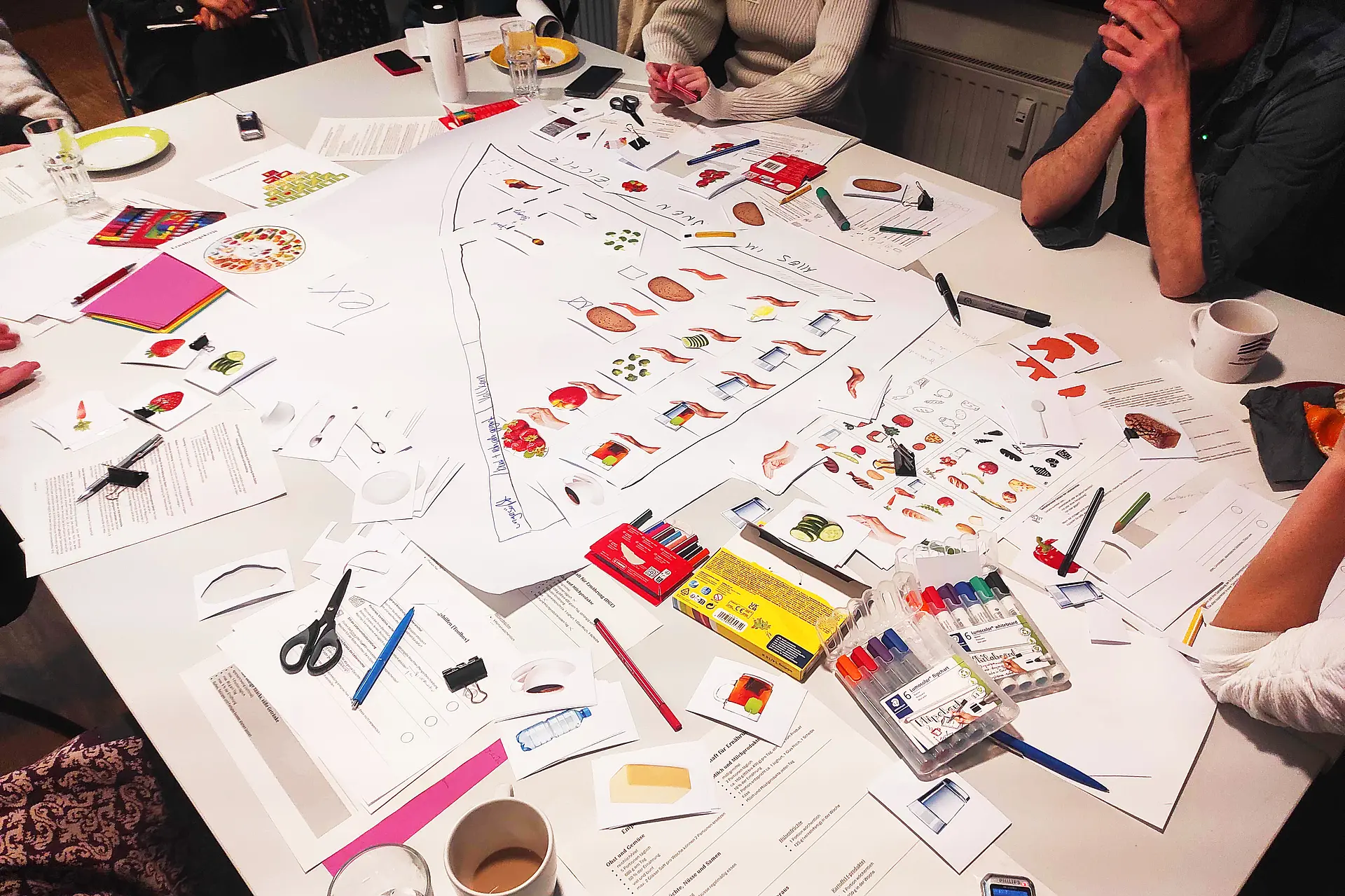
An important part of the project was the participatory involvement of the various target groups. Participants were not merely asked for their views on finished visualisations, but were actively involved in the development process. First, they examined existing representations such as the DGE Food Circle and the Food Pyramid: What is immediately understandable? Where do misunderstandings arise? What information is missing? The researchers then conveyed current dietary recommendations during input phases tailored to each target group – for the children, for example, interactively using real food and clear examples of portion sizes. Research communication thus flowed in both directions: scientific knowledge was conveyed in an accessible way, whilst the participants contributed their everyday knowledge, experiences and own ideas to the research process. They then developed their own ideas and prototypes for accessible dietary recommendations – both individually and collectively as a team. Teachers and nutritionists were also actively involved in the development process: they contributed their experiences from teaching and counselling respectively and, on this basis, jointly developed their own visualisation concepts and prototypes.
It was precisely this creative element that highlighted where scientifically developed representations reach their limits in everyday life and where specific challenges with visualisation lie. For many participants, for example, the question of how to intuitively represent recommended quantities and portions proved particularly difficult. Area ratios, hand measurements, portions, glasses or spoons were tried out and weighed up against one another. At the same time, ideas emerged that went beyond a single static graphic: visualisations should be adaptable to different dietary habits or health needs and should not necessarily display all the information at once. In particular, the principle of a simplified basic representation with additional layers of information proved to be one of many insights arising from the workshops. This qualitative work thus helped not only to understand which representations people prefer, but also why certain design decisions appear clear, ambiguous or relevant to everyday life.
Crucially, this involvement did not end with the workshop. The ideas from the focus groups were incorporated directly into the next phase of the project. Particularly where no clear solution emerged – for example, regarding shape, colour, portion presentation, quantity communication or text – different variants were specifically tested in experimental surveys. In doing so, the project went a step beyond the question ‘What do people like?’: it investigated which design supports the actual understanding of dietary recommendations. Among other things, the results confirmed the importance of concrete portion illustrations and clear quantity information. The combination of research literature, specialist expertise, participatively developed ideas and experimental examination ultimately led to the creation of target-group-specific prototypes. The participants’ perspectives clearly shaped these results: participation thus became a unifying element between science and society – and a key building block in making scientific recommendations more understandable not just for, but together with, the public.
It was particularly fascinating to see what people expect from the visualisation of dietary recommendations and what ideas they came up with themselves for a clear presentation. The participants not only provided feedback on existing visualisations, but also designed, discussed and developed solutions themselves. These perspectives were extremely valuable for further research and were directly incorporated into the experimental examination and the development of the prototypes.
Dr Sabine Best, FBDG VISUAL project team
The project ends on 30 September 2026. The results are currently being prepared for scientific publication and, at the same time, adapted for specific target groups. The aim is to make the findings both understandable and accessible to both the specialist community and interested members of the public. In this way, the perspectives developed jointly during the project are intended to continue to have an impact beyond the project’s duration and to support both specialist discussion and the practical communication of dietary recommendations.