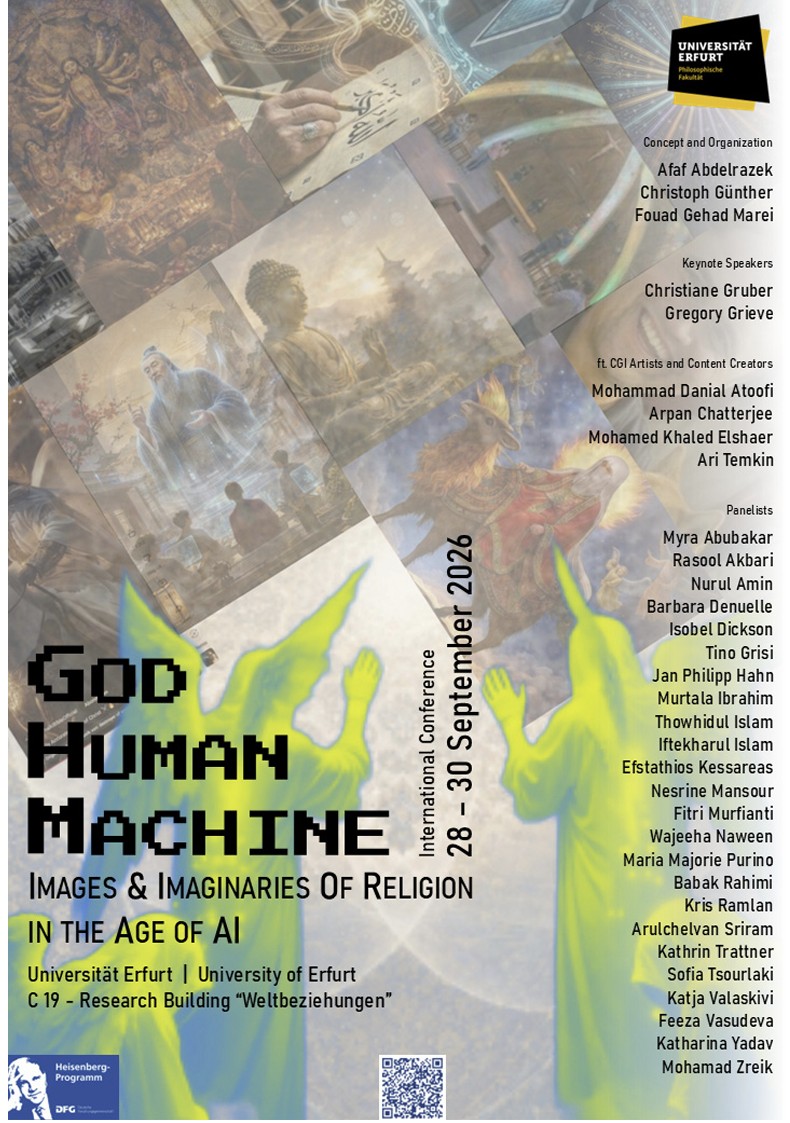
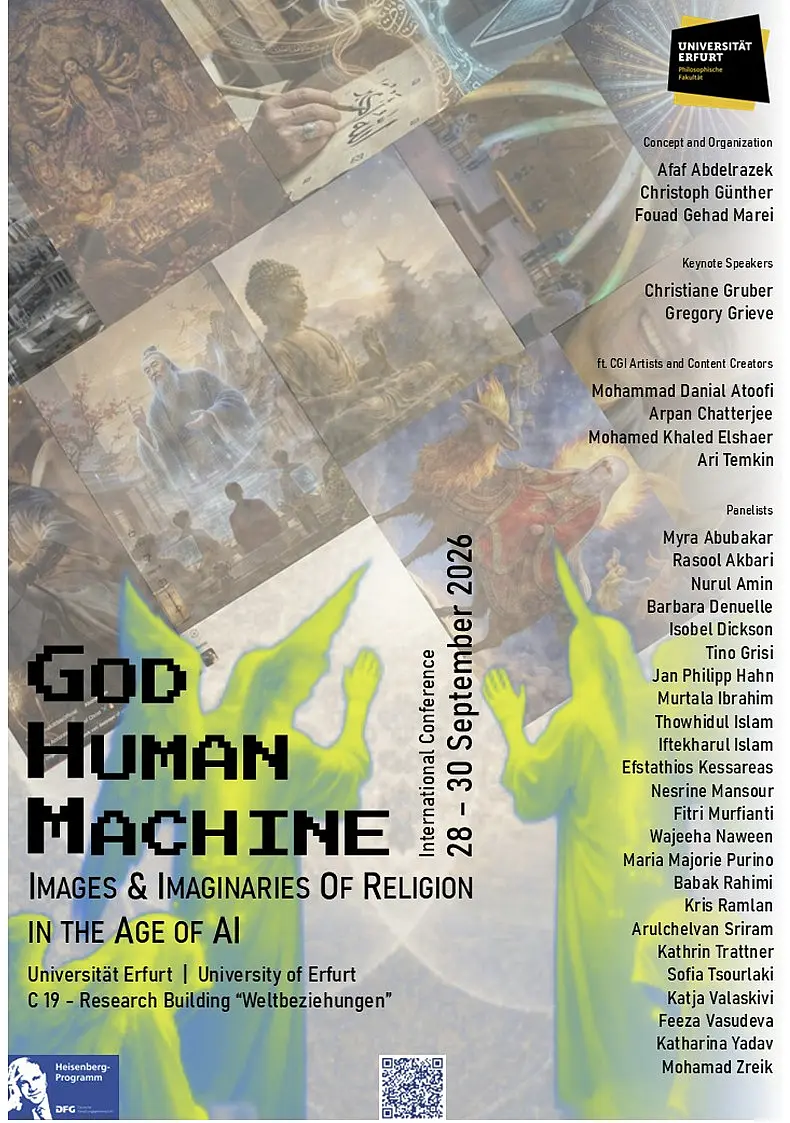
God, Man, Machine: A Conference about Images and Imaginaries of Religion in the Age of AI
Professor Günther, how did the idea arise to organise a conference specifically on the topic of AI-generated images and religion? Was there a specific catalyst?
We see this more as a general trend. Although the opportunities and risks of AI systems are predominantly discussed in relation to language models, we believe it is appropriate to take a critical look – in the truest sense of the word – at AI-generated images and videos and their interaction with specific areas of society – in this case, religions. ‘Seeing is believing’ is an ambiguous proposition that gives us particular food for thought in an age saturated with images, as it also highlights the doubts that, now more than ever, surround digital images and their meanings.
‘God, Man, Machine’ – the title covers a broad spectrum. Could you explain in a few sentences what this conference is essentially about, for someone who has never engaged with the subject before?
Our title ties in with aspects that feature in many debates surrounding AI systems: on the one hand, utopian visions of humanity’s future self-transcendence, in which humans, in a god-like manner, ‘create’ machines in their own image to free themselves from biological limitations; and, on the other hand, apocalyptic scenarios of humanity’s subjugation by intelligent systems. Religious ideas therefore quite clearly play a role in many social and scientific debates concerning the handling of AI systems. These aspects are also playing an increasingly significant role in research on religions. At the same time, many studies focus on language and text, for example in the case of (religious) chatbots or the use of robots in religious contexts. However, the question of the interplay between human imagination, religious knowledge and AI systems in relation to images and videos has so far been largely overlooked. We aim to explore these aspects during our conference with academics and artists.
Why is now, in 2026, the right time for such a conference?
In the field of religion – not least as highlighted by Pope Leo XVI’s encyclical ‘Magnifica Humanitas’ – it is becoming clear that AI systems are playing an increasingly significant role in the production and dissemination of religious knowledge, thereby influencing religious beliefs, values, norms, practices and communities. Alongside religious chatbots that allow users to converse with Buddha or Jesus, or to seek legal advice from Muslim clerics, we are seeing a flood of images and videos created using AI systems that convey religious stories or explain the ‘correct’ way to practise one’s faith. The year 2026 is precisely the right time to address the question of how religion is presented (audio)visually and what significance AI-generated images, videos and sounds hold for believers, religious communities and wider society.
Can you give an example of how AI is already changing or reshaping religious imagery or conceptual worlds today?
One example from my own research concerns the depiction of paradise and hell in videos by Muslim content creators on YouTube and TikTok. This shows that the AI systems used were presumably trained primarily on image data from Christian iconography and computer game worlds. On the one hand, this leads to a loss of knowledge regarding the visual traditions of classical Islamic scholarship, which may result in a ‘standardisation’ of religious imagery. On the other hand, the audience for these images seems hardly to take offence at this and, rather, appreciates the opportunity to form their own picture of end-times expectations.
Does this issue actually affect all religions equally, or are there traditions in which AI-generated images play a particularly significant or, conversely, a particularly minor role?
At the conference, we aim to discuss the similarities and differences with colleagues who specialise in Hinduism, Buddhism, Judaism, Christianity, Islam and polytheistic movements. We warmly invite anyone interested to take part in our discussions.
Do you see this as presenting more opportunities or risks when AI helps shape religious imagery?
I’ll leave that assessment to the members of the respective religious communities. As a researcher, I am naturally interested in their assessment, as it forms part of an emerging phenomenon and the debates surrounding the production and transmission of religious knowledge in the 21st century. So, first and foremost, I am driven by the question: ‘What is it?’ The colleagues taking part in the conference will offer insights into this from their respective fields of research.
Who is attending the conference – is it a purely academic audience, or are there also practitioners, for example from religious communities or the arts scene?
Alongside renowned colleagues from various disciplines within the humanities and cultural studies, we have also managed to attract participants who, as practising members of religious communities and artists, use AI image technologies themselves to express their conceptions of religion. For us, it is essential to engage in an open dialogue with one another.
One item on the programme is a discussion with creators of religious digital images. What can participants expect from this session?
I don’t want to give too much away just yet! A key aspect of this is giving a voice to people whose views and insights are usually anonymised in academic publications and only heard through citations. So we want to bring onto the stage those who, as participants and research partners at academic conferences, are primarily perceived through an academic filter.
A total of seven panels are planned. What are the key questions that will be discussed there?
The programme features two keynote lectures by Christiane Gruber (University of Michigan) and Gregory Price Grieve (UNC Greensboro), as well as seven thematic panels exploring the relationship between human imagination, religious knowledge and AI systems. We will discuss how AI-generated images influence religious practices, rituals and ways of life; analyse creative and critical engagements with AI images and videos in a religious context; and develop global and comparative perspectives on AI images and religion.
Why should anyone outside the academic world be interested in this topic, or to put it another way: what insights from the conference could be relevant to everyday life or to shaping public opinion?
AI systems have become an integral part of oureveryday lives and are an increasingly global phenomenon. Debates surrounding deepfakes, the veracity of news and public trust in media reporting are fuelled not least by the realisation that the technical capabilities for creating and manipulating digital images have improved dramatically in recent years. So if the most technically sophisticated digital images are, so to speak, the ‘most convincing’ and prompt people to act, this raises, in a very general sense, the question of the relativity of reality and, thus, quite fundamentally, the question of the basis on which we as a society wish to live together. The conference’s theme thus also touches on fundamental questions regarding how we deal with AI-generated images – beyond the religious context.
What are your hopes: what impact do you hope the conference will have in the long term, even beyond these three days?
I hope that, together, we will succeed in making a contribution to the debates outlined above and thereby help foster a better understanding of an evolving phenomenon. Furthermore, this conference could mark the start of research initiatives that will put the University of Erfurt on the international map in this field.
Further information / contact:

During the semester break: by appointment via e-mail

![[Translate to English:] facebook icon](/fileadmin/SocialMediaIcons/iconfinder_06-facebook_white.svg)

![[Translate to English:] instagram icon](/fileadmin/SocialMediaIcons/iconfinder_38-instagram_white.svg)
![[Translate to English:] YouTube icon](/fileadmin/SocialMediaIcons/iconfinder_18-youtube_white.svg)
![[Translate to English:] xing icon](/fileadmin/SocialMediaIcons/iconfinder_xing_white.svg)