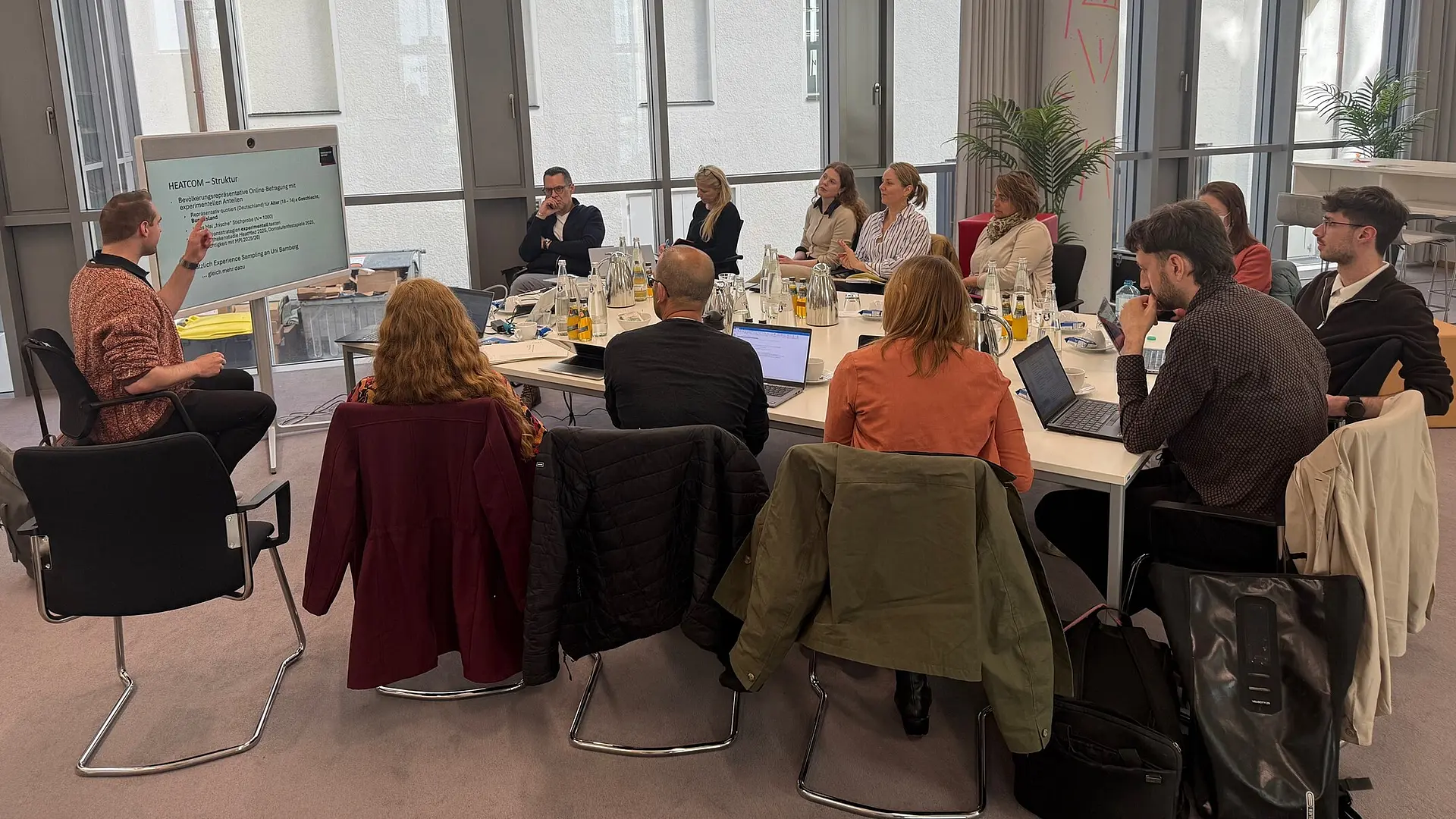
On 29 April 2026, the project team from HEATCOM for an expert dialogue on the strategic further development of heat protection communication in Germany at the Federal Ministry of Health in Berlin.
HEATCOM is a research project of the University of Erfurt and the University of Bamberg. Since 2024, the researchers involved have been investigating how heat protection communication in Germany can be made more effective - including with regard to psychological factors, communication behaviour, risk perception, trust, addressing target groups and specific protective measures.
At the expert dialogue Dr Mirjam Jenny, Dr Dominik Daube, Sarah Pelull (University of Erfurt) and Robert Bruckmann (University of Bamberg) presented current results and discussed with stakeholders from politics and practice how heat protection in Germany can be communicated in a more visible, coordinated and target group-orientated way in the future. Representatives from ecolo, the German Climate Change and Health Alliance (KLUG), the Robert Koch Institute, the Federal Institute of Public Health (BIÖG), Healthy Earth - Healthy People and the Helmholtz Centre Munich were among the participants .
The focus was on questions such as: How do heat warnings actually reach the population? What role do multipliersplay as trustworthy senders? Which messages promote not only risk perception but also specific protective behaviour? And how can existing guidelines, toolkits and communication services be better utilised and bundled?
The discussion has made it clear that heat protection communication needs more than just information. Understandable messages, trust, suitable channels, everyday recommendations and strategies that support people in actually implementing protective behaviour are crucial. Robert Bruckmann summarises:
'Our results from HEATCOM show: Risk perception should not be the primary endpoint of heat protection communication. It is crucial to strengthen people's ability to act: to understand which measures work well for whom and how they can be anchored in everyday life and under stress.

![[Translate to English:] facebook icon](/fileadmin/SocialMediaIcons/iconfinder_06-facebook_white.svg)

![[Translate to English:] instagram icon](/fileadmin/SocialMediaIcons/iconfinder_38-instagram_white.svg)
![[Translate to English:] YouTube icon](/fileadmin/SocialMediaIcons/iconfinder_18-youtube_white.svg)
![[Translate to English:] xing icon](/fileadmin/SocialMediaIcons/iconfinder_xing_white.svg)
