German first? (Zuerst deutsch?)
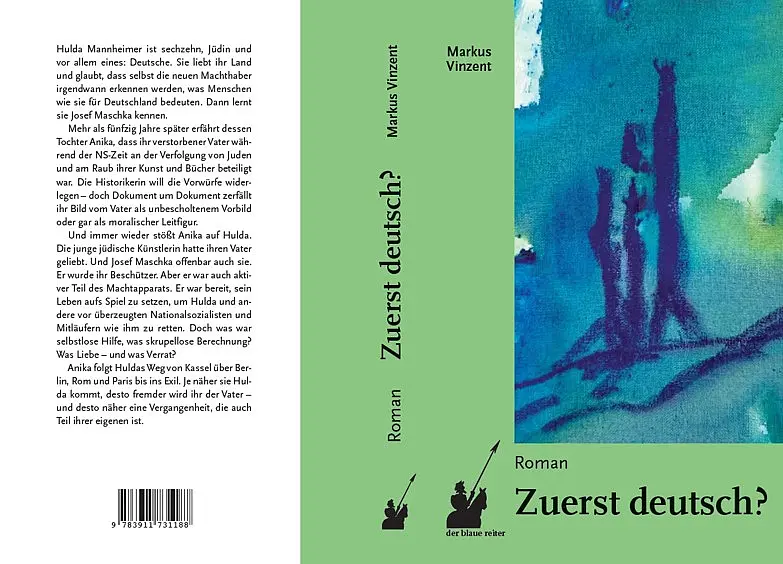
She is a Jewish artist with German nationalist leanings who wants, above all, to be one thing: German. He is a researcher specialising in Meister Eckhart, a staunch National Socialist who takes part in the persecution of Jewish people – and, of all people, falls in love with her. Decades later, his daughter discovers this relationship – and is forced to rewrite the history of her father, her family and her own origins.
On 18 January 2027, the new novel Zuerst deutsch? by Markus Vinzent will be published by Verlag der blaue reiter. It tells the story of the Jewish artist Hulda Mannheimer, who grows up in Germany in the 1930s, becomes involved in nationalist Jewish youth organisations and naturally sees her future as a German. Yet Nazi Germany – to which she initially feels a stronger connection than she realises poses a threat – increasingly denies her the right to belong.
Hulda meets Josef Maschka, who wrote his doctoral thesis on Meister Eckhart and is now a rising Nazi official. A romantic relationship develops between the two that not only crosses social and political boundaries but also puts both of them in existential danger. Maschka participates in the Nazi policies of persecution and expropriation, particularly the plundering of Jewish art and cultural property. At the same time, he tries to save the woman he loves from the consequences of the very system he serves.
Munich, 1991. Art historian Anika Maschka is confronted with her late father’s Nazi past following a late-night phone call. Unable to believe the allegations, she begins to investigate. Whilst conducting academic research into persecuted female artists, she stumbles upon Hulda’s life story – and discovers that her research has unexpectedly turned into an investigation into her own family.
Her search for clues takes her from Kassel via Berlin and occupied Paris to Britain and Africa. Archival documents, diaries and memoirs bring to light a past in which political convictions, personal relationships, artistic ambitions and existential decisions intertwine. The more Anika discovers, the less she is able to categorise her father unequivocally. The man who took part in crimes simultaneously risked both his position and his life to save Hulda. But can such a rescue alter his guilt?
Hulda, too, defies simple categorisation. Her early German nationalist self-image, her artistic self-assertion and her journey through persecution and exile make it clear just how contradictory personal identities and political allegiances can be.
In Zuerst deutsch?, Markus Vinzent combines historical research with a multi-layered family history. The novel tells of love and political blindness, of philosophy, art and dispossession, of flight and survival. Above all, however, it asks what happens when national allegiance is placed above humanity – and when future generations discover that their own history cannot be separated from the history of the perpetrators.
The title Zuerst deutsch? is therefore not merely a historical question. It points to the tensions between national, religious and personal identity, and to the dangers of a mindset that judges people first and foremost by their affiliation.
How German must one be to belong? And what remains of love when one’s own convictions threaten the very existence of the person one loves?
About the author
Markus Vinzent, born in Saarbrücken in 1959, is a historian, theologian and writer. He has taught at the universities of Cologne, Birmingham and Seoul, and at King’s College London. He currently heads the ‘Meister Eckhart’ Research Centre at the Max-Weber-Kolleg, University of Erfurt. In addition to numerous academic publications, he has published the two-volume novel Nicht alle Tage (2025) and Der Schatten der Nähe with the publisher der blaue reiter.