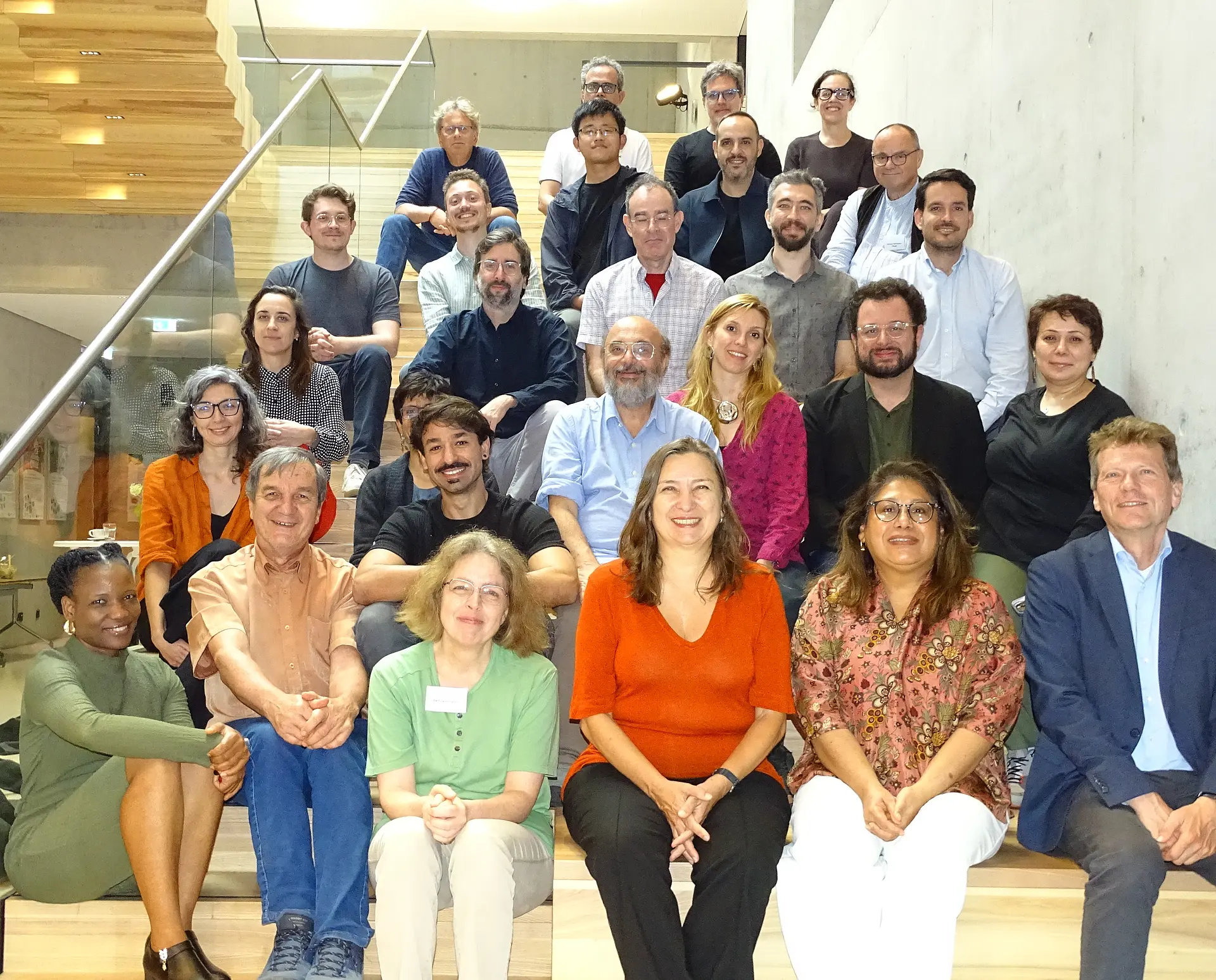
The format of the Intercontinental Academy was developed by UBIAS, the international network of University-Based Institutes for Advanced Study and was held for the fifth time. Two Institutes for Advanced Study from different continents jointly host this event, first for one week on one continent and then, a few months later, on another. On this occasion, the ICA was organised by the Max-Weber-Kolleg at the University of Erfurt and the Institute for Advanced Transdisciplinary Studies (IEAT) at the Federal University of Minas Gerais (UFMG) in Belo Horizonte (Brazil) in cooperation with the Aarhus Institute for Advanced Study. Fifteen postdocs (fellows) from a wide range of countries were selected from a large number of applications to work on their projects with international mentors and develop new collaborative projects. Accordingly, the ICA week featured a variety of alternating formats. Alongside several public keynote lectures and round-table discussions, there were internal project presentations by the fellows, as well as intensive one-to-one mentoring sessions with mentors and meetings for small, newly formed working groups of fellows, designed to facilitate genuine interaction and interdisciplinary collaboration.
Hartmut Rosa set the tone with a keynote lecture on the topic of ‘Pluralities of Resonant Relationships’, in which he addressed the challenges posed by plurality for resonant world relations. These challenges arise not only at the level of concrete relationships between people, or with environments or objects, but also for the concept of world relations theory itself. The keynote lecture therefore encouraged a critical further development of the theory of world relations.
As part of a speed-dating session, the fellows were able to discover shared interests and areas of expertise and form small working groups for joint projects. In this way, seven working groups comprising between two and four people—who had not known one another previously—were formed; during the ICA week, they jointly developed new creative projects which they intend to complete by the next meeting in March in Belo Horizonte. One group (Anna Luiza Coli, Marina Suárez, João Tziminadis) will prepare a transfer event for the meeting in Belo Horizonte on the theme ‘Mediation of artistic creativity in the age of generative AI’, which aims to explore collaboration between researchers and artists. The focus will be on performances with and without AI. A second group (Arthur Bueno, Ernane Salles da Costa Junior) is preparing a workshop for the meeting in Belo Horizonte on the theme ‘No Future – On the Closing and Opening of Temporal Horizons’, which is also intended to lead to a publication. A third group (Sebastián Moreno, Daniel Pucciarelli) is examining normative aspects of critical cultural studies and will organise a panel at a conference in Berlin and develop a joint course based on this. A fourth group (Enno Friedrich, Hisashi Hayakawa) will write a paper on the topic ‘Diodorus. Total Solar Eclipse and Resonance’, which takes an interdisciplinary approach spanning the natural sciences and classical philology to examine the phenomenon of total solar eclipses in ancient texts. Another group (Bharti Arora, Thiago Canettieri) is exploring the connection between space and resonance in the Global South and will write a paper on “Tracing Resonances in Indian Dalit and Brazilian Peripheral Literary Narratives on Displacement”. A sixth group (Priscila Delagado Carvalho, Emily Mashonganyika, Daniel Medeiros de Freitas) is investigating what constitutes communities and what distinguishes them in terms of resonance, focusing on care, food security through agriculture and religion. A joint publication is to be produced based on reciprocal visits to exemplary communities. Finally, a last group (Daniel Medeiros de Freitas, Narciss M. Sohrabi) is examining resonance in carnival movements in Brazil and Iran and will produce a joint comparative article on the subject.
The diversity of topics demonstrates the fruitfulness of the format, which has led to creative ideas and inspiring encounters.
In addition to the keynote lecture by Hartmut Rosa, Leonardo Avritzer also delivered a keynote lecture on the topic of ‘Modernity, the crisis of democracy and resonance’, in which he addressed the crises facing democracy today. Furthermore, two panel discussions took place: one with Patricia Kauark (co-organiser and director of the IEAT in Belo Horizonte), Andras Roepstorff (co-organiser and director of the AIAS in Aarhus), Frederic Vandenberghe (Rio) and Yasmeen Arif (Delhi), moderated by Hartmut Rosa on the topic ‘What does plurality mean in research and do we need resonance with our research objects?’, which sparked a lively discussion with the other participants. In addition, a further panel discussion took place with Hartmut Rosa, Martin Fuchs, Patricia Kauark and Eduardo Soares – moderated by Bettina Hollstein – on the topic ‘How to organise collaboration in contexts of plurality’, which followed the presentation of a collaborative project proposal between the Max-Weber-Kolleg and Porto Alegre, introduced by James William Santos. Alongside the academic exchange, social interactions were also fostered, including at the opening and closing dinners, as well as through participation in the Max-Weber-Kolleg’s summer festival and joint excursions to the research library in Gotha or the Andreasstraße memorial site in Erfurt.
The feedback in the final evaluation of the first week was extremely positive. “This was the best academic event of my life!” said one participant. The working groups and fellow-mentor groups will now continue to collaborate, predominantly online, until they meet again in Belo Horizonte in early March, when the results of both the individual and collaborative projects will be presented.
The Intercontinental Academy was made possible thanks to the generous support of the Ernst Abbe Foundation and the Porticus Foundation.
![[Translate to English:] facebook icon](/fileadmin/SocialMediaIcons/iconfinder_06-facebook_white.svg)

![[Translate to English:] instagram icon](/fileadmin/SocialMediaIcons/iconfinder_38-instagram_white.svg)
![[Translate to English:] YouTube icon](/fileadmin/SocialMediaIcons/iconfinder_18-youtube_white.svg)
![[Translate to English:] xing icon](/fileadmin/SocialMediaIcons/iconfinder_xing_white.svg)
