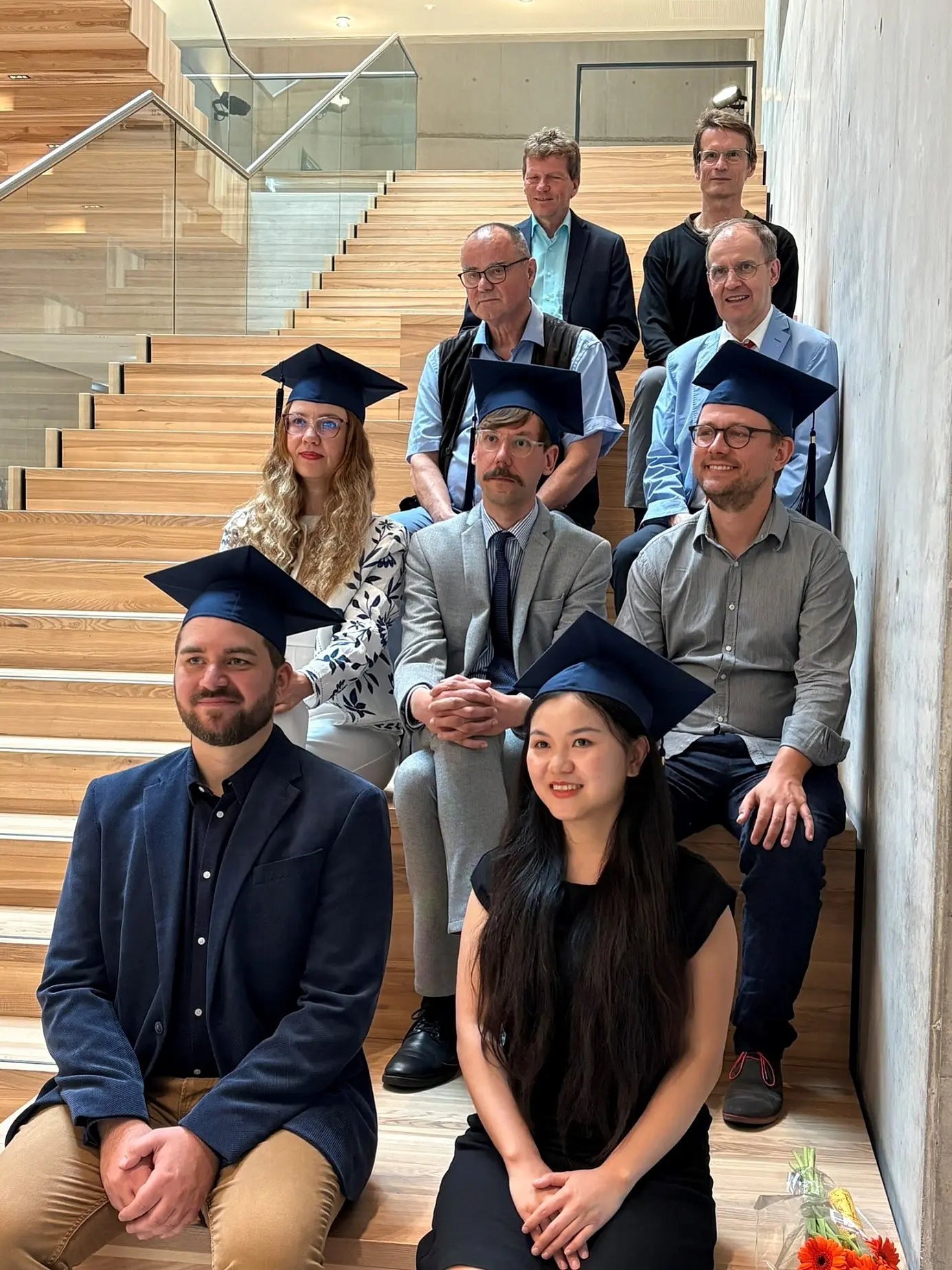
The laudators presented the content and particular merits of the theses in detail. The doctoral thesis “Spatiality, Religion and Body: Relocating Female Experiences in Post-Revolutionary Iran” by Behnaz Ghazi Moradi was honoured by Jürgen Martschukat, who highlighted, amongst other things, the author’s high level of personal commitment and the associated depth of reflection. Hartmut Rosa, standing in for Tilo Wesche and Stephan Moebius, presented Marcus Döller’s thesis “Autonomy as Social Practice: Sociality and Revolution after Hegel”, noting that the author is distinguished by his exceptional erudition and his ability to bring together a wide variety of theoretical traditions. Jörg Rüpke delivered the laudatory address on behalf of Georgia Petridou for Lukas Jung’s work “Between Competition and the Imperial Cult: The Agone of Side and the Cities of Pamphylia in the Tension between Imperial Ideology and Local Identity”, highlighting the successful combination of archaeological empirical fieldwork with social science theories. Hartmut Rosa read out the laudatory address, written by Stephan Moebius, for Anton Röhr’s thesis “Resonance and Negativity: Towards a Critical Theory of World Relations”, which adopts a critical perspective towards Rosa’s own theory. Finally, Carsten Herrmann-Pillath paid tribute to Ling Li’s excellent thesis on “Cultural Governance in China: A Study on the Interaction of State Strategies and Local Lineage Revival”, which was produced within the context of the Collaborative Research Centre on Structural Change in Property Relations and analysed how cultural aspects have an impact on specific property regimes in China.
As the publication of doctoral theses still takes some time following the completion of the examination, it takes a while before the final doctoral certificate can be awarded. Consequently, a tradition has been established of awarding doctoral hats once a year to mark the festive conclusion of this important phase in an academic career. The doctoral hats were presented by the directors of the research group, Hartmut Rosa and Jörg Rüpke, together with the laudators. In addition, a plant (tree or shrub) is now planted each year for the respective cohort around the “Weltbeziehungen” research building, to create a lasting memento and also to contribute to the sustainable development of the campus.
This was followed by the Max-Weber-Kolleg’s summer party, which was also attended by participants from the Intercontinental Academy, a kind of summer school initiated by UBIAS and organised by the Max-Weber-Kolleg and the Institute for Advanced Study in Belo Horizonte, comprising fifteen selected international postdocs and their mentors (from ten countries), who were staying at the Max-Weber-Kolleg for a week to explore the theme “Pluralities of Resonant Relationships”. This was another opportunity not only to have fun at the table football tournament and karaoke, but also to forge international contacts and have interesting conversations.
![[Translate to English:] facebook icon](/fileadmin/SocialMediaIcons/iconfinder_06-facebook_white.svg)

![[Translate to English:] instagram icon](/fileadmin/SocialMediaIcons/iconfinder_38-instagram_white.svg)
![[Translate to English:] YouTube icon](/fileadmin/SocialMediaIcons/iconfinder_18-youtube_white.svg)
![[Translate to English:] xing icon](/fileadmin/SocialMediaIcons/iconfinder_xing_white.svg)
