The rich history of the Casimirianum Grammar School in Coburg is documented not only by its magnificent building but also by a book that has formed part of the school’s core collection since its foundation in 1605 by Duke Johann Casimir of Saxe-Coburg (1564–1633). This is the school register, bound in dark leather, which runs to over 1,000 pages in folio format. Here, the names of the headmasters, teachers and pupils newly admitted to the Secunda were recorded, along with brief biographical details. This was still the case as late as 1826. The content of the lessons is to be reconstructed on the basis of the register and other sources for the winter term of 1826/27 – including pupil lists, lecture schedules, general assessments and report cards for the individual subjects, as well as timetables.
Dr Sascha Salatowsky is Director of the Coburg State Library. In 2004, he was awarded a PhD from the Free University of Berlin with a thesis entitled “De Anima. The Reception of Aristotelian Psychology in the 16th and 17th Centuries”. From 2009 to 2011, he led the DFG-funded research project “Transformations between the Renaissance and the Enlightenment. The Philosophy of the Socinians”. He then worked until 2017 as a research assistant at the Gotha Research Library of the University of Erfurt on the DFG-funded project “Expansion of the Gotha Research Library into a Centre for Research and Study on the Cultural History of Protestantism in the Early Modern Period”. This was followed by a role there as a research officer for press and public relations, science communication, and as an exhibition curator until 2022.
Eine Matrikel für die Schule. Einblicke in den Unterricht am Gymnasium Casimirianum im Jahr 1826
Due to limited capacity, please register by 11 May.
By telephone 0361 737-5530 or by e-mail:
About the exhibition
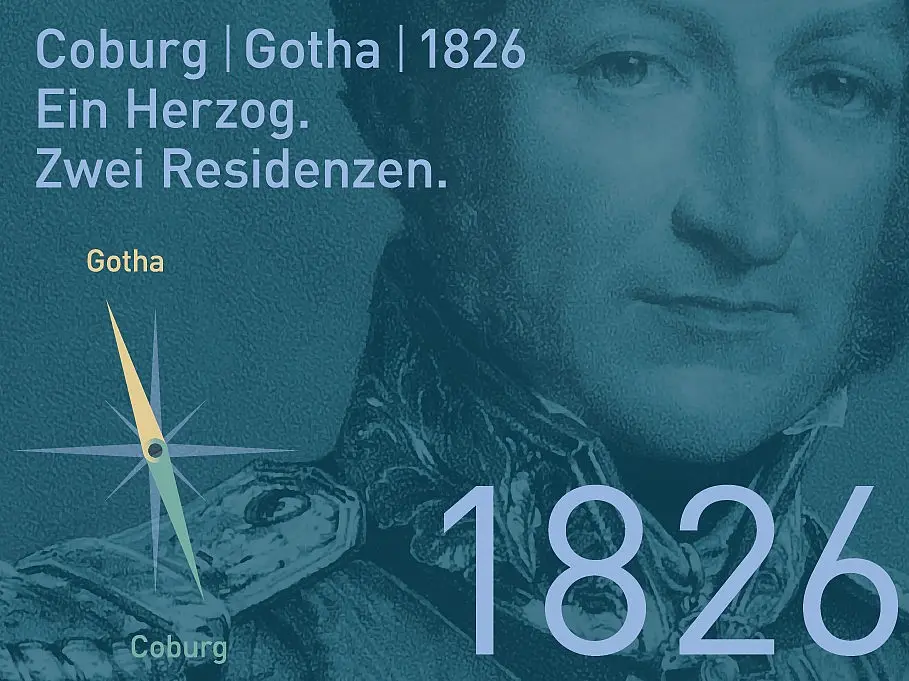
200 years ago, the Ernestine duchies were reorganised and the Dual Duchy of Saxe-Coburg and Gotha was created. Under the title "Coburg | Gotha | 1826", an exhibition at various locations in Gotha and Coburg will focus on the anniversary of the dynasty in 2026: While Duke Ernst I of Saxe-Coburg and Gotha (1784-1844) takes centre stage in Coburg, Gotha traces his networks at court. Who were the people who worked around the duke and shaped the administration and (re)organisation of the collections in the course of the change of dynasty? The anniversary exhibition documents the upheaval in the form of letters of homage in silk and paper and tells the story of the collections through exhibits in silver filigree, majolica, shells and minerals as well as on paper. It shows the breaks in the collections, but also and especially their continuity.
The Gotha exhibition can be seen from 12 April to 5 July 2026 and is a joint project of the Gotha Research Library of the University of Erfurt and the Friedenstein Foundation Gotha. The extensive supporting programme can be found in the flyer or on the exhibition page.
The Thuringian Palaces and Gardens Foundation (Stiftung Thüringer Schlösser und Gärten) is presenting an accompanying exhibition from 12 April 2026 to 3 January 2027 in the ducal apartments in the north wing. Illuminated steles will shed light on the background and protagonists of the events around 1826, in particular Ernst I and his wife Luise. What impact did the reorganisation of the Ernestine territories have on the Thuringian residential landscape as a whole? In addition, the rooms of Duke Ernst I on the Friedenstein will be brought back to life with historical illustrations by Ferdinand Rothbart.
Please also note the events in Coburg.

![[Translate to English:] facebook icon](/fileadmin/SocialMediaIcons/iconfinder_06-facebook_white.svg)

![[Translate to English:] instagram icon](/fileadmin/SocialMediaIcons/iconfinder_38-instagram_white.svg)
![[Translate to English:] YouTube icon](/fileadmin/SocialMediaIcons/iconfinder_18-youtube_white.svg)
![[Translate to English:] xing icon](/fileadmin/SocialMediaIcons/iconfinder_xing_white.svg)
