
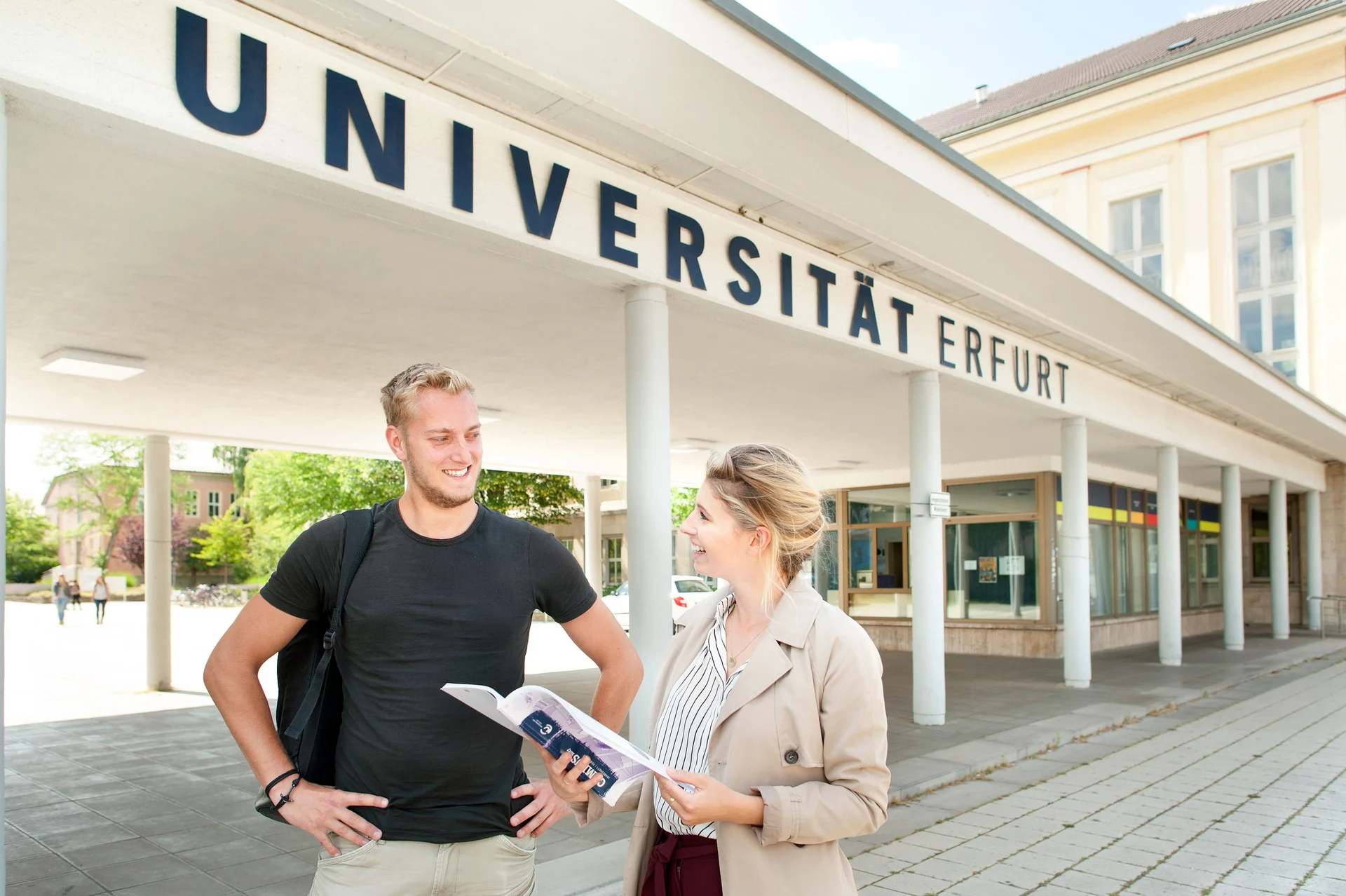
Are you looking for a great place to study and live? Then the University of Erfurt is the perfect choice for you. On our leafy campus, close to the city centre, you can study on more than 50 bachelor's and master's programmes – alongside around 5,600 fellow students, supervised by around 100 professors and other teaching staff.
Small enough to know one another – big enough to change the world
Here, you’re not just a student number – not just another face in the crowd. Here, you know your lecturers and they know you. You’ll be in small seminars and get the support you need. At the same time, you’ll broaden your horizons: with more than 170 partner universities in around 50 countries, the University of Erfurt opens up the world to you. Students, lecturers and researchers from around 90 countries make our campus a place where you’re welcome – just as you are.
Three issues that matter to us
“Education. School. Behaviour.” – “Religion. Society. Relationship with the world.” – “Knowledge. Spaces. Media.” These three areas define our university’s profile. As well as providing extensive specialist knowledge, studying at the University of Erfurt also equips you with important core skills for personal development – ‘skills’ that you’ll need to get your career off to a flying start and perhaps even make the world a little better.

Show moreI decided to study History and German Studies at the University of Erfurt because I was impressed by the city, the campus and – last but not least – the course content. I stayed on for my master's programme because the content of the ‘Transcultural History’ programme once again won me over. Furthermore, I really appreciate the friendly atmosphere in the seminars and on campus.
Did you know?
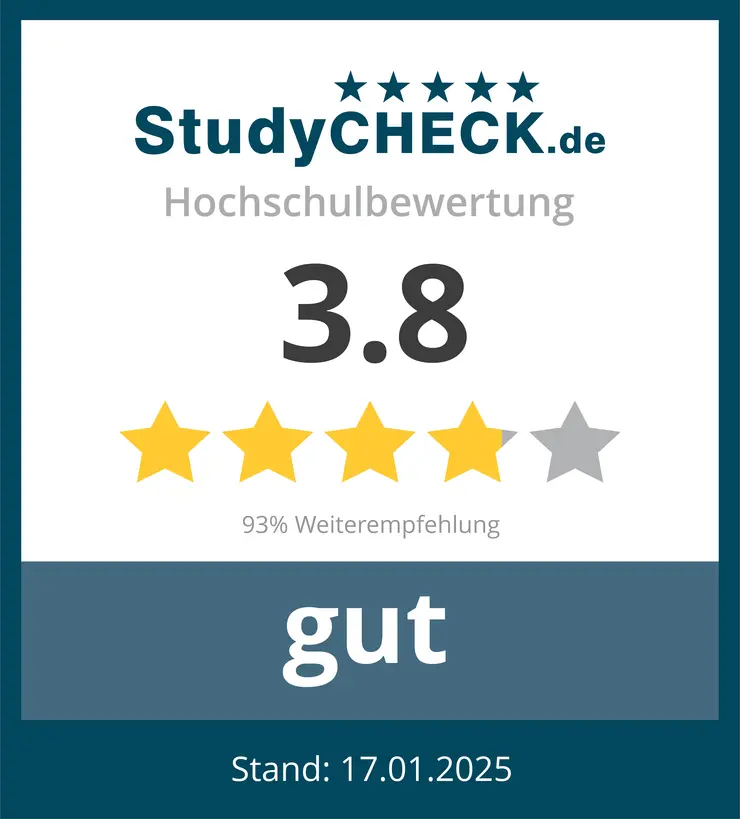
According to the independent platform Studycheck, 93 per cent of our students would recommend us to others. And who knows, maybe one day you’ll be one of them?





Benefits: 10 good reasons to choose the University of Erfurt
Why study at the University of Erfurt? We asked our students and former students what makes their university so special and have summarised their answers in ten points.
Small but lovely
93 per cent would recommend us to others
Independently reviewed on Studycheck
The vast majority of our students would recommend the University of Erfurt – based on voluntary and independent reviews. Take a look at the reviews for your chosen degree programme yourself.
The most popular degree programmes at the University of Erfurt:
International Relations
Educational Science
Psychology of Teaching, Learning and Training
Communication Studies
Primary Education (Primary School Teaching)
Dual-subject Bachelor’s degree
Studium Fundamentale
Thinking outside the box – right from the start
A truly unique feature of the University of Erfurt: as an integral part of the Bachelor’s programme, in the “Studium Fundamentale” you take specific courses from other disciplines, acquire key skills and learn to think in an interdisciplinary way right from the start.
Well-equipped
Short distances
Care and support right from the start
Excellent career prospects
Operating internationally
Living and housing at affordable prices
A-levels – what next?

Vocational education, a degree, a year abroad or an internship to start with? There are plenty of options open to you after your A-levels – so it’s important to think carefully before making a decision. Your personal interests, your own strengths and your career aspirations are the best guide here.
University of Applied Sciences or university? Anyone considering a degree course should ask themselves early on: do I prefer a more academic and theoretical approach – or am I looking for a more practice-oriented start to my future career? Universities have a more generalist focus and offer greater academic depth, more freedom in subject choice and a strong academic education. Universities of applied sciences, on the other hand, focus on a structured, practice-oriented course of study.
At the University of Erfurt, you can obtain your first professionally qualifying degree with a Bachelor’s degree. This usually takes three years. If you wish to explore a subject in greater depth, you can follow this up with a Master’s degree, which lasts a further two years, allows you to specialise or deepen your knowledge, and at the same time paves the way for an academic career, such as a doctorate or habilitation.
Still unsure? Our General Student Advice and Counselling Service will be happy to support you in making the right decision for you.

What makes it special: a dual-subject Bachelor’s degree
At the University of Erfurt, you’ll be studying a dual-subject Bachelor’s degree – which means you’ll combine a main subject with a minor. This opens up more opportunities than studying a single subject alone and gives you a broader base for the job market. Our online tool Studimat shows you which combinations are possible. It automatically takes all combination rules into account and helps you with your planning.

Show moreIn fact, there were several reasons why I chose the University of Erfurt. For one thing, the ‘International Relations’ degree programme is only offered at very few universities in Germany. Furthermore, the dual-subject Bachelor’s programme gives me the opportunity to make my studies more varied. It was also important to me to have good train connections to my home country. Erfurt is very centrally located and, thanks to the ICE hub, I can not only get from Erfurt to Prague quickly, but also to any other destination in Germany.
The Studium Fundamentale
A truly unique feature of the University of Erfurt is the Studium Fundamentale. Integrated into the Bachelor’s programme, this allows you to take specific courses from other subject areas, acquire additional key skills and apply what you have learnt in practice. This enables you to think outside the box right from the start.
The degree programme system
The academic year is divided into two semesters: the summer and winter semesters. The Bachelor’s degree programme usually lasts six semesters, followed by a Master’s degree programme lasting four. All degree programmes are modular in structure – that is, they are divided into self-contained learning units, each of which concludes with an examination. The workload is measured in credit points (ECTS): 30 points per semester, with one point representing approximately 30 hours of study.
The Bachelor’s programme is divided into two phases: during the orientation phase (1st and 2nd semesters), you will familiarise yourself with the study system, try out your subjects and acquire initial foundational knowledge. Once you have successfully completed this phase, you will move on to the specialisation phase (3rd to 6th semesters). Here, you will explore the course content in greater depth and set your own areas of specialisation.
By the way: if, after your first year of study, you realise that a different subject suits you better, you can easily change your subjects – all it takes is a simple application. So your choice of degree programme does not have to be final.



Degree programmes at the University of Erfurt
What degree programmes are available at the University of Erfurt? How can I find a suitable degree programme? Our course catalogue includes almost 50 bachelor's, Magister and master's programmes with good career prospects, including most subjects without an admission quota.







Please note: Once you watch the video, data will be transmitted to Youtube/Google. For more information, see Google Privacy.
Whether it’s science, education, media, culture, politics, public administration or international organisations – a degree from the University of Erfurt opens doors for you. That’s because the dual-subject Bachelor’s degree, the Studium Fundamentale and the integrated internships ensure that you can complete your degree not only with specialist knowledge, but also with a range of additional personal skills.
Our graduates share how their studies have benefited their future careers in the campus blog ‘Ich mag meine Uni’ (I like my uni).
Entry requirements
The first requirement for a Bachelor’s degree programme is a qualification for university entry, usually the Abitur. There are additional requirements for some subjects: at the University of Erfurt, there is an aptitude test for Music, Arts and sport, and a so-called aptitude test for communication studies.

Admission: with or without a numerus clausus
Most of our degree programmes have no entry requirements – in these cases, you simply need to enrol by the deadline. Others have admissions restricted courses. This means that admissions restricted courses determine the maximum grade point average required to be allocated a place on the course. You can find out whether your chosen subject has an NC and what the deadlines are on the website for the relevant degree programme.
At the University of Erfurt, there are only three degree programmes with restricted admission (with an NC):
- International Relations
- Psychology of Teaching, Learning and Training (major only)
- Primary Education (Teaching Profession for Primary Schools)
Important deadlines
Application deadlines vary depending on the degree programme. Make sure you find out in good time – ideally one or two semesters before you plan to start your studies.



Enrolment
You enrol directly on courses with no entry restrictions. For courses with restricted entry, you will receive a letter of offer after submitting your application. This will state the deadline by which you must accept your place and pay the semester contribution. Once you have enrolled, you will receive your student ID card and your enrolment certificates.
A city you’ll love
Erfurt is a compact yet very lively city, and surprisingly diverse to boot. The roughly 10,000 students in Thuringia’s capital will find everything they need for a great time at university: for example, a wide range of cultural and sporting activities, cosy pubs and cafés in the medieval old town, and plenty of green spaces all around. And for those who do feel the urge to travel further afield, the city’s convenient location in the heart of Germany is a real advantage: Berlin is just 1.5 hours away by ICE, Munich 2.5 hours and Hamburg 4 hours – all without having to change trains.

Show moreFor one thing, I was won over by the location – I really like Erfurt as a city. What’s more, the university is a campus-based institution of a manageable size, which helps students to complete their primary school teacher training within the standard period of study. The fair allocation of seminar places, as well as the wide range of sporting and language courses on offer, were also important reasons for me to choose the University of Erfurt.
Housing & Financing
Relatively affordable rents, several residential homes run by the Thuringian Student Services Organisation (Studierendenwerk) located right on campus, and a generally good range of facilities make Erfurt one of the most attractive places to study in central Germany. The Studierendenwerk offers personalised assistance, free of charge, with any queries regarding accommodation, as well as student finance and BAföG.


Campus life
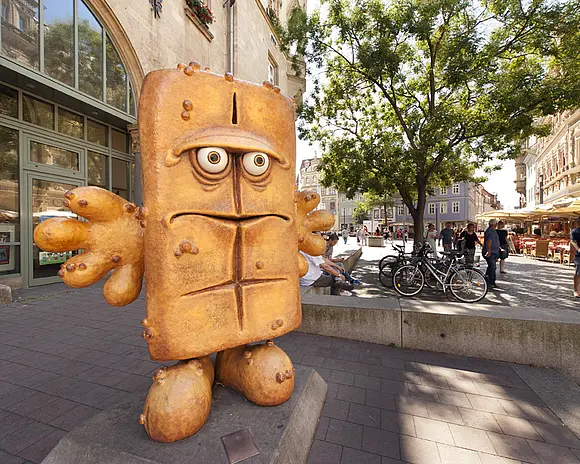
Of course, university life is about more than just lectures and examinations. That’s why there are numerous university groups, student initiatives and, above all, plenty of events at the University of Erfurt. Would you like to have a say and be involved in decision-making? No problem: you can play an active role in shaping the university through the Student Council (StuRa), the faculty student councils and other committees.
Sport
The Erfurt University Sports Club (USV) also offers around 150 courses in more than 80 sports – ranging from football and basketball to yoga, climbing and tango.
Languages & International Affairs
Or would you prefer to learn a language? Whether on your own or in a tandem pair, the Language Centre regularly offers around 140 courses in 16 languages. What’s more, the International Office can help you organise a study visit to one of our more than 170 partner universities in around 50 countries worldwide.

Show moreI decided to spend a semester in Paris on the Erasmus exchange programme. On the one hand, I wanted to put my French language skills into practice as part of my everyday student life and, alongside social sciences and Literary Studies, delve into many other subjects. I was even able to have the interdisciplinary courses recognised as credits towards my ‘Studium Fundamentale’ at the University of Erfurt.



Advice & Contact
Good advice – from choosing your course to graduation
Whether you have questions about choosing a course, the application process or life on campus – we’re here to support you throughout your studies. Make use of our support services:
General Student Advice and Counselling Service
Guidance and advice for prospective students
The General Student Advice and Counselling Service provides personalised advice on all matters relating to your studies, from the orientation phase right through to graduation. If you are unsure who to contact, they will be happy to put you in touch with the right people to help with your enquiry.

The General Student Advice and Counselling Service provides information and advice on the following topics:
- course catalogue
- Study guides
- further education
- Entry requirements
- application
- Admissions restrictions/procedures
- aptitude test
- Aptitude tests
- semester contribution
- re-registration
- Leave of absence
- Change of degree programme
Subject advice and counselling for the degree programmes
Do you have any questions about the degree programme?
Advice on subject-specific issues relating to your degree programme is provided by subject advisers:
- course catalogue
- Combination options
- Course content
- Entry requirements
- application
- Admission restrictions/procedures
- aptitude test
- Aptitude Tests
- Course content and key areas of focus for the subject,
- Study regulations/study plans, examination regulations,
- Academic requirements and evidence of achievement,
- Recognition of previously completed academic achievements (in the event of a change of degree programme and/or university).
They also provide advice and support with personal planning and organising your degree programme (drawing up a timetable, study techniques, exam preparation).
You can find the relevant contact persons on the respective programme pages in our course catalogue.
Open Day & Discovery days

Open Day on 10.04.2027
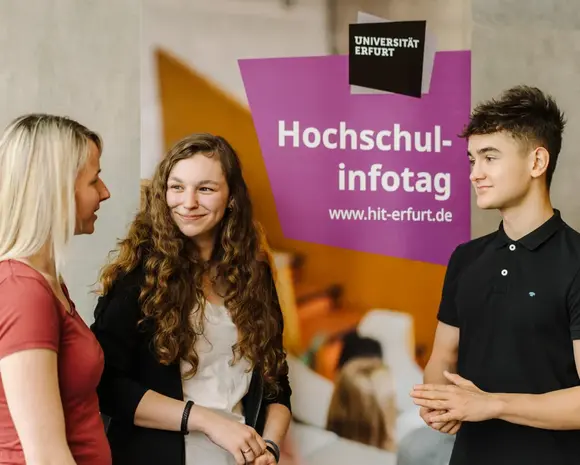
Numerous information and counselling services offer you the opportunity to see the study and living conditions in Erfurt for yourself at the Open Day. Get to know the green campus and the beautiful old town centre on guided tours.
Information and programme:
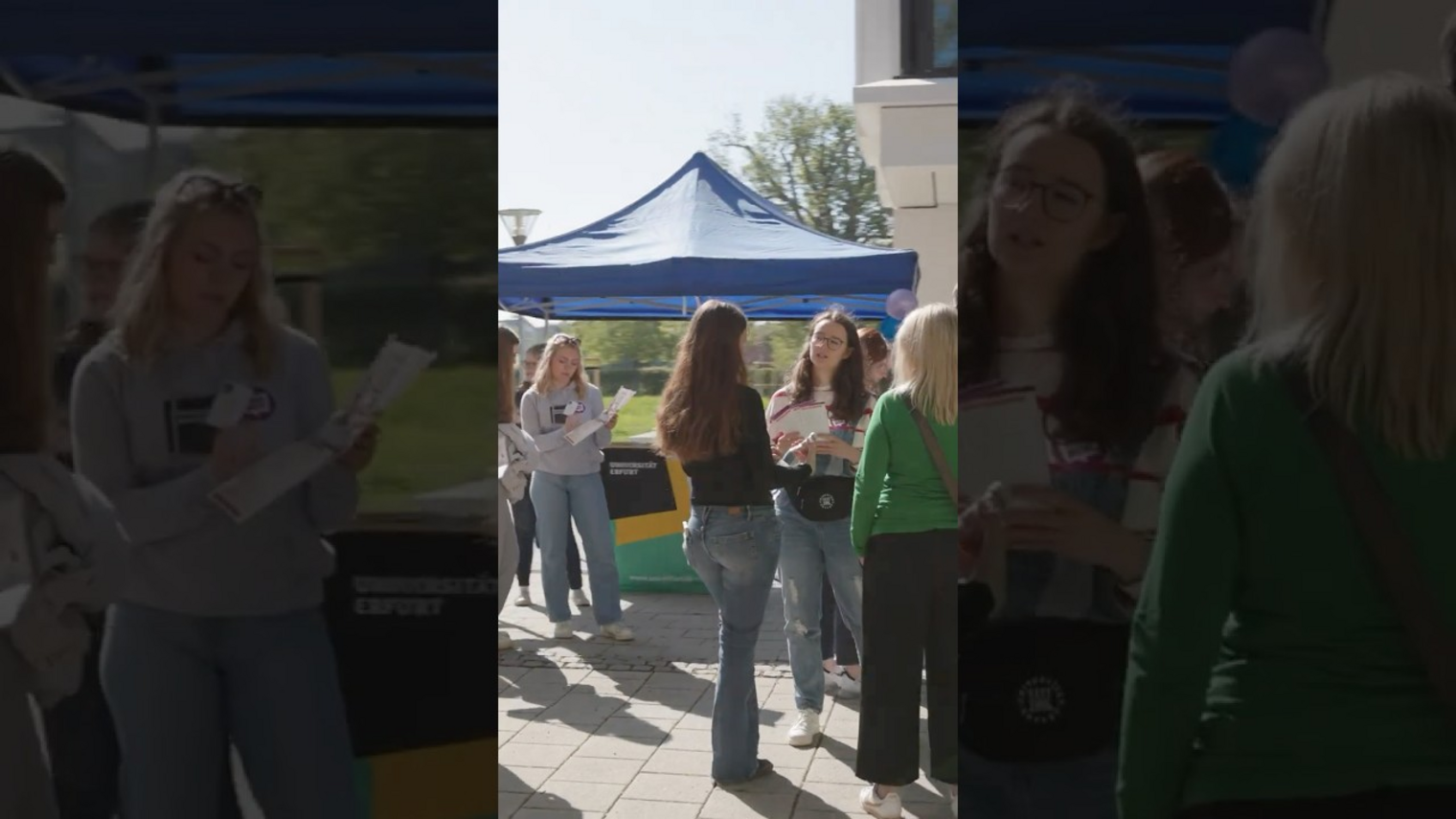
Please note: Once you watch the video, data will be transmitted to Youtube/Google. For more information, see Google Privacy.

Discovery Days 21.06.-25.06.2027
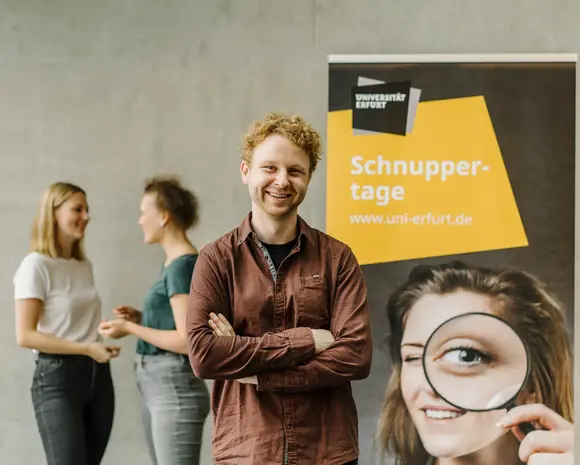
Discovery Days at the University of Erfurt mean experiencing "studying up close". Within a week (on as many days as you like) you can attend selected courses (lectures or seminars) and get a taste of campus life.
Information and programme:

Please note: Once you watch the video, data will be transmitted to Youtube/Google. For more information, see Google Privacy.

Student campus specialists

What’s it like to study in Erfurt? Is it easy to find a flat or a room here? What’s student life like? Is it easy to get to know fellow students? Anyone thinking about going to university has lots of questions. And who better to answer them than current students?
Our campus specialists are on hand to answer your questions. Just get in touch or sign up for a campus tour!
Information on semesters abroad and studying abroad

For student applicants from abroad, the International Office is the first point of contact regarding applications and admission, as well as for any questions or issues that may arise during their studies. A range of integration projects are designed to help students settle in easily and succeed in their studies.
Exchange programmes at the University of Erfurt
Our students can obtain advice and information from the International Office regarding the University of Erfurt’s exchange programmes, as well as study placements and internships abroad.

Show moreThe Open Day and a further visit to the campus gave me the push I needed to enrol to study Economics, Law and Social Sciences - Law concentration. I was interested in law, the use of language and political decision-making. In the end, talking to other students and having a consultation with the subject advice and counselling team proved very helpful. Today I work for a health insurance company as a speaker in contract management and health policy.
Good preparation is everything – then your first day at uni won’t feel like a leap into the deep end. To make settling in at the University of Erfurt as easy as possible, we invite all first-year students to our Student Orientation Days – a structured programme at the start of the winter term, where students from higher years act as your first points of contact: They’ll take you on a tour of the campus, show you their favourite spots, answer questions about everyday student life and share their personal experiences. In addition, there are introductory sessions on academic work, using the university library and the key facilities on campus.
But you won’t be left to your own devices as your studies progress either: as part of the University of Erfurt’s mentoring programme, our Bachelor’s students are supported by a tutor who helps them plan their studies and offers assistance when things get tricky.
This way, you’ll quickly find your feet – and can tackle your degree in a structured way and with confidence right from the start.
Information from the International Office on starting your studies at the University of Erfurt

Fortunately, I got off to a very good start with my studies. Even during the Student Orientation Days, my tutors at the time looked after me very well, and I was able to make new friends quite quickly. Once I realised I wasn’t on my own, things became much easier. Right from the start, I also got involved at university, for example on the student representative council. Through this involvement, I quickly got to know lots of new people.


![[Translate to English:] facebook icon](/fileadmin/SocialMediaIcons/iconfinder_06-facebook_white.svg)

![[Translate to English:] instagram icon](/fileadmin/SocialMediaIcons/iconfinder_38-instagram_white.svg)
![[Translate to English:] YouTube icon](/fileadmin/SocialMediaIcons/iconfinder_18-youtube_white.svg)
![[Translate to English:] xing icon](/fileadmin/SocialMediaIcons/iconfinder_xing_white.svg)
