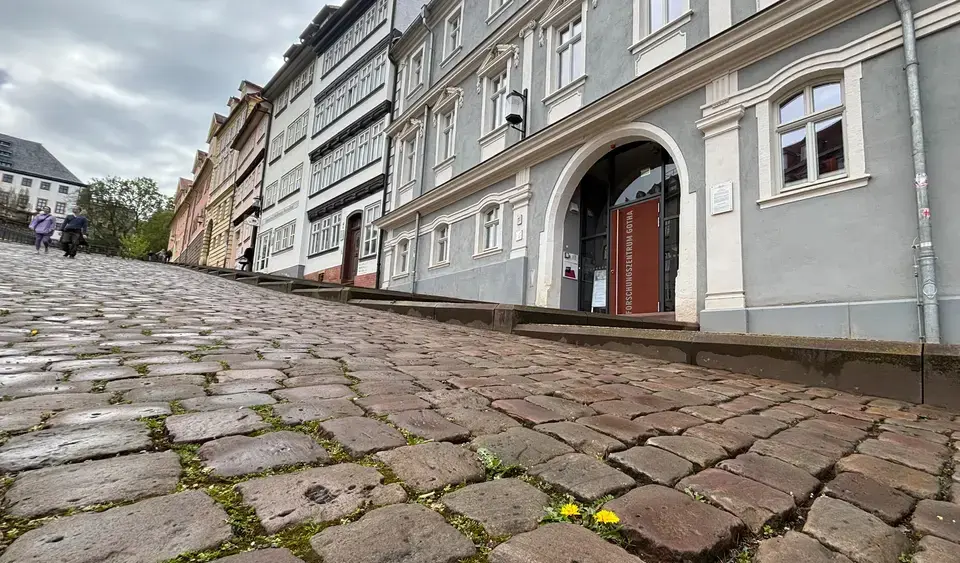
The event is aimed at advanced students during their Master's thesis, doctoral students and postdocs as well as employees of museums and similar institutions with an interest in the history of perception and knowledge in Africa, the history of court culture and the history of objects, books and scholarship in early modern Europe. Accompanied by lectures and guided tours by recognised experts, participants will get to know the rich holdings of the Gotha Research Library, the Friedenstein Foundation and the Gotha State Archives with active participation in workshops.
Since Greco-Roman antiquity, Africa has been regarded as the third continent alongside Europe and Asia. For a long time, Europeans were only geographically familiar with its northern part, while the areas south of the Sahara remained unknown. It was not until the maritime expansion of the Iberian seafarers in the 15th and 16th centuries that they were initially only explored along the coasts. For humanist Europe, the circumnavigation of Cape Boyador, then the crossing of the equator and the circumnavigation of the Cape of Good Hope, which also opened up the sea route to Asia, was a sensation.
This southern movement of European expansion around 1500 was long overshadowed by the so-called discovery of the New World. Unlike America, Africa was neither a new nor a completely unknown continent. The knowledge circulating in Europe about Africa was hardly certain, but this made it seem all the more promising. People believed in the existence of a Christian priest-king John, in a land of gold with fabulously rich rulers, but also in hostile regions populated by strange animals and people.
Today, numerous traces of this interest in Africa can be found in Gotha. The Duchy of Saxe-Gotha was founded in 1640 in the middle of the Thirty Years' War. The first Duke Ernst I (1601–1675) modelled his inheritance into a princely state that was exemplary for the time: he built a new residence, Friedenstein Palace, whose name was also the programme, and carried out numerous reforms in administration, education and coinage. Ernst also promoted the study of Ethiopia and Ethiopian studies, which the scholar Hiob Ludolf (1624-1704) had founded in Gotha. The Abyssinian clergyman Abba Gregorius (1595–1648) was invited to the court to be questioned about the situation of the Ethiopian Christians, their language and culture, as well as many other things. Travellers, such as Ludolf's pupil Johann Michael Wansleben (1635–1679), were also sent to Africa. The ducal library focussed on the collection of travelogues, which continued to grow in the 18th century and resulted in further Gotha trips to Africa.
But why was a relatively small court like Gotha interested in Africa? Why did they collect knowledge about Africa as well as objects from Africa? What functions did these collections fulfil at court? Was this interest in the continent typical of the early modern period? Or was Gotha's Africa a special case of pre-modern courtly culture? The summer school sets out in search of answers...


![[Translate to English:] facebook icon](/fileadmin/SocialMediaIcons/iconfinder_06-facebook_white.svg)

![[Translate to English:] instagram icon](/fileadmin/SocialMediaIcons/iconfinder_38-instagram_white.svg)
![[Translate to English:] YouTube icon](/fileadmin/SocialMediaIcons/iconfinder_18-youtube_white.svg)
![[Translate to English:] xing icon](/fileadmin/SocialMediaIcons/iconfinder_xing_white.svg)
