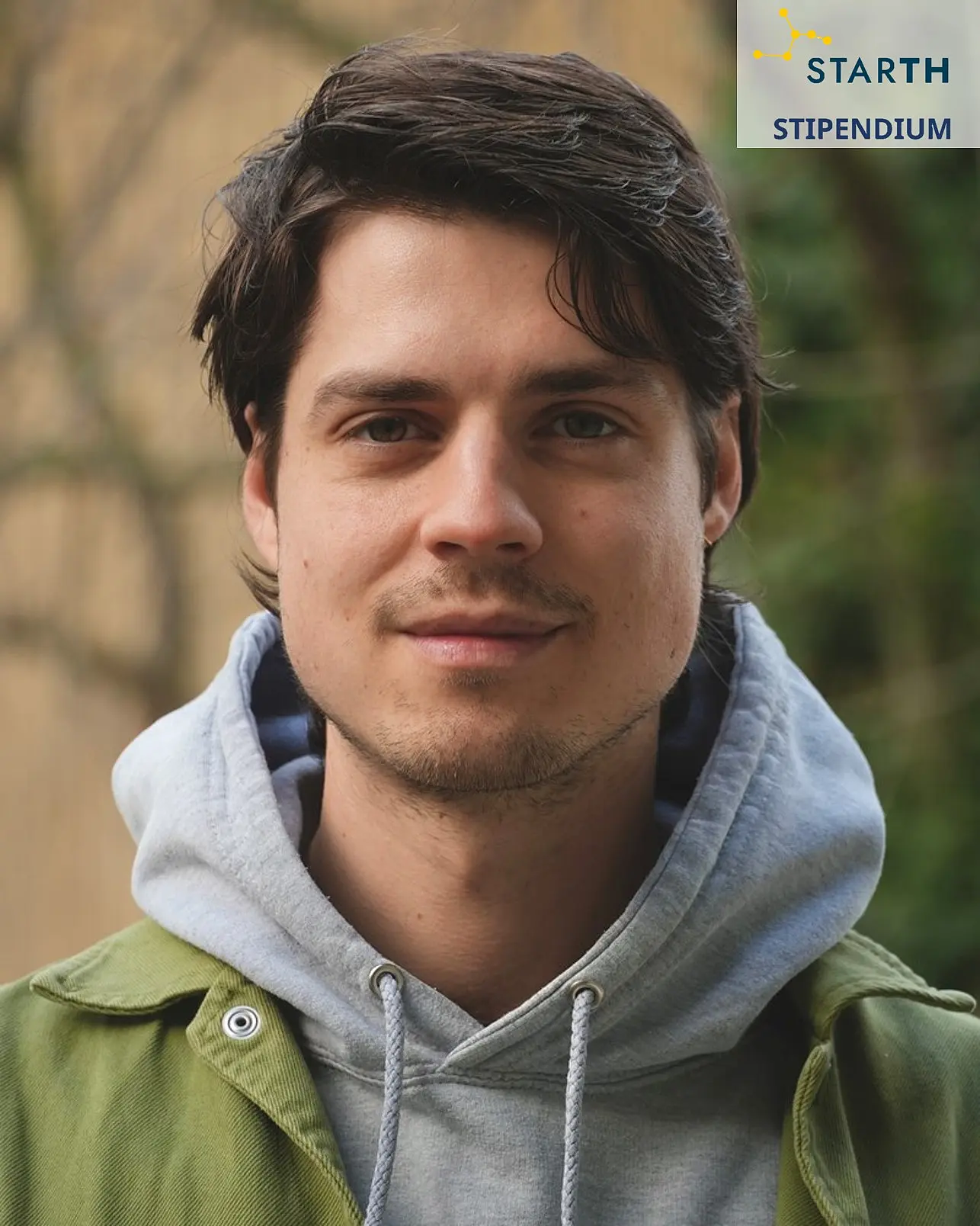
"Turning ideas into the future - reports from founders at the University of Erfurt"
The University of Erfurt supports students, academic employees and graduates on their path to self-employment. The StarTH start-up scholarship gives prospective founders the opportunity to develop their ideas further, build networks and prepare for the step into a start-up.
In our interview series, scholarship holders have their say: they talk about their experiences, successes, challenges and plans for the future. In this way, we want to provide insights into the everyday life of a start-up and at the same time encourage them to put their own ideas into practice.
Getting started - your motivation and your background
1. Would you like to briefly introduce yourself? Who are you and how did you come to the University of Erfurt? come to Erfurt?
I'm Basti, an educator, social and media pedagogue. During my bachelor's degree in Munich, I completed a six-month internship at the JFF Institute for Media Education, during which I discovered my enthusiasm for the media education work with children and young people . Between my bachelor's thesis and Corona boredom, I thought a lot about and enquired about possible Master's degree programmes on the World Wide Web. And in the end, every "this-programme-fits-perfectly-for-you" tool recommended the Master's in Children's and Youth Media Studies at the University of Erfurt.
2. what is your founding idea - and are you founding alone or as part of a team?
I develop and realise media education offers and projects for children aged 6-13 and young people aged 14-27 that are fun, encourage creativity and at the same time support essential development tasks. I want to give young people tools to reflect on their digital and analogue reality, to find their own voice in it and to position themselves socially. I use formats such as film and podcast workshops to do this. I am also involved in the programming of film festivals. As part of more extensive media projects, I also provide long-term support for children and young adults in order to strengthen their media skills.
3. What motivated you to develop your own start-up idea?
The opportunity to realise my own projects to . creatively and simultaneously with different target groups .
different target groups and together to set up something new on the legs. And possibly also the independence from a 40-hour job.
4. was there a key experience that tipped the scales in favour of your idea?
After submitting my master's thesis, I found myself in a new phase of discovery, searching for myself or a deeper meaning. Well, no, actually and sadly simply only after that, which job I would like to plunge into as a freshly baked university graduate for the next 80 years . I quickly realised that none of the ideas, visions and motivation buzzing around in my head appeared in any of the job advertisements. It was here that I slowly came up with the idea of not just doing a job, but realising completely different, independent media education projects.
The scholarship and its impact:
5. you received the StarTH start-up grant - what does this funding mean to you personally?
First of all, the scholarship means independence and freedom for me. Thanks to StarTH , I was able to concentrate fully on my start-up and pay the associated costs without a guilty conscience.
I was able to concentrate fully on my start-up and pay the associated costs without a guilty conscience . StarTH also showed me that there are ways to make ideas come true - they just have to be found.
6. to what extent has the scholarship helped you to actively organise the time after your studies/between your studies and starting your career?
The funding minimises money worries in the start-up process and increases the scope for shaping your own idea. The scholarship also makes it possible to take part in fee-based projects or further training or higher expenses, such as e.g. e.g. voluntary insurance.
7 What role did the advice from the Founders Service play during your funding?
The advice from the Founders Service was perhaps even the most important part of the funding for me. The money is a nice thing, but the opportunity to receive constant and advice over such a long period of time and thus to reflect on my own ideas, concepts and thoughts again and again was particularly helpful to me. So thanks again to Martin and Jana from the Founders Service, who have travelled this path with me, listened to me, understood my fears and encouraged me to always keep going ( almost sounds too pathetic:D).
Your founding process:
8. What was your milestone plan during the scholarship? Were there any stages that particularly formative were particularly formative?
Particularly formative was above all the beginning. If you ask yourself the whole time : "Am I doing this seriously now?". I don't know if there was a clear defining moment or something for me. Rather is probably today the looking back on this time something special. How everything is slowly building up, where before was still nothing . I mean: I have now simply a website - if someone had told me that a year ago.
9 What specific offers or services have you developed during this time?
Since I started my own business as a media educator, I mainly focussed on developing workshops. I already had experience in implementing film and audio workshops with children and young people. I further developed these workshop formats within the framework of the scholarship and and worked out a viable business model. The knowledge on impact orientation and impact measurement imparted as part of the StarTH scholarship was a particular focus of the workshop concept.
10. How did you go about developing the vision, mission and target groups?
As banal it sounds , first I had to read to find out what is the exact difference between vision and mission - CLIFFHANGER. I then looked at my own goals, my ideas and ideals and asked myself : "What do I actually want to do with who together ?". Based on my training and several years of professional experience working with children and young people, I already knew that I wanted to develop programmes for young people. This also means taking into account the target group(s), their current interests, needs, requirements and differences. A vision and mission can be written quickly, but for it to work, for a precise target group description for the target group must be researched, spoken to and worked with the target group.
11. were there any setbacks or challenges that other founders can learn from?
I think especially at the beginning you have to expect setbacks . For example, when an application for funding is written, but you receive a rejection - even though you were sure that your concept was perfectly thought out. That is probably just part of it. But you shouldn't let that put you off . In the end, it was the most rewarding for me to approach people and talk to each other. Even in the respective industry I find a competitive mindset rather counterproductive, much better is it but together something on the legs . So: network you, become creative together and make a difference!
Networks, further education and visibility:
12. what role did the exchange with others (e.g. founders, companies, family, friends, potential customers, etc.) play in your start-up process?
Networking is simply super important! Fortunately, there are several events for media professionals in Thuringia and also great institutions, which connect . I can therefore only recommend going to networking events to , telling people about to to but also to have an open ear for the other person and their projects. And otherwise just have a look at who is already out there in the industry and send them an email.
13. which further education or training courses were particularly helpful for you?
For example the further education on impact management in cooperation with Social Entrepreneurship network Germany (SEND) e.V. but also practical further education, for example on the topic of "Making films with children" at the Talent Lab of Goldener Spatz.
14 You have also invested in marketing and visibility - what has changed as a result?
I haven't actually invested that much money, apart from my domain - which only costs €1 a month . Purely personally I have but before especially invested time in my networks and the visibility of my projects, which has now brought me more requests for workshops, etc.
Experiences and learnings:
15 Which experiences were the most valuable for you - professionally, but also personally?
The advice at Founders Service, the participation in many different events and that I was able to meet so many great new people.
16 Has your self-image as a founder changed as a result of the scholarship?
I think that for me the concept of a founder has changed . There are many people who build great and important things out of self-employment. Founding does not mean that you have to develop a new nanochip or a Mars robot , but that you can realise yourself a little more - in what you enjoy doing.
17 Was there a moment that particularly motivated or inspired you?
When I received the acceptance for the scholarship .
18. Did you start a business as a sideline or as your main occupation and what are your next steps?
I started up as a sideline and would like to continue this way for the time being - but you never know.
Outlook and tips:
19 What goals have you set yourself for the coming months?
2026 I have a few things coming up , but I have set myself at any case to go on holiday so really nice !
20. what advice would you give to other students or employees who are thinking about starting a business?
Why don't you go to and to the Founders Service and get some advice . I think that's the easiest way to get constructive feedback quickly. And: don't be put off - yes, it's a lot of time that you invest, but in the end you can do it the way you think is right! You also learn a lot for the time after your studies in terms of personal skills and entrepreneurial approaches to more complex problems.
21. And finally: How do you look back on your time with the scholarship?
It's hard to believe how quickly time flies. An intensive time with many aha-moments!
Conclusion
Thank you very much for the interview!
To the homepage of Sebastian Stöcker
to the portrait as part of the "Filmfest München 2026"
Do you have an idea yourself that you would like to develop further? The University of Erfurt's Founders Service supports you with personalised advice, workshops and funding opportunities - from the initial idea to its implementation.
You can find more information here.
![[Translate to English:] facebook icon](/fileadmin/SocialMediaIcons/iconfinder_06-facebook_white.svg)

![[Translate to English:] instagram icon](/fileadmin/SocialMediaIcons/iconfinder_38-instagram_white.svg)
![[Translate to English:] YouTube icon](/fileadmin/SocialMediaIcons/iconfinder_18-youtube_white.svg)
![[Translate to English:] xing icon](/fileadmin/SocialMediaIcons/iconfinder_xing_white.svg)
