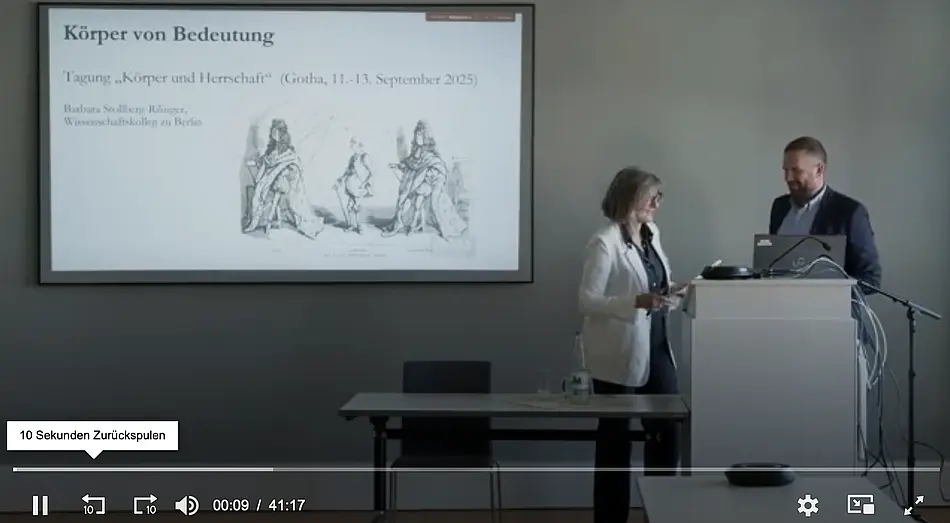
The conference organised by PD DR. Benjamin Steiner (Gotha/Munich) and PD Dr Anja Rathmann-Lutz (Basel/Tübingen) in September 2025 was dedicated to the question of how bodies can be methodically and historically understood in political contexts. The participants discussed the visibility and invisibility of "mere" bodies behind the façade of staging, ritual and symbolism and focussed on the repercussions that political spaces, institutions and techniques of rule have on the bodies of those in power. In particular, the conference programme focused on specific transformations in the relationship between body and rule in the transition from the late Middle Ages to the early modern period.
Even if modern democratic states are based on procedures and the exercise of state power is decoupled from individual bodies, the staging and thematisation of corporeality remain part of politics. In the evening lecture at the Gotha conference "Body and Rule", historian Prof. Dr Barbara Stollberg-Rilinger (Berlin) presented theses on the relationship between body and rule in the pre-modern era, using 18th century rulers such as Maria Theresa, Frederick William I of Prussia and Marie Antoinette as examples.
The L.I.S.A. portal of the Gerda Henkel Foundation, which prepares academic content for a wider public as podcasts and videos, is now making the audio and video of the lecture available on a long-term basis. Further lectures from the conference are to follow. The Gerda Henkel Foundation also features content of the Early Modern Conference 2024.

![[Translate to English:] facebook icon](/fileadmin/SocialMediaIcons/iconfinder_06-facebook_white.svg)

![[Translate to English:] instagram icon](/fileadmin/SocialMediaIcons/iconfinder_38-instagram_white.svg)
![[Translate to English:] YouTube icon](/fileadmin/SocialMediaIcons/iconfinder_18-youtube_white.svg)
![[Translate to English:] xing icon](/fileadmin/SocialMediaIcons/iconfinder_xing_white.svg)
