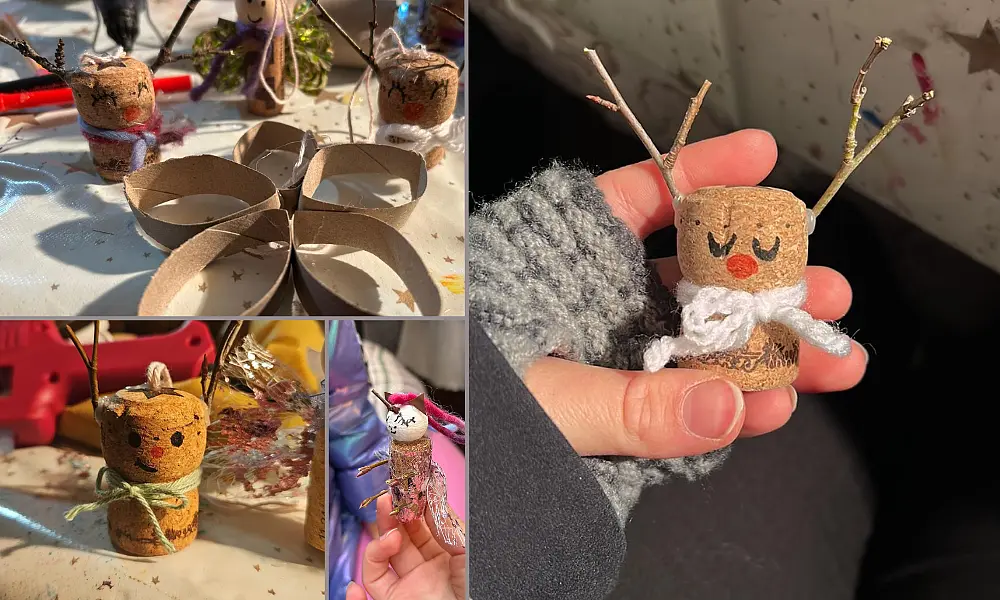
How can children experience sustainability? This question was the focus of our practical project as part of the sustainability seminar, which we implemented together with "Öko + fair vor Ort", a working group of the Catholic inner-city parish of St. Laurentius, which endeavours to design the church site according to ecological and fair criteria. The aim of the project was to communicate the topic of sustainability in an easily accessible and creative way. Children should learn through play that new things can be created from supposed waste. At the same time, we wanted to sensitise parents to sustainable behaviour and gauge their attitudes towards the topic.
The project combined ecological, social and educational sustainability. By making Christmas decorations from corks and empty toilet rolls, the conservation of resources became a tangible experience. The open dialogue with families promoted social participation and awareness-raising. Educational aspects took centre stage, as learning was made possible through active action and reflection.
Together with our practice partner, we designed an interactive stand at the fair Advent market in the Barfüßerruine on 29 November 2025. We developed craft ideas, collected suitable materials and planned the implementation on site. We explained the background to sustainability in a child-friendly way, held discussions with parents and supported the children in designing the Christmas decorations. In addition, we distributed questionnaires that we had created to record attitudes towards sustainability in everyday family life.
The children's re-registration was very positive: they wanted to hang up their self-designed decorations at home and were surprised that it is not that difficult to create something beautiful and personalised from existing materials. The answers in the questionnaires from parents and children also showed that sustainable behaviour is increasingly being recognised: Many stated that one should not consume or buy so much, but rather use things several times, reuse or upcycle them. The issue of intergenerational justice also became clear, as families emphasised that conscious action
today also benefits future generations. Overall, it became clear that creative hands-on activities are an effective way of making sustainability tangible, cross-generational and relevant to everyday life.
In terms of education for sustainable development (ESD), the project promoted design skills, critical thinking, a change of perspective and a sense of responsibility. For future projects, the idea is to develop even more participatory formats, because sustainability begins in everyday life – and everyone can contribute to this.
text: Jasmin Kämmler, Sarah Pätzold and Emily Helm (participants in the StuFu seminar) // photos: Emily Helm
![[Translate to English:] facebook icon](/fileadmin/SocialMediaIcons/iconfinder_06-facebook_white.svg)

![[Translate to English:] instagram icon](/fileadmin/SocialMediaIcons/iconfinder_38-instagram_white.svg)
![[Translate to English:] YouTube icon](/fileadmin/SocialMediaIcons/iconfinder_18-youtube_white.svg)
![[Translate to English:] xing icon](/fileadmin/SocialMediaIcons/iconfinder_xing_white.svg)
