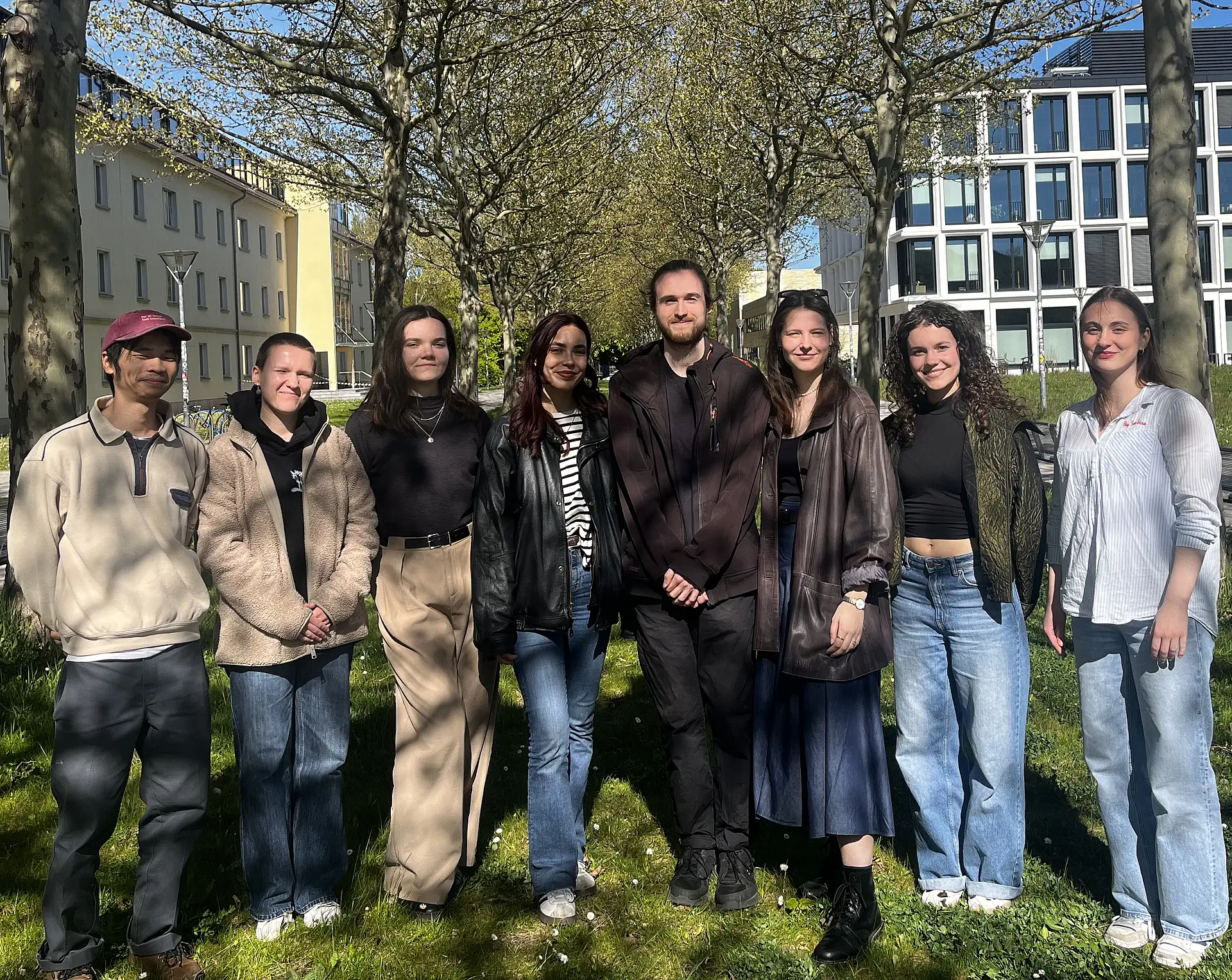
"Turning ideas into the future - reports from founders at the University of Erfurt"
The University of Erfurt supports students, academic employees and graduates on their path to self-employment. The StarTH start-up scholarship gives prospective founders the opportunity to develop their ideas further, build networks and prepare for the step into a start-up.
In our interview series, scholarship holders have their say: they talk about their experiences, successes, challenges and plans for the future. In this way, we want to provide insights into the everyday life of a start-up and at the same time encourage them to put their own ideas into practice.
Getting started - your motivation and background
1. Would you like to briefly introduce yourselves? Who are you and what are you currently doing?
We are Leon and Maren from "brot//los" magazine (and the non-profit organisation "Fundsache Literatur e.V."). Like the rest of our editorial team, we study at the University of Erfurt. Leon is studying for an M.A. in Literary Studies and Maren for a B.A. in German Studies and English. We are also both working in the literary and cultural sector.
2. what is your founding idea - and how did your team come together?
We want to publish a free literary magazine for young (young = inexperienced) writers and people interested in culture and literature with the lowest possible threshold and contribute to emotional education through readings, workshops and the like. We found each other through our work in the Cultural Department of the Student Council of the University of Erfurt.
3. what motivated you to develop a founding idea together?
The main motivation was and is to set up our own project and connect Erfurt to the young DACH literature scene.
4. was there a key experience that tipped the scales in favour of your founding?
Not directly - we wanted to found the organisation so that we could create reliable structures that have the potential to grow and remain in the long term.
5. what different backgrounds and skills do you bring to the team?
Basically, we all have similar backgrounds and have also realised that we complement each other well in most cases. Especially when it comes to networking and communication, we have a good division and similar interests. Leon has been networked in the young DACH literature scene for a long time and Maren on a local level. He has more of a need for structure and she wants to "just do it". It all works quite well. Good centre, good synergies.
Your founding path
6. how did you start the organisation?
A member of the Student Council at the University of Erfurt suggested we contact the Founders Service. Then we came along and it was a lot of fun. It seemed like there was a huge amount of work ahead of us (there was) but thanks to the support, it felt like it was doable at the beginning.
7. what support did you receive along the way - inside or outside the University of Erfurt?
A lot of people helped right from the start. Because we came from the committee sector, we were able to rely a lot on the Student Council. Thank you Student Council. We were also able to successfully connect with other DACH literary journals and receive valuable help from them. We were also able to have a nice chat with the City of Erfurt's cultural coordinator over tea, biscuits and mandarins.
8. were there certain phases that were particularly challenging for you as a team?
The phases in which journals and founding work coincided were particularly challenging, as it can quickly happen that unforeseen complications can arise on two "fronts". But we managed it all well.
9. how did you allocate tasks and roles in the team?
We didn't really - we just got on with it and made sure that nothing got lost along the way. The editorial team's tasks and roles are also very clearly and democratically organised, which is great. Everyone should be able to do what they want to do, but without losing sight of the bigger picture.
Idea, offer and realisation
10. can you briefly present your founding idea or your programme?
Our organisation "Fundsache Literatur e.V." and the associated magazine "brot//los" for young literature (young in the sense of inexperienced) is aimed at people of all ages who would like to express themselves creatively and literarily. We publish the magazine free of charge in order to bring Arts and literature to the public at as low a threshold as possible. For the contents of our second issue, we were able to attract authors from all over the DACH region, 25 per cent of them exclusively from Thuringia. That makes us very proud!
11 How did you define your target group and what needs would you like to cover with your offer?
We were able to easily define the target group by openly exchanging ideas with other journals and their target group experiences. We were also able to determine from the first issue on site that the target group is primarily to be found in the student milieu, but also among local cultural representatives/consumers. The demand we are meeting is for personal (entry-level) literature outside of the established literary scene.
12. were there any particular hurdles in developing the vision, mission, business model or your statutes?
Mainly the formulation. We were already relatively clear about what we wanted, but finding the right words (also in the legal field) were the main hurdles.
13. what role do practical tests, prototypes or pilot projects play in your founding process?
They didn't play a particularly important role. We had already found a functioning format through our first published magazine as a student group. However, we developed this further for specific target groups.
14 How do you make important decisions in the team?
Democratically, in dialogue and then ultimately through individual assumption of responsibility, which is often intrinsically motivated.
Networks, further education and visibility
15. what role did the exchange with others (e.g. founders, companies, family, friends, potential customers, etc.) play in your start-up? customers, etc.) play in your start-up process?
As described, a big role. We would be nothing without them! (see support "for free" for our first magazine issue).
16. which further education or training courses have helped you - or would you recommend to other teams or founders?
We did not directly participate in any specific further education or training programmes, but we were interested in and committed to the start-up support offered by the Founders Service and the StarTH network. The exchange with other founders from Thuringian universities at the StarTH Together Event 2025 was particularly valuable for us.
17 What strategies do you use to build visibility for your project/your company?
We use various channels such as Instagram, posters and then our magazine itself is already the channel for visibility.
18. do you specifically use networks to develop as a team?
Our networks in the literary and cultural sector provide the most benefits.
Experiences and learnings
19. what experiences have shaped you most as a team so far?
Developing and publishing an emotionally profound print product together is both formative and bonding. After the eagerly awaited release, we held a reading together in Würzburg. That was team building at its best.
20. has your self-image as a founding team changed over time?
Our self-image has changed insofar as friendships have developed in parallel with the founding of the company and at the same time the sense of responsibility for a more "professional" framework has grown. That's a stroke of luck that we really appreciate.
21 Was there a moment when you realised: "This was exactly the right decision"?
Yes, the release party for the second issue with various guest authors, when we sat on the sidelines like "mum hens" and watched the project take another step towards a broader public without our involvement.
22. how do you deal with conflicts or differing opinions within the team?
We talk until we find a good compromise, while always maintaining a democratic process.
Outlook and tips
23 Where are you today with your start-up - and what are your next steps?
At the moment we are at the stage of setting up the association following its successful foundation. Among other things, we are waiting to be entered in the register of associations and are also planning the next, third issue of the journal.
24 Did you set up your organisation as a main or secondary occupation?
Founding an association is a part-time, voluntary activity.
25. what advice would you give to students or employees who want to set up a team?
Have fun! Don't lose sight of the common goals and values. Stay committed and positive - even in challenging phases. Communicate transparently, honestly, openly and at eye level.
26 What do you wish for the start-up culture at the University of Erfurt or in Thuringia in general?
That everyone who has a project or start-up idea makes use of the services offered by the Founders Service at an early stage, receives free advice there and thus acquires important skills for their own future (both privately and professionally).
Conclusion
Thank you very much for the interview!
Do you have an idea yourself that you would like to develop further? The University of Erfurt's Founders Service supports you with personalised advice, workshops and funding opportunities - from the initial idea to its implementation.
You can find more information here
![[Translate to English:] facebook icon](/fileadmin/SocialMediaIcons/iconfinder_06-facebook_white.svg)

![[Translate to English:] instagram icon](/fileadmin/SocialMediaIcons/iconfinder_38-instagram_white.svg)
![[Translate to English:] YouTube icon](/fileadmin/SocialMediaIcons/iconfinder_18-youtube_white.svg)
![[Translate to English:] xing icon](/fileadmin/SocialMediaIcons/iconfinder_xing_white.svg)
