Modern Subjectivity and the Political Economy of Colonialism
C19.00.02
About the event
The consolidation of modern social theory in the writings of Marx, Weber and Durkheim coincided with the highpoint of European empires and the outbreak of global war between them. Yet, empire lay outside the purview of mainstream social theory except as a phenomenon associated either with earlier historical periods and civilizations, or, as a later development of an expanded capitalism whose rise is understood separately from the colonialism that made it possible. The issue, as Gurminder K. Bhambra will argue, is not simply to add empire and colonialism to sociology’s repertoire of topics, but to show how the concepts and methodologies with which that repertoire is associated need to be fundamentally transformed.
The talk addresses the broader relationship of colonialism to modern social theory and its idea of the modern subject. The modern (European) subject is defined in terms of self-ownership associated with wider discourses of emancipation and equality. However, that understanding of the modern subject arises in the context of colonial domination, including the practices of taking others into ownership and appropriating their means of subsistence and reproduction. Those who were alienated from the idea of self-ownership, by themselves being taken into ownership—or, more simply, enslaved—cannot just be included within understandings of modern subjecthood based on the idea of the subject capable of property, the possessive individual. Those subjects who refuse self-alienation through their disavowal of the very idea of individuated property—and who were dispossessed and annihilated in the process of the European expression of modern subjecthood—similarly are unable simply to be accommodated into a definition of modern subjecthood by virtue of being freed from the ‘tyranny’ of traditional life. They stand outside standard understandings of the modern subject epistemologically, while their outsider position is itself a consequence of historical actions undertaken by European subjects as the expression of their own (misrecognised) modern subjectivity.
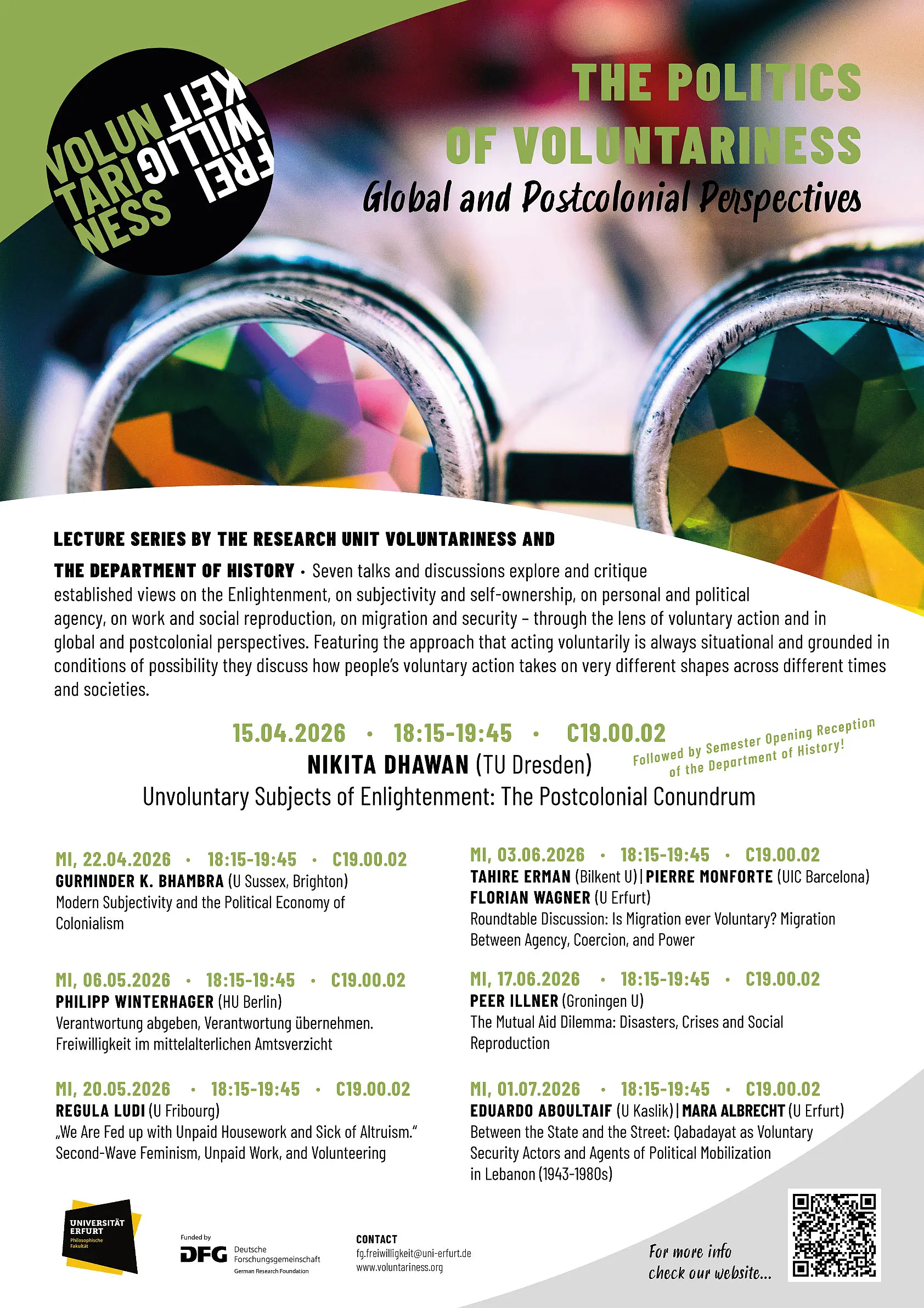
Seven talks and discussions explore and critique established views on the Enlightenment narratives, on subjectivity and self-ownership, on personal and political agency, on work and social reproduction, on migration and security – through the lens of voluntary action and in global and postcolonial perspectives. Featuring the approach that acting voluntarily is always situational and grounded in conditions of possibility they discuss how people’s voluntary action takes on very different shapes across different times and societies.


![[Translate to English:] facebook icon](/fileadmin/SocialMediaIcons/iconfinder_06-facebook_white.svg)

![[Translate to English:] instagram icon](/fileadmin/SocialMediaIcons/iconfinder_38-instagram_white.svg)
![[Translate to English:] YouTube icon](/fileadmin/SocialMediaIcons/iconfinder_18-youtube_white.svg)
![[Translate to English:] xing icon](/fileadmin/SocialMediaIcons/iconfinder_xing_white.svg)
